Author: Bu Shuqing, Wall Street Insights
Musk recently revealed that GPU cluster rentals for large-scale, high-bandwidth AI training are rising significantly, while prices for smaller-scale computing power leases are falling, especially for orders with fewer than approximately 5,000 GPUs. Despite this divergence, the average rental price per SpaceX GPU is still increasing. Meanwhile, Google has expressed its willingness to expand SpaceX's computing power leasing operations. As AI companies continue to compete for large-scale training computing power, SpaceX's infrastructure leasing business is seeing new growth opportunities.
New price signals have emerged in the AI computing power leasing market. Elon Musk recently revealed that rental prices for GPU clusters used for large-scale, high-bandwidth AI training are rising significantly, while prices for small-scale computing power leasing are falling.
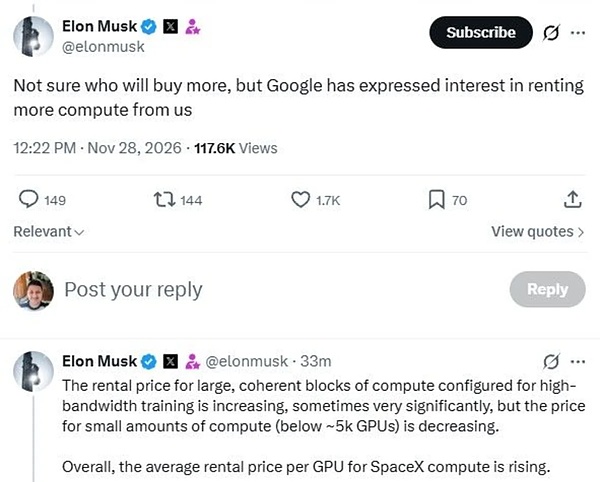
Elon Musk stated on the social media platform SpaceX on Saturday that Google is interested in leasing more computing power from SpaceX. This statement stems from market discussions about whether Google or Anthropic will become SpaceX's larger computing power customer. Musk responded, "It's uncertain who will lease more, but Google has expressed its willingness to lease more computing power from us."
In addition to revealing potential customer demand, Musk also discussed the price changes taking place in the AI computing power leasing market.
He stated that rental prices for large-scale, highly interconnected computing clusters dedicated to high-bandwidth AI training are rising, sometimes significantly. Conversely, rental prices for smaller-scale computing power are falling, especially for orders with fewer than approximately 5,000 GPUs.
However, Musk emphasized that despite the divergent price trends of computing power rentals across different scales, the average rental price of GPUs in SpaceX's computing power business is still rising.
This means that the demand in the AI computing power market is not simply growing across the board, but is shifting towards large-scale, high-performance training clusters. Training cutting-edge AI models requires a large number of GPUs to work together, placing higher demands on cluster size, interconnect bandwidth, and computing power. The supply and demand situation for these resources is different from that in the small-scale computing power leasing market.
Google already has a long-term, large contract, and may further expand its cooperation.
Google is not a new customer of SpaceX. According to previous media reports, SpaceX and Google have already signed a multi-year cloud services agreement. Under the agreement, Google will pay SpaceX $920 million per month from October 2026 to June 2029.
This collaboration involves approximately 110,000 Nvidia GPUs, as well as CPUs, memory, and other supporting components. SpaceX disclosed in regulatory filings in June that its computing capacity agreements with Google and Anthropic were worth over $70 billion.
Musk has now revealed that Google intends to further expand its computing power leasing, but has not disclosed the specific number, price, or contract term of the new orders.
For Google, external computing power procurement complements its own computing infrastructure, supporting the development of AI products and models such as Gemini. As the demand for AI model training and inference grows, tech giants are continuously increasing their investment in data centers, advanced chips, and cloud computing resources.
SpaceX ramps up investment in supercomputing facilities, continuing to expand its computing business.
SpaceX is also accelerating the expansion of its computing power. This month, the company announced plans to invest more than $74 billion to build a new supercomputing facility in Starbase, Texas, and a second campus in Cochise County, Arizona, further expanding its existing computing infrastructure.
This investment aligns with SpaceX's growing need for external computing power. The company leases computing resources to AI companies like Google and Anthropic, while also advancing its own AI business.
However, this business model also involves trade-offs in resource allocation: renting out computing power can bring long-term contract revenue, but SpaceX's own AI projects also require a lot of computing resources.
Musk's disclosure of these price changes provides a new window into this business. Rising rental costs for large AI training clusters, increased average rental prices for SpaceX GPUs, and the potential for Google to expand its procurement all indicate that there remains strong commercial demand for high-performance computing resources.
Source:Global Cybersecurity Alliance (GCSA)
Website:www.gcsa.org
Get updates in your inbox
We respect your privacy. See our Privacy Policy