By Mach, Forestight News
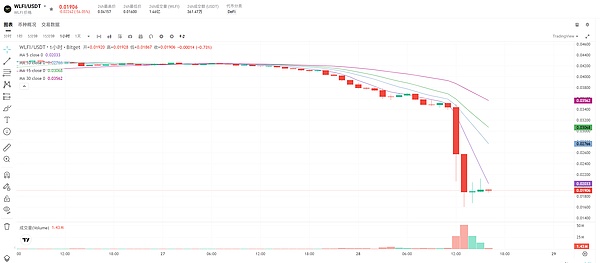
Around 12:00 PM on November 28th, World Liberty Financial's token, WLFI, experienced a flash crash. According to Bitget market data, WLFI plummeted from around $0.04, breaking through $0.016. As of press time, the price had recovered to around $0.019 and was fluctuating, representing a 24-hour drop of over 50% and a market capitalization shrinking to approximately $600 million.
The panic then spread to stablecoins. Around 3 PM today, the depegging of the project's stablecoin USD1 intensified, briefly falling below the $0.95 mark and dropping to $0.946 (a maximum depegging of 5.4%). It has now recovered to around $0.99, with a current market capitalization of $2.76 billion.
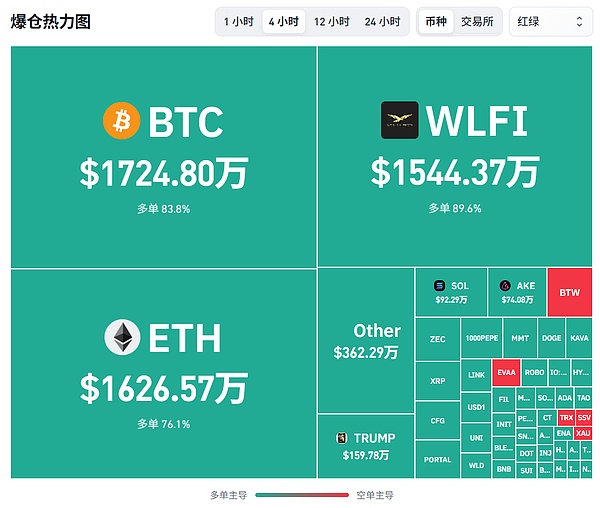
In terms of derivatives, according to CoinGlass data, the total liquidation amount of WLFI contracts across the network surged to $15.4437 million in the past 4 hours, with long positions accounting for as high as 89.6%. The liquidation volume is approaching that of BTC and ETH during the same period, and even the stablecoin USD1 has appeared on the network liquidation heat map.
This WLFI spot flash crash quickly breached the WLFIUSDT perpetual contract defenses on major platforms like Binance. Because the margin call gap under extreme market conditions exceeded the insurance fund's capacity, exchanges were forced to trigger the Automatic Liquidation (ADL) mechanism. Positions with returns exceeding 300% were ranked by the product of return on investment (ROI) and effective leverage, and some top-performing short positions were forcibly liquidated at the counterparty's bankruptcy price.
Currently, contract funding rates have fallen into deep negative territory, and short-selling sentiment is crowded in the market.
Selling 12,100 ETH at a loss to put out the fire
The immediate trigger for this flash crash stemmed from the impending liquidation of the massive collateralized position held by the WLFI team on the lending protocol Dolomite.
Public information shows that Corey Caplan, co-founder of Dolomite, is an official advisor to WLFI. WLFI-related addresses have staked approximately 5.1 billion WLFI tokens in the protocol (equivalent to nearly 16% of the total circulating supply based on current market capitalization), borrowing a large amount of USD1. The liquidation line before margin calls is hovering around $0.021. Once this level is breached, the illiquid WLFI will inevitably face a series of forced liquidations.
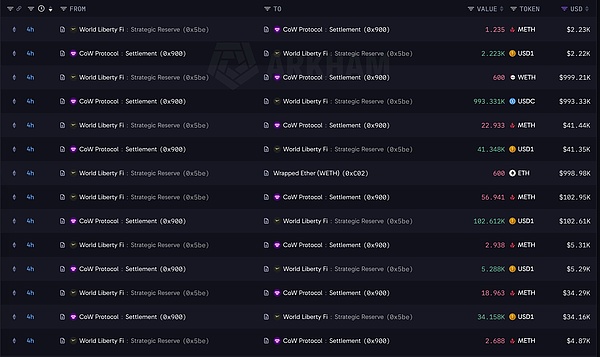
According to Arkham on-chain data, the WLFI strategic reserve wallet (address starting with 0x5be) urgently sold approximately 10,600 ETH (including WETH) and 1,378 mETH in batches via CoW Protocol around noon. This was equivalent to approximately 12,121 ETH at the then-current exchange rate, receiving 17.58 million USDC and 2.48 million USD1, at an average price of $1,655. This portion of ETH was purchased last year at an average price of approximately $3,244, resulting in a loss of approximately $19.26 million from this sale. After funds were injected into Dolomite to replenish margin, the liquidation price of this position shifted down to approximately $0.0118.
Even though the project team was selling ETH instead of WLFI, the market still voted with its feet.
The use of core strategic reserves to "cut losses in half" confirms the team's predicament of tight dollar liquidity.
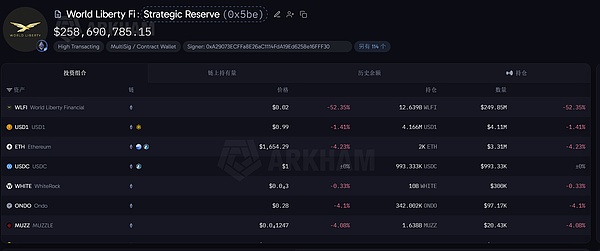
Arkham's real-time position data provides a stark answer.
As of press time, the WLFI strategic reserve wallet (address starting with 0x5be) shows holdings of $258 million, but a staggering 96.6% of that (approximately $250 million, or 12.639 billion tokens) is its own token, WLFI, which has plummeted in value. The remaining external hard currency ammunition is severely depleted, with only about 2,000 ETH (approximately $3.31 million), 993,000 USDC, and 4.166 million of its own stablecoin USD1 (approximately $4.11 million).
This means that if WLFI continues to fall below the $0.0118 clearing line, the reserve wallet will have almost no options left.
Market maker arbitrage
Besides the project team's efforts to salvage the situation, the USD1, with a market capitalization of over $2.7 billion, deviated from its anchor by more than 5% in just a few hours, which was due to a double whammy of liquidity mismatch and a structural trust crisis.
November 28th was a Saturday in the United States, and traditional bank clearing and some custody channels were closed, resulting in a significant thinning of the secondary market order book.
Ordinary holders cannot directly redeem their tokens from the issuer, BitGo, and can only sell them on exchanges, causing the price to plummet to around $0.94. However, institutions with BitGo accounts can still redeem them at $1 through the primary market. According to Lookonchain monitoring, Jump Crypto has already begun arbitrage during the de-pegging period: buying USD1 at a discount on exchanges and then transferring it to BitGo to redeem at face value. As of press time, Jump has withdrawn approximately 43.26 million USD1 tokens from exchanges.
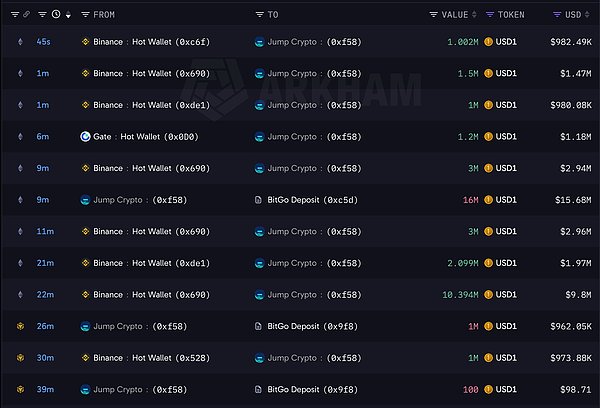
This combination of panic selling in the secondary market and redemption restrictions limited to qualified institutions in the primary market amplified the short-term de-pegging of USD1.
Furthermore, WLFI has pledged nearly 20% of its circulating supply as collateral in an advisory agreement to borrow its own stablecoin, essentially using a highly volatile governance token to leverage stablecoin liquidity. If WLFI breaches its liquidation line, causing Dolomite to incur unmanageable bad debts, market concerns will arise that the risk will directly erode the underlying credit of USD1, leading to a flight of safe-haven funds.
Political premium returns to zero, valuation anchor loosens.
Looking at the longer term, the collapse of WLFI and Trump family-related assets did not happen overnight.
Following the conclusion of the US midterm elections on November 3, with the Democrats regaining control of both the House of Representatives and the Senate, related assets such as Trump coin immediately plummeted, and WLFI also entered a prolonged period of decline.
WLFI's high valuation has never been based on the moat of DeFi products; its core pricing chip is "political asylum and regulatory privileges".
With the congressional landscape shifting and the sword of Damocles hanging over them—conflict of interest reviews and regulatory investigations—smart money has already taken advantage of the situation to withdraw. When the valuation anchor of political premiums completely crumbles, today's selling at a loss to buy more is merely the final straw that breaks the camel's back.
Justin Sun calls for the removal of WLFI and USD1 from the market.
Just as the market was still reeling from the shock, at around 3 PM today, Justin Sun, the founder of Tron, who was an important early investor and advisor to WLFI and later publicly broke with the project team due to the asset freeze controversy, posted an article on the X platform criticizing the WLFI incident. He claimed that today's WLFI incident was nothing more than a replay of internal circular lending for cash out, insider illegal sales, illegal freezing of investor assets, and investor fraud. He also accused members of the relevant team of deleting social media content and communication records in bulk in an attempt to cover up their crimes.
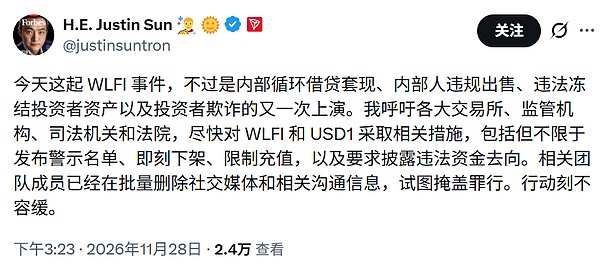
Justin Sun further publicly called on major exchanges, regulatory agencies, judicial authorities, and courts to take immediate action, including "issuing warning lists, immediately delisting, and restricting deposits" for WLFI and USD1, and demanding disclosure of the destination of illegal funds. As of press time, WLFI has not yet responded to the above allegations.
Although the project team's replenishment action temporarily halted the immediate burst at $0.021, the new WLFI defense line at $0.0118 remains exposed to the bears.
Until USD1 regains its stable anchor, the team responds positively to market accusations, and publicly discloses Dolomite's complete lending ledger and reserve allocation, the battle between bulls and bears surrounding liquidity and the credit crisis is far from over.
Source:Global Cybersecurity Alliance (GCSA)
Website:www.gcsa.org
Get updates in your inbox
We respect your privacy. See our Privacy Policy