Author: Dong Jing, Wall Street Insights
Bank of America warns that hyperscale cloud companies will see their free cash flow turn negative by $131 billion in 2027, and $215 billion in off-balance-sheet debt poses a systemic risk, potentially triggering an AI credit crisis. Referring to the 1998 LTCM crisis scenario, the bond market will collapse first, but the stock market may rise for another 18 months before truly peaking—at which point the decline will be even deeper. The peak of the current cycle will occur around May 2028, but key bubble indicators have not yet been triggered, making it too early to sell.
In its latest annual outlook report, Bank of America warned that the current AI market is now more than just “interesting” to “astonishing” in its resemblance to the dot-com bubble of the late 1990s, and that every major technological wave in history has ended in a massive asset bubble.
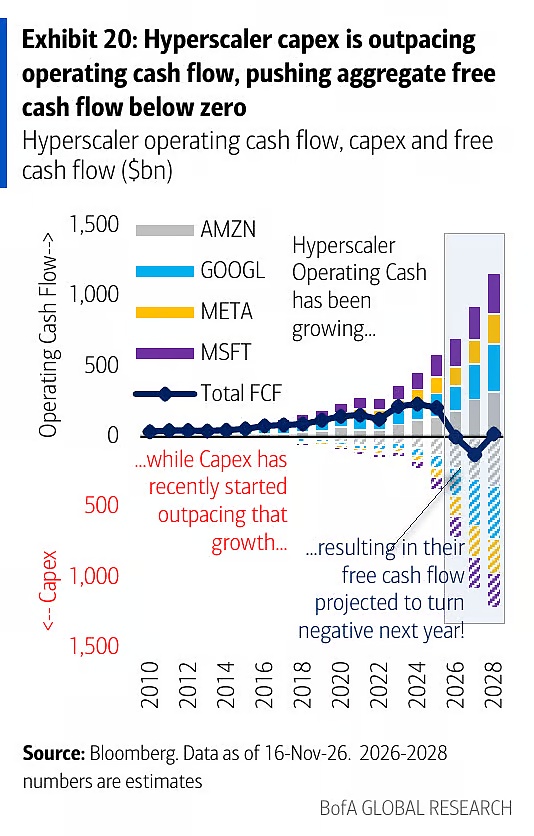
Bank of America's credit team points out that the free cash flow of hyperscale cloud computing companies is projected to approach zero in 2026 and turn negative by $131 billion in 2027, making external financing a pressing need. Meanwhile, approximately $215 billion in off-balance-sheet debt for data center projects has quietly accumulated, and the risk will ultimately be transmitted back to the public market through insurance and pension funds. Bank of America's core assessment is that AI credit risk is essentially an equity risk—bondholders have limited upside potential, while stock investors have already priced in years of AI growth expectations; if growth fails to materialize, the downside potential is far greater than for bonds.
Bank of America cited the historical precedent of the 1998 LTCM crisis, pointing out that while high-yield bond spreads widened and default rates rose after the credit crisis, the Nasdaq index still rose for 18 months before giving back most of its gains in the following 18 months. This suggests that even if the credit market issues an early warning, the actual repricing in the stock market may still take a considerable amount of time.
The LTCM crisis refers to the major financial event in 1998 in which Long-Term Capital Management (LTCM), a top U.S. hedge fund, was on the verge of bankruptcy due to extremely high leverage and extreme market volatility, and was ultimately rescued by a joint bailout by several Wall Street banks under the coordination of the Federal Reserve.
Bubble signals are everywhere, but key indicators have not yet been triggered.
In his report, Benjamin Bowler, head of the equity derivatives team at Bank of America, listed several anomalies in the current market: the volatility of individual stocks is close to the highs of the dot-com bubble, but the correlation of individual stocks is at its lowest level since the 1990s. The two cancel each other out, causing the VIX index to fail to accurately reflect the sharp divergence within the market.
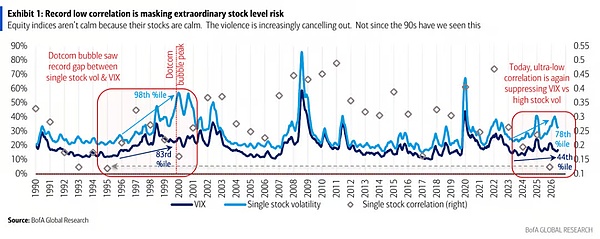
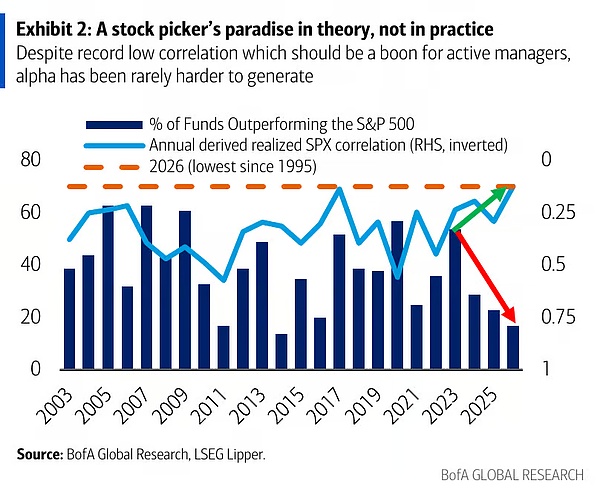
Meanwhile, the realized correlation of S&P 500 constituent stocks is projected to be at its lowest level since 1995 by 2026, theoretically a golden age for active stock picking. However, the proportion of funds actually outperforming the S&P 500 has shrunk dramatically. Bank of America calls this "a theoretical stock-picking paradise, a nightmare in practice."
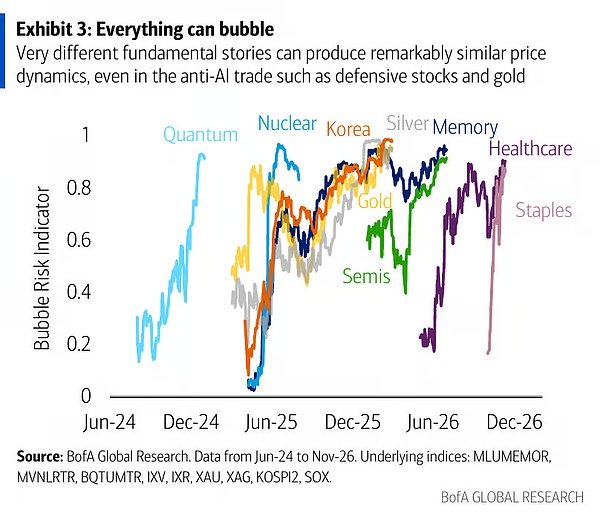
Bank of America’s Bubble Risk Indicator (BRI) has been flashing warnings over the past year in a series of sectors, including quantum computing, nuclear energy, South Korean stocks, silver, memory chips, and even defensive sectors such as gold, healthcare, and consumer staples—the latter being what Bank of America previously described as “the 1999 frenzy…in Coca-Cola.”
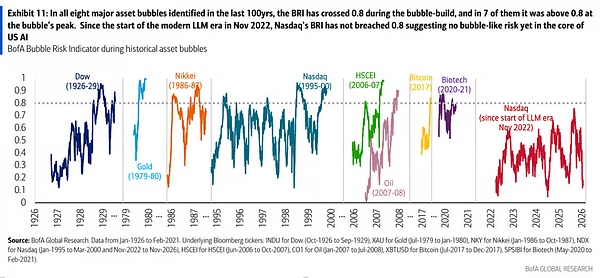
However, Bank of America explicitly stated that it does not recommend selling now because its core bubble detection indicator has not yet triggered a key threshold. Since the beginning of the modern big language model era in November 2022, the BRI reading of core US AI assets, measured by the Nasdaq index, has consistently failed to break through 0.8.
Bank of America’s historical data, dating back to the 1920s, shows that all eight major asset bubbles in the past century—including the Dow Jones in the 1920s, gold in 1979, the Nikkei in the 1980s, the Nasdaq in the 1990s, the Hang Seng China Enterprises Index, crude oil in 2008, Bitcoin in 2017, and biotechnology in 2020-21—broke through 0.8 during their upward trend, with seven of them still above that level at their peak.
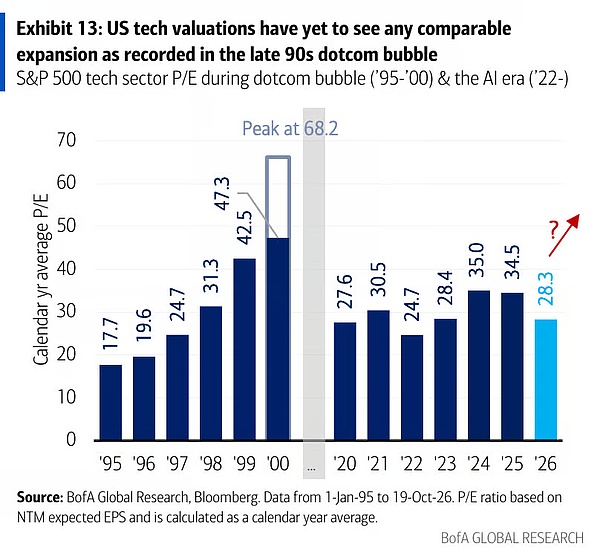
From a valuation perspective, the forward P/E ratio for the S&P Technology sector in 2026 is approximately 28 times, compared to 68.2 times at the peak of the dot-com bubble. Bank of America points out that current AI trading has actually undergone valuation compression, with Nasdaq earnings now accounting for a larger proportion of the S&P 500's earnings than its relative price performance. This is a stark contrast to the situation in the late 1990s when prices and fundamentals were severely divergent.
A "Netscape moment" analogy: If history repeats itself, the peak may occur in May 2028.
Bank of America compared the Nasdaq Composite Index's rise since the launch of ChatGPT on November 30, 2022, with the upward trajectory following Netscape's founding in October 1994, finding a striking correlation between the two trends. The report indicates that if this historical pattern continues, the peak of the current cycle will occur around May 2028.
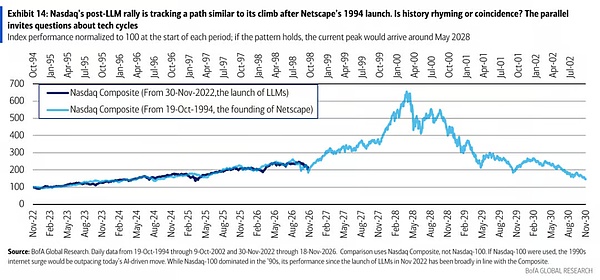
Bank of America also pointed out that if the Nasdaq 100 index is used as a benchmark, the gains in the 1990s actually exceeded the current market rally. This means that if investors believe this analogy, they are currently in a situation similar to the market in 1997, while the risks of 1998 (LTCM crisis) and 2000 (bubble burst) are waiting ahead.
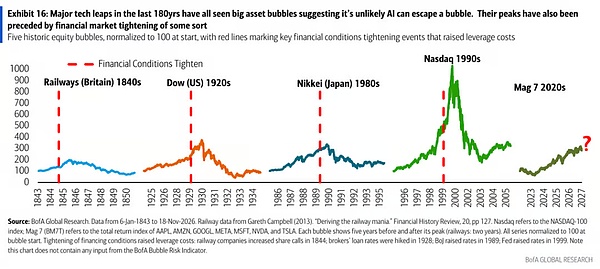
From a broader historical perspective, Bank of America has analyzed every major technological leap in the past 180 years—British railroads in the 1840s, the United States in the 1920s, Japan in the 1980s, and the Nasdaq in the 1990s—all of which ended in large-scale asset bubbles, and each peak was preceded by some form of financial tightening: the railroad stock purchases in 1844, the increase in brokerage loan rates in 1928, the Bank of Japan's interest rate hike in 1989, and the Federal Reserve's interest rate hike in 1999.
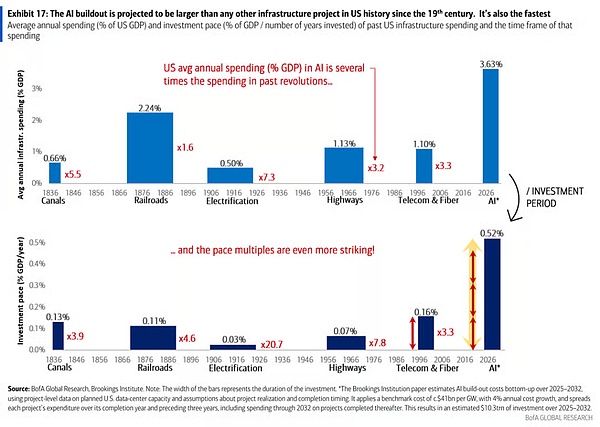
This wave of AI infrastructure construction far exceeds the scale of any previous technological wave. The Brookings Institution estimates that between 2025 and 2032, investment in AI construction will average about 3.6% of US GDP, totaling approximately $10.3 trillion. In comparison, it was about 2.2% during the railroad era and about 1.1% during the dot-com bubble. Bank of America concludes that "being deeply involved makes a collapse unavoidable."
Off-balance-sheet debt accumulation and credit risk transmission to the stock market.
In his report, Nitin Saksena, head of the credit team at Bank of America, detailed the inherent vulnerabilities of the AI credit system. The core issue lies in the cash flow gap: the combined free cash flow of the largest hyperscale cloud computing companies is projected to decline from approximately $204 billion in 2025 to near zero in 2026, and then turn negative to approximately $131 billion in 2027. This means that some of the most profitable companies in history are about to become net borrowers.
Bank of America points out that since August 2025, project financing has raised approximately $215 billion in debt for data centers, accounting for about 30% of total financing. Furthermore, SPV bonds backed by the credit of hyperscale cloud computing companies have coupon rates 40 to 130 basis points higher than direct bonds issued by the same issuer.
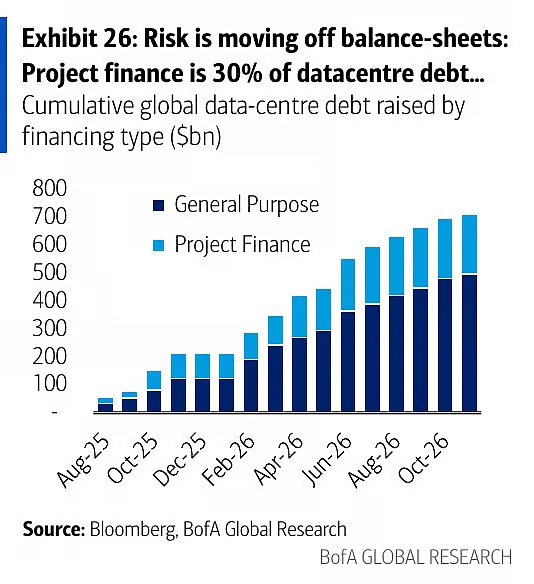
These off-balance-sheet financing instruments have multiple hidden dangers: weak equity buffers, residual value often relies on the credit backing of ultra-large-scale cloud computing companies, and there is a maturity mismatch—the debt's duration often exceeds the economic lifespan of the chips it finances. More importantly, a large amount of risk is ultimately borne by private investors, and is transmitted to the public market through insurance and pension funds.
Bank of America also highlighted the cyclical risks within the system: hyperscale cloud computing companies invest in AI companies (Bank of America estimates this at approximately $300 billion, citing IMF data), and these AI companies then commit to purchasing computing power from the same group of investors ($1.4 trillion), with debt layered on top of this ($650 billion). This structure works well when AI demand continues to grow, but once demand stagnates, "losses will erupt in a concentrated manner, rather than being released gradually through a single default."
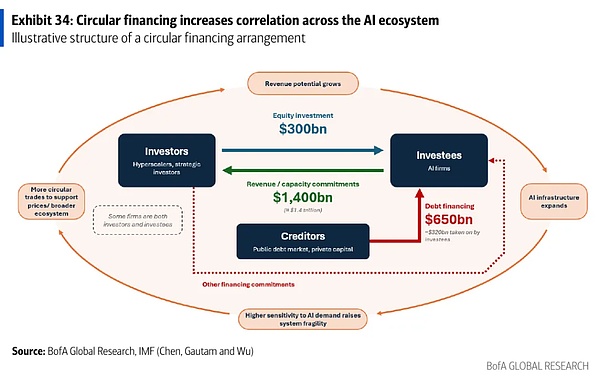
Bank of America also warned that even if overall demand doesn't decline, a "DeepSeek-like shock"—the sudden loss of technological leadership by a cutting-edge lab—could trigger a chain reaction, directly impacting its massive cloud computing investors and creditors. Since these cutting-edge labs are already reflected in the public stock market, this weakest link is now being priced in by the market daily.
The 1998 scenario: The bond market sounded the alarm first, followed by a deeper stock market crash.
Bank of America ultimately converged its two analytical threads, providing the most crucial historical analogy. The report points out that the bursting of the dot-com bubble followed the same sequence: high-yield bond spreads began to widen from the 1998 LTCM crisis, with default rates rising accordingly, but the Nasdaq 100 index still rose for about 18 months before giving back most of its gains in the following 18 months.
This timeline presents a double dilemma for current investors: those shorting AI trading may be right, yet still suffer losses for up to a year and a half; those going long face the risk of a rapid shift from "still room for growth" to "bubble bursting." Bank of America explicitly warns: "Buying protection too early could drain your capital in the long run."
Based on this, Bank of America recommends hedging strategies including: cheap stock volatility instruments, "look-back put options" (which automatically increase the strike price as the stock price rises), and put spreads on a basket of AI-related stocks—the latter based on the logic that, given the cyclical nature of the system, the relevant stocks "may fall in tandem."
Bank of America's momentum model suggests that, based on the scale of this rally, the S&P 500 would fall by about 22% and the Nasdaq 100 by about 28% in a major correction.
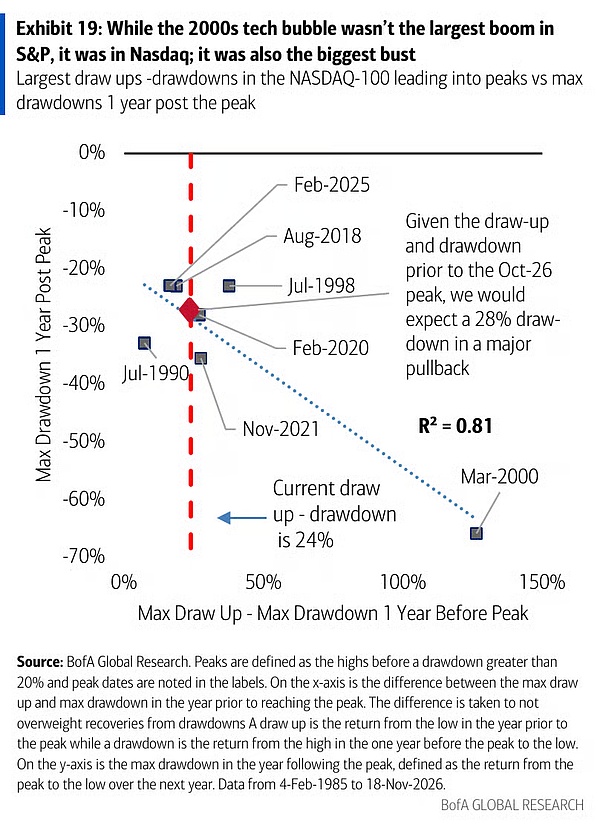
Meanwhile, Bank of America strategist Michael Hartnett had previously set two targets for 2027: 6,666 points (crash scenario) and 8,888 points (bubble scenario), highlighting the high degree of uncertainty surrounding the current market path.
Bank of America summarized this dilemma in a single sentence in its report:
"The AI boom is not over yet. History will look back and see a major AI bubble that we are already deeply involved in, and it is difficult to avoid a collapse—because macro risks, such as fiscal sustainability, themselves depend on the success of AI."
Source:Global Cybersecurity Alliance (GCSA)
Website:www.gcsa.org
Get updates in your inbox
We respect your privacy. See our Privacy Policy