Introduction
Global education testing giant College Board has suffered an AI-assisted cyberattack. In addition to some students' account passwords being compromised, its college financial aid application system and third-party data service providers were also affected, potentially exposing students' and their families' Social Security numbers, income, assets, and tax information.
As the organizer of the SAT and AP exams, the College Board serves more than 7 million students worldwide each year, with annual operating revenue exceeding $1 billion. Its services span key aspects of standardized testing, Advanced Placement (AP) courses, college admissions evaluation, and financial aid applications, making it one of the most influential institutions in the global higher education services system.
This incident occurred during the US college application season. Attackers used AI tools to discover a vulnerability in the professional account registration page, and further gained access to the account creation and CSS Profile scholarship application systems. Some services were forced to suspend, and the scope of data compromised to third-party vendors is still under investigation.
GCSA believes there are three aspects of this incident that deserve the most attention:
AI is changing the costs of offense and defense.AI-assisted vulnerability discovery is lowering the technical threshold for cyberattacks, posing new challenges to traditional security testing and vulnerability management mechanisms.
Educational data is becoming a high-value target for attacks.Behind student accounts lies not only exam scores and personal identity, but also potentially the financial information of entire families. The potential harm from the leakage of this sensitive data far exceeds the loss of ordinary accounts.
The boundaries of trust in the digital education ecosystem are expanding.The deep interconnectivity between examination institutions, universities, student aid platforms, and third-party data service providers means that localized security incidents can evolve into cross-institutional security risks.
The College Board incident was not only an educational platform intrusion, but also a wake-up call for digital security governance in the global education industry.
GCSA Insights
College Board compromised: AI tool found vulnerability in professional account registration page, some student account passwords were changed, and CSS Profile scholarship applications were suspended.
Daily Security Insights (Event Analysis) | November 29, 2026 | All times in this article are Tokyo time (UTC+9)
On November 27th, Eastern Time, the College Board, the U.S. non-profit organization responsible for SAT and AP exams and CSS Profile scholarship applications, released a security incident page confirming that attackers had gained access to the system used by students and professionals to create College Board accounts and submit CSS Profile scholarship applications. The attackers were able to read some users' basic account information and initiate password resets for some accounts. The College Board explained to BleepingComputer that the attackers discovered and exploited a vulnerability on the professional account registration page using AI tools. At the same time, a third-party provider storing submitted scholarship information was also compromised. The College Board believes the two incidents are related, and the details of what was accessed at the provider's site are still under investigation.
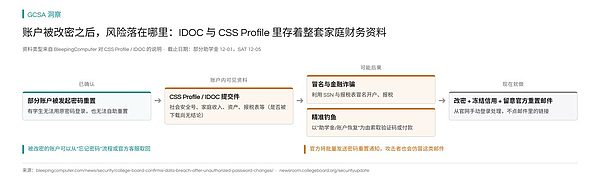
The incident occurred during the US college application season. Many students had already uploaded their Social Security numbers, family income, assets, and tax returns through CSS Profiles and IDOCs. Some financial aid applications closed on December 1st, and there was an SAT exam on December 5th. Even though the College Board stated that test scores and the question bank were not accessed, a student account with a changed password is still linked to the entire family's financial information.
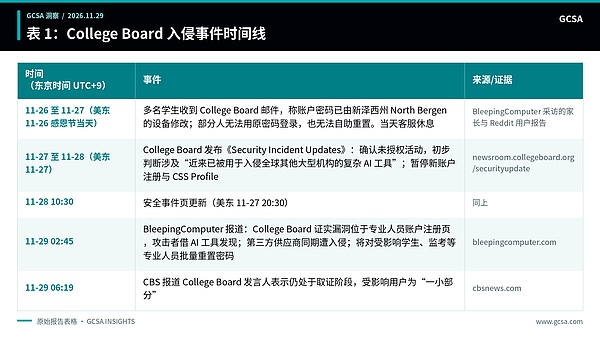
I. Event Timeline
Table 1: Timeline of College Board Intrusion Events
II. How did the attackers gain access?
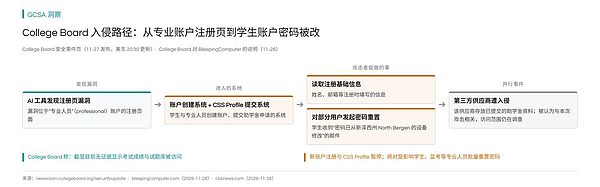
2.1 Entry point: Registration page for professional accounts
College Board's account system serves two groups: students and "professionals" such as school advisors and proctors. It has been officially confirmed that attackers gained access to the shared "create new account" and CSS Profile submission systems for both groups. The entry point was a vulnerability in the professional account registration page, which the attackers discovered using AI tools. College Board has not released information about the vulnerability type, exploitation method, or the number of affected accounts. The registration page is inherently anonymous and open to the internet; anyone can repeatedly submit requests, making it an ideal target for large-scale automated testing.
2.2 After logging in: Read the documentation and change your password.
Official confirmation indicates the attacker could do two things: first, read basic information submitted by some users during registration (the College Board cited names and email addresses as examples for BleepingComputer); second, initiate password resets for some users. Students saw the result of the second action: receiving a "password changed" notification with the change originating from the same location in North Bergen, New Jersey, rendering their old passwords invalid. Some parents reported that their children had submitted applications through CSS Profile and uploaded family tax returns through IDOC, "We have no way of knowing how long someone accessed their account, or whether the data was viewed or downloaded." The College Board has not yet stated whether the data in the compromised accounts was viewed or downloaded.
2.3 Parallel Supplier Intrusion
The College Board also revealed that a third-party vendor storing submitted financial aid information was simultaneously compromised, which the College Board believes is related to an attack on itself. The vendor's name and the scope of the accessed data have not yet been released. The CSS Profile and IDOC collect the very information schools use to verify financial aid, including Social Security numbers, family income, assets, and tax returns; therefore, the findings of this investigation are more crucial than the breach of basic account information.
III. Impact and Handling
College Board serves over 7 million students worldwide annually (CBS). Currently logged-in users can still access their accounts with limited functionality, but new accounts cannot be registered, and CSS Profiles are temporarily unavailable. The board stated it is working to help families complete their applications or secure deferrals. College Board claims there is no evidence of access to exam scores or the question bank, no attackers have contacted it, and BleepingComputer has not found any group claiming responsibility. Next, College Board will reset passwords for affected students and proctors/professionals in batches, and users are advised that more reset notifications may be received as the investigation progresses.
IV. What you should do now
1. Check if your account password has been changed.Students and parents should log in to their College Board account using the website address they entered; if they cannot log in, please use the "Forgot Password" option or official support channels, and do not click on links in emails. Check if your linked email address and phone number have been changed.
2. Anticipate and verify the official password reset email.College Board sends out password reset notifications in batches, and attackers may use this opportunity to impersonate them. Once you receive the email, do not click the link; instead, open the official website and complete the reset yourself.
3. Families who have submitted CSS Profiles or IDOCs should be dealt with as their data may be leaked.Have their credit records frozen by the three major U.S. credit reporting agencies; apply for an Identity Protection PIN from the IRS to prevent someone from using their tax forms and SSN to file taxes under their name; be vigilant for unfamiliar activity from banks and credit cards.
4. Do not reuse your College Board password elsewhere.If you have used the same password on other websites, change it and enable two-step verification.
5. Professional accounts of schools and institutions:Invigilators and consultants should be prepared to receive a forced reset and check the range of student information they can view and recent login records in their accounts.
6. Deadline:Students who need to submit their CSS Profile before December 1st should contact the financial aid office of their target institution as soon as possible to explain the system suspension.
V. Main Sources
- College Board: Security Incident Updates:
https://newsroom.collegeboard.org/securityupdate - BleepingComputer: College Board confirms data breach after unauthorized password changes (2026-11-28):
https://www.bleepingcomputer.com/news/security/college-board-confirms-data-breach-after-unauthorized-password-changes/ - CBS News: College Board financial aid profiles, student registration hit by cyberattack (2026-11-28):
https://www.cbsnews.com/news/college-board-cyberattack-financial-aid-accounts/
Conclusion
For students and their families in the midst of college application season, a cybersecurity incident can bring not only threats to personal privacy, but also uncertainty regarding college admissions, scholarship applications, and future planning. These impacts are difficult to measure using traditional cybersecurity loss metrics.
As the global education industry becomes increasingly digital, leading education service providers, while reaping commercial benefits and industry influence, also bear commensurate social responsibility. Transparency, remedial capabilities, and protection of affected individuals after a security incident are also important criteria for evaluating an institution's trustworthiness.
The value of digitalizing education lies in expanding opportunities for human development, not in allowing technological risks to become new obstacles.
Copyright and Disclaimer
This article was published by the GCSA Global Cyber Security Alliance. Copyright of original content belongs to GCSA; copyright of third-party content cited or reproduced belongs to the original rights holder. Please indicate the source and retain the original link when reprinting.
This article is for cybersecurity research and informational purposes only and does not constitute investment, legal, or financial advice. The related technical analysis, risk assessments, and attack attributions are based on existing evidence. The scope of GCSA's independent verification is as disclosed in this article, and the conclusions may be updated as new evidence emerges.
Follow GCSA on social media for the latest updates.
GCSA X (Twitter):
GCSA Telegram:
GCSA WeChat Official Account:
Source:Global Cybersecurity Alliance (GCSA)
Website:www.gcsa.org
Get updates in your inbox
We respect your privacy. See our Privacy Policy