NTT Smile Energy, a well-known Japanese energy digitization service provider, recently disclosed a cybersecurity incident in which the attack expanded from its solar remote monitoring platform to external cloud services, potentially resulting in the leakage of bank account information from some of its business partners.
Founded in 2011, NTT Smile Energy is a joint venture between Japanese telecommunications giant NTT Group and industrial automation giant Omron. Its core product, "Ekomegane," is a representative remote monitoring platform for solar power generation in Japan. As of January 2026, the platform has been deployed in approximately 126,000 units, connecting solar power equipment with a total capacity of approximately 3.6 GW. The total power generation of the monitored equipment in 2025 is estimated at approximately 4.75 billion kilowatt-hours.
On November 27, the company issued its fourth incident announcement, confirming that attackers exploited a software vulnerability to infiltrate the server and abused external cloud service credentials, affecting sensitive information of enterprise customers and business partners. Previously, the same incident had resulted in the theft and redemption of approximately 8 million points.
Through the analysis of this incident, GCSA further examines cross-cloud security, identity and credential management, and risk transmission issues in the digitalization process of energy infrastructure.
Original analysis document
Approximately 8 million NTT Smart Encyclopedia points were stolen and redeemed: The solar energy monitoring service "Ekomegane" was compromised by a software vulnerability, and the fourth report confirms that the credentials for linking external cloud services were also misused.Daily Security Insights (Event Analysis) | November 28, 2026 | All times in this article are Tokyo time (UTC+9)
At 3 PM on November 27th, NTT Smile Energy (headquartered in Osaka) released its fourth report on the intrusion incident involving its solar power remote monitoring service, "Ekomegane." This report details the attack path for the first time: attackers exploited a software vulnerability to infiltrate "Ekomegane's" server. Using information stored on the server for linking with external cloud services, they gained unauthorized access to and manipulated the external cloud service, reading and stealing data including the names, addresses, and contact information of PPA (Power Purchase Agreement) customers and business partners, as well as some bank account information (financial institution names, branch names, account numbers, etc.).
Prior to this, the same intrusion had already caused real losses: in the company's points reward service, "Smil ePoint," the points management number, redemption URL, and points balance were read by a third party. These points were then redeemed into digital gift codes in approximately 14,000 transactions totaling 8 million points within two days, October 30th and 31st. Even if you have never filled in your bank information on "Ekomegane," as long as you are a user or have dealings with them, your email and phone number may already be in the attacker's hands. The most realistic risk now is phishing emails and text messages impersonating NTT Smil Enigma.
I. Event Timeline
Table 1: Timeline of invasion and disposal of 『Ekokoめがね』
| Time (Tokyo time UTC+9) | event | Source/Evidence |
|---|---|---|
| 10-28 20:20 | Suspicious access traces were detected on the 『エコめがね』 web server. | Announcement on October 30 |
| 10-28 22:30 | To prevent further spread and to determine the cause, website services have been immediately suspended. | Same as above |
| 10-29 00:10 | An initial report (emergency maintenance notice) has been released on the official website. | Same as above |
| 10-29 02:50 | Cut off communication with all servers within the company's cloud environment and immediately shut down the database server storing customer information. | Same as above |
| 10-30 | Announcement: Attack traces have been found on the database server; customer names/company names, addresses, phone numbers, email addresses, service login IDs, and passwords may have been compromised; the intrusion path has not yet been determined. | Announcement on October 30 |
| October 30 to October 31 | The "Smart ePoint" was redeemed in a concentrated manner: approximately 1,500 transactions (1 million points) from October 30th, and approximately 12,500 transactions (7 million points) from October 31st. | Report No. 2 |
| 10-31 | The redemption partner discovered an abnormal surge in redemptions and immediately suspended points redemption. | Report No. 2 |
| 11-04 | The partner reported back the number of items and points redeemed by the customers who were fraudulently redeemed. | Report No. 2 |
| 11-06 | Report #2: Confirmation that points redemption data was read and redeemed in large quantities; full compensation announced. | nttse.com 11-06 |
| 11-13 | Report #3: Log analysis confirms the intrusion method involved exploiting a software vulnerability; a preliminary report has been submitted to the Personal Information Protection Commission. | nttse.com 11-13 |
| 11-27 15:00 | Report #4: Confirmed that the linkage information of external cloud services was misused, and published the scope of affected legal entities and business partners, as well as the recovery timeline. | nttse.com / PR TIMES 11-27 |
II. What did the attackers do?
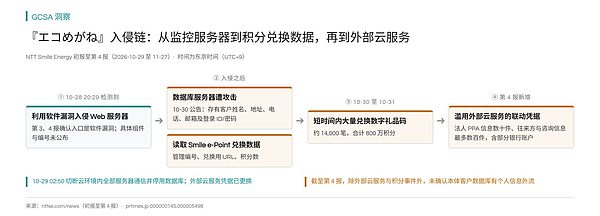
Step 1: Exploit software vulnerabilities to gain access to the web server
At 8:20 PM on October 28th, NTT Smart Energizer detected suspicious access on the web server of "Ekomegane". By the third report on November 13th, an external professional organization confirmed based on logs that this was "unauthorized access exploiting a software vulnerability"; the fourth report further stated that the attackers used this vulnerability to "infiltrate the 'Ekomegane' server". The company has not yet specified which software, which vulnerability number, or whether a patch has already been released.
"Ekomegane" is a remote monitoring service for residential and corporate solar energy systems: on-site metering equipment transmits power generation and consumption data to a cloud server operated by the company, allowing users and contractors to view power generation status and receive anomaly alerts via a webpage. Such a server naturally needs to be accessible to the internet for login and viewing, while also connecting to a database storing customer data. Therefore, if the publicly accessible software has an exploitable vulnerability, attackers gain access not just to a web server, but to a foothold that can continue to move laterally to the backend.
Step 2: The database server was attacked.
The announcement on October 30 stated that further investigation revealed evidence of an attack on the database server managing customer information. Potentially leaked information included the names or company names, addresses, phone numbers, and email addresses of donors and partner companies, as well as service login IDs and passwords. At 2:50 AM on October 29, the company cut off communication to all servers within the cloud environment and disabled the database. This prevented attackers from continuing to use the environment, but also stopped sending abnormal power generation alert emails and suspended the registration for new equipment installations.
As of the fourth report, the company's stance is: aside from information and points-related incidents on external cloud services, no leaks of personal information from the 'Ekomegane' entity's customer database have been confirmed. In other words, the database being "attacked" has been confirmed, but the "data being stolen" has not yet been confirmed; these two need to be considered separately.
Step 3: Read the points redemption data and redeem 8 million points within two days.
"Smil ePoint" is a points-based reward system that rewards users based on their household electricity consumption. Users are primarily households that have purchased Omron Social Solutions (OSS) energy storage systems and joined the "Minna Detsukuru Eco-Activation System." Points management and redemption are handled by NTT Smart Energy. Report 2 confirms that the "management number," "redemption URL," and "points count" within this points system were accessed by a third party and subsequently redeemed in large quantities within a short period for purposes such as cash conversion.
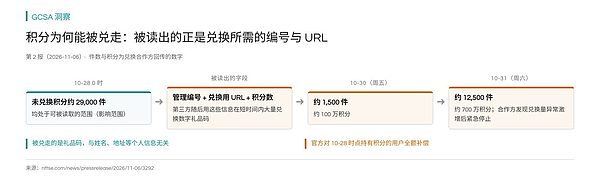
The key to this success lies in the fact that the fields read were sufficient to complete the redemption. The official statement claims the attackers "used this information" to conduct numerous redemptions, without mentioning the need for user account passwords or secondary verification. Therefore, it can be inferred (analysis and inference, as the official statement doesn't specify the verification method on the redemption page): the redemption URL served as a "hold and redeem" credential. With the URL and corresponding number, one could exchange points for digital gift codes on the partner's redemption page. Once issued, digital gift codes could be resold or used directly, which explains why the attackers made approximately 12,500 redemptions on October 31st alone. What truly halted the redemption process wasn't NTT Smart Enigma's system, but rather the emergency stop implemented by the redemption partner after detecting the abnormal surge.
Step 4: Access external cloud services using the linked credentials on the server.
The fourth newly added fact is that a detailed analysis of the internal and external linkage paths of the server shows that "information used for linkage with external cloud services" was misused. Attackers made unauthorized access to and operations on external cloud services, and some data may have been viewed and obtained. Dozens of pieces of information related to the corporate PPA service were affected, as well as up to several hundred pieces of information related to other business partners and inquiries. The items included the legal representative's name, personal name, address, telephone number, email address, inquiry content, and bank account information of some business partners.
This type of linked information is typically API keys, access tokens, or service account credentials, deployed on a server for programs to automatically invoke external services. Their characteristics are: they do not require manual login, are not protected by employee multi-factor authentication, and external cloud services cannot distinguish whether the request comes from a legitimate program or an attacker who has control of the server. Therefore, once the server is compromised, the permissions for these credentials are entirely transferred to the attacker. NTT Smart Enigma has severed related access and replaced the authentication information, while also strengthening access control review and monitoring of external cloud services.
III. Losses and Handling
The confirmed direct losses stem from "Smil ePoint": According to NTT Smart Entertainment's second report on November 6th, approximately 14,000 transactions totaling 8 million points were identified as fraudulent redemptions. These figures were provided by the points redemption partner on November 4th. The company announced full compensation to users holding points as of October 28th. No intrusion was detected on Omron's "Omron Point".
Regarding service restoration, Report No. 4 outlines the following goals: The company's own consumer and energy storage solar panels will be restored in early December after external security verification is completed; the full-capacity and surplus-capacity solar panels will be migrated to a new system base, with a planned full restoration in early February 2027. Prior to this, alarm notifications and metering data provision upon request will be restored in phases starting in December. The power generation, sales, and output control of the solar equipment itself will not be affected by the system shutdown. The company has submitted preliminary and supplementary reports to the Personal Information Protection Commission and is cooperating with the police.
IV. What should users and their counterparts do now?
If you are an Ekomegane user or distributor, firstly, consider any passwords used on this service before October 28th as compromised: the announcement on October 30th explicitly listed service login IDs and passwords as potentially compromised items. Any passwords used on other websites that are the same or similar should be changed immediately. Secondly, be wary of emails, text messages, and phone calls impersonating NTT Smile Energie, Omron, or points redemption services. The company will never request credit card numbers, bank account numbers, or passwords via email or text message. For inquiries related to this incident, only use the forms published on the official website.
If you are a corporate PPA customer or business partner who received individual notifications, the acquisition of your account information means that attackers could use real bank names, branch names, and account numbers to forge requests such as "change of receiving account" or "payment of outstanding fees." The finance department should verify any payment or account change requests originating from NTT Smart Engineering by calling back the known phone number. For companies operating similar IoT cloud monitoring services, the lesson from this incident is: credentials used on servers to call external services should have minimum permissions and source restrictions; redeemable vouchers such as points and gift codes that can be directly converted into cash cannot be protected by a single URL; abnormal redemption rates should trigger circuit breakers within their own systems.
V. References
- NTT スマイルエナジー 4th report (2026-11-27):
https://nttse.com/news/pressrelease/2026/11-27/3314/ - PR TIMES, Issue 4 (Original Text):
https://prtimes.jp/main/html/rd/p/000000145.000005498.html - NTT スマイルエナジー No. 3 report (2026-11-13):
https://nttse.com/news/pressrelease/2026/11-13/3310/ - NTT スマイルエナジー 2nd report: スマイルeポイント incorrect exchange (2026-11-06):
https://nttse.com/news/pressrelease/2026/11-06/3292/ - NTT Smart Enigma 10-30 Announcement: System shutdown and potential leakage of personal information:
https://nttse.com/news/pressrelease/2026/10-30/3288/ - Initial report: Emergency maintenance notice (2026-10-29):
https://nttse.com/news/2026/10-29/3284/
Source:Global Cybersecurity Alliance (GCSA)
Website:www.gcsa.org
Get updates in your inbox
We respect your privacy. See our Privacy Policy