
Introduction
If the security management server responsible for protecting the enterprise network is compromised, can the firewall still serve as a reliable security barrier?
Founded in 1993, Check Point is a pioneer in modern firewall technology and a leading global cybersecurity vendor, providing security protection for more than 100,000 organizations.
The latest GT13 attack campaign disclosed by threat intelligence company GreyNoise reveals that 24 Check Point security management servers in 17 countries and regions around the world have been compromised, involving 22 organizations covering important sectors such as finance, energy, government, transportation, and manufacturing.
Attackers exploited a previously patched SmartConsole authentication bypass vulnerability to steal the firewall database and internal CA files, and attempted to issue new certificates and uninstall security policies. This breach did not occur on ordinary business servers, but rather at the security management hub that controls the enterprise's network defense strategies and core trust relationships.
Through the analysis of this incident, GCSA has clarified the attack chain, vulnerability exploitation mechanisms, and potential harms, and further examined the protection and trust reconstruction issues of the security infrastructure itself.
| Original Analysis Document
24 Check Point management servers were compromised by GT13: Forged HFS sessions were used as springboards to bypass firewall databases and internal CA access via SmartConsole authentication.
Daily Security Insights (Event Analysis) | November 27, 2026 | All times in this article are Tokyo time (UTC+9)
Threat intelligence firm GreyNoise disclosed an intrusion campaign codenamed GT13: attackers compromised 24 Check Point Security Management Servers belonging to 22 organizations across 17 countries and regions, including the UK, Ireland, France, Germany, Greece, India, Thailand, Vietnam, South Korea, Hong Kong, Australia, and the US, spanning the finance, energy, government, transportation, mining, engineering, and manufacturing sectors. GreyNoise obtained activity logs from one of the attackers' jump servers, including over 1,400 network sessions, over 800 command-line logs, and over 1,200 uploaded, downloaded, or created files.
These records indicate that the attackers exploited the SmartConsole authentication bypass vulnerability CVE-2026-16232, which Check Point patched in July 2026, to issue over 100 administrative tasks to the victim's management server: copying the firewall database and internal Certificate Authority (CA) files, issuing new certificates, and uninstalling security policies. The security management server controls the entire firewall policy and root of trust; its compromise means that perimeter protection itself has fallen into the attackers' hands. GreyNoise's visibility was interrupted on November 2nd, but it determined that the attackers still held access to these devices, suggesting that the activity is likely still ongoing.
I. Event Timeline
Table 1: GT13 Event Timeline (UTC time recorded by GreyNoise converted to Tokyo time)
| Time (Tokyo time UTC+9) | event | Source/Evidence |
|---|---|---|
| 2026-07 | Check Point fixed the SmartConsole authentication bypass CVE-2026-16232, noting in its announcement that it had been discovered being used in the wild; CISA subsequently listed it as a KEV. | BleepingComputer July report; Check Point statement |
| 10-02 22:17 | An automated scanning and pipeline attack was initiated on a Rejetto HFS server (CVE-2026-61500). | GreyNoise GT13 Report |
| 10-02 22:19 | HFS was compromised after an administrator request carrying a forged session cookie was received. | Same as above |
| 10-05 21:21 | The session is forged again, an HFS middleware hook is installed to execute commands, and the SSH public key is written to /root/.ssh/authorized_keys. | Same as above |
| 10-08 | An attacker's automated program performs checks such as `uname -a` via an HFS command hook. | Same as above |
| 10-19 23:53 | Attempt to download the ZULT Linux implant using the HFS vulnerability failed. | Same as above |
| 10-20 16:22 | The attacker logged in via SSH and started an unauthenticated HTTP upload service on the jump server; the first return packet was a route scan result of a Check Point management server. | Same as above |
| 10-20 22:54 | First run of exploit.py on Victim A's Check Point server (CVE-2026-16232) | Same as above |
| 10-21 09:34 | Use pull_*.py to retrieve credentials, internal CA, and firewall configuration from the second Check Point device via the first device. | Same as above |
| 10-26 11:17 | The task of batch issuing certificates to 24 controlled Check Point management servers all resulted in errors. | Same as above |
| 11-02 11:28 | The system performs a self-check on the Linux IPv4 release and reuse vulnerability CVE-2026-98432 on the jump host, and then uses nftables to automatically "patch" it. | Same as above |
| 11-02 12:19 | The last GT13 event recorded by GreyNoise | Same as above |
| 11-25 | Check Point responded to the media: The vulnerability used was CVE-2026-16232, which was disclosed in July, and patches and protections have already been provided. | BleepingComputer 11-25 Update |
II. How is the jump server obtained: Recovering the session signature key from Math.random()
The GT13 used a Rejetto HFS (HTTP File Server) exposed to the internet as a data relay platform. GreyNoise reconstructed the attacker's process using CVE-2026-61500: Each time a POST request was sent to the HFS'sloginSrp1interface, the server returned a new signed session cookie, withsidvalue derived from JavaScript'sMath.random().Math.random()is not a cryptographically secure random number generator; the pseudo-random number algorithm behind the V8 engine can reconstruct its internal state given enough consecutive outputs. The attacker logged in multiple times, collectedsid, reconstructed the PRNG state, and thus recovered the HFS session cookie signing key, which was then used to sign out an administrator session. The entire process required no password knowledge.
This forged cookie also containedallow_session_ip_change:true, meaning the session was allowed to remain valid even after the IP address changed. GreyNoise statistics show that the 99 IP addresses used by GT13 were either ExpressVPN exits or the compromised victim's Check Point device. This field allowed the attacker to switch between different exits without losing connection. After obtaining the administrator session, the attacker installed an HFS middleware hook to execute system commands, writing their own SSH public key into root's `authorized_keys, thus turning HFS into their "operation relay station".
On October 20th, the attacker wrote a script on this server to start an unauthenticated HTTP service specifically for receiving uploads. They then installed Nmap and Chisel, setting Chisel as a reverse proxy server. The first compressed file uploaded contained the routing scan results of a Check Point security management server. GreyNoise concluded from this that the Check Point device had already been compromised before HFS was breached; however, the exact time and method of initial access remain uncertain.
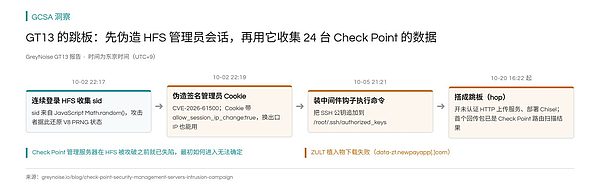
Figure 1: GT13 forged an HFS administrator session and wrote SSH public keys, turning this HFS into a springboard for collecting Check Point data (GreyNoise GT13 report).
III. What happened after taking over the management server?
CVE-2026-16232 is an authentication bypass vulnerability in Check Point SmartConsole: an unauthenticated attacker can obtain an application login token and authenticate with administrator privileges. Check Point stated in its July announcement that the exploit requires no restrictions on the source of the trusted client (GUI client) and that the management server's IP address is accessible from the internet.exploit.pyscript that GreyNoise saw on the jump server targets this vulnerability; GreyNoise claims it's adapted from a publicly available Metasploit module, which attackers use to send "Run Script" tasks to the management server.
From October 20th to 26th, the attackers tricked a compromised device on Victim A into downloading and running Chisel in client mode. Through tunneling and gaining access to Victim A's internal network, they initiated over 100 administrative tasks on multiple Check Point management servers using CVE-2026-16232. These tasks included: replicating the firewall database and internal CA; issuing a new certificatepivot.p12; and uninstalling security policies, effectively disabling the firewall. Since one device couldn't directly send the results back to the jump server, the attackers wrote apull_*.pyscript named after the target device. This script, via the first device, relayed the credentials, internal CA file, and firewall configuration from the second device.
Within the internal network, the attackers also probed Citrix NetScaler, Ivanti Connect Secure, VMware vCenter, Microsoft Exchange, Oracle TNS, and multiple domain controllers, using scripts such asspray_portal.pyandssh_spray.pyto perform password spraying. GreyNoise noted that these scripts contained not only common weak passwords but also usernames and passwords customized for the victims, indicating that the attackers either knew or were specifically guessing the passwords the targets would use.
At 11:17 AM on October 26th, the jump server received 24 result files, corresponding to the output of the same certificate management task performed by 24 compromised Check Point management servers. The files were arranged in ascending order of the victim's IP address, indicating that they were distributed to each server by an automated program and then returned via SCP. All of these tasks resulted in errors, and GreyNoise did not see any subsequent retries. However, it was these outputs containing IP addresses and task information that allowed it to directly or through government partners notify most of the victim organizations. Each file was delivered directly from the victim device, indicating that each compromised device stored the SSH private key corresponding to the public key implanted on the jump server. One error message indicated that/usr/lib/.libproc.sowas registered in/etc/ld.so.preload, which GreyNoise believes may be an implant on the device.
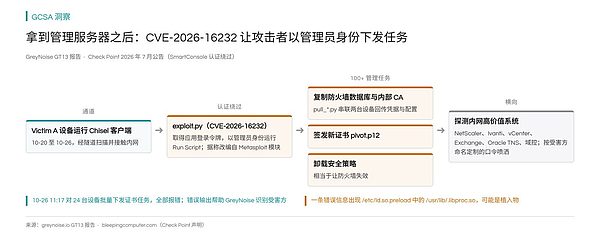
Figure 2: Using CVE-2026-16232, an administrator issued the following tasks: replicate the firewall database with the internal CA, issue a new certificate, and uninstall the security policy (GreyNoise GT13 report).
IV. Why GreyNoise believes that an AI-driven attack platform is behind this.
GreyNoise discovered that the attackers used at least 30 Python scripts on the jump server, many of which were auxiliary programs or launchers for other scripts, along with a batch of vulnerability detection and exploitation scripts. It detected traces of human intervention, but also observed numerous "strange actions" that could only be explained by multi-proxy automation: for example, on October 19th, despite having SSH access, the attackers still allowed the automated pipeline to re-run the HFS vulnerability to download the implant, repeatedly checking after failure. On November 2nd, other attackers began scanning this jump server. GT13 first used a script to self-check for the Linux IPv4 release and reuse vulnerability CVE-2026-98432, then used nftables to drop IPv4 packets with IP options, thus blocking the same vulnerability for its own jump server.
Based on these behaviors, the level of automation, and the customized tools, GreyNoise concluded that GT13 possesses a mature AI-assisted attack system, responsible for weaponizing vulnerabilities, scanning vulnerable assets, and automated exploitation, initially accumulating a batch of systems that could act as relays or actual targets. It also stated that the use of AI was only an assessment based on behavior and had not been confirmed. GreyNoise did not attribute GT13 to any known group; the attackers' manual operations were concentrated between 0:00 and 17:00 UTC, and the malicious domainnewpayapp[.]comwas registered in March 2026 with the registration location listed as Haiphong, Vietnam. GreyNoise explicitly stated that it would not give too much weight to such time zone clues.
V. What should Check Point users check?
1. CVE-2026-16232 has been confirmed to be patched, and the management plane has been tightened.Check Point states that the patch and protection were available in July, and Smart-1 Cloud customers are unaffected. Following their hardening guidelines, restrict trusted clients to specific IP addresses or network segments to ensure unauthorized addresses cannot access the management server; the management server should not be directly exposed to the internet.
2. Review the audit logs for token logins.The Check Point July announcement suggested searching forAuthentication method: application token" in SmartConsole's "Logs & Monitor → Audit Logs". If the management interface was publicly accessible before the patch, this should be treated as a potential vulnerability.
3. Check against GreyNoise's metrics.Pay attention to management connections originating from ExpressVPN (AS206092) and accompanied by the SSH fingerprint HASSHeeca2460550b9ded084ecf2f70a75356(GreyNoise notes that this fingerprint is common and needs to be combined with other characteristics); User-AgentMozilla/5.0 (X11; Linux x86_64) research; Domain namedata-zt.newpayapp[.]com; Whether/usr/lib/.libproc.sois registered on/etc/ld.so.preloadon the device; and whether there have been any unexpected certificates (such aspivot.p12), policy uninstallation, or batch management tasks recently. The GreyNoise report includes a complete list of IPs used by GT13 and the corresponding time periods.
4. Once a breach is confirmed, rotate the root of trust in the firewall system.The copied firewall database and internal CA files mean that attackers could potentially issue trusted certificates, restore policies and credentials. It is necessary to rebuild the management server, reissue the internal CA and related certificates, rotate all credentials stored on the management server, and simultaneously investigate systems that have been probed, including NetScaler, Ivanti, vCenter, Exchange, and domain controllers.
VI. Main Information Sources
- GreyNoise: 99 IPs but a C2 ain't one: An Active Intrusion Campaign Against Check Point Security Management Servers:
https://www.greynoise.io/blog/check-point-security-management-servers-intrusion-campaign - BleepingComputer: Hackers compromise Check Point Servers in 22 organizations (with 11-25 Check Point statements):
https://www.bleepingcomputer.com/news/security/hackers-compromise-check-point-servers-in-22-organizations/ - BleepingComputer: Check Point patches SmartConsole zero-day exploited in attacks (July 2026):
https://www.bleepingcomputer.com/news/security/check-point-patches-smartconsole-zero-day-exploited-in-attacks/ - The Hacker News report (including a response from the head of threat intelligence at Check Point):
https://thehackernews.com/2026/11/hackers-compromise-24-check-point.html
Conclusion
The intrusion into Check Point's security management server is not only an attack targeting a well-known cybersecurity product, but also exposes three deep-seated issues in the enterprise's security system that deserve attention.
Dual attributes of security infrastructure
Firewalls, security management platforms, and identity authentication systems are the core of an enterprise's network defense and also critical assets with highly centralized access. Once these systems are compromised, attackers may be able to bypass or even dismantle existing security defense mechanisms.
While deploying security products, enterprises must also establish independent protection, access control, and abnormal behavior monitoring mechanisms for their security infrastructure itself.
From vulnerability patching to trust rebuilding
The Check Point vulnerability exploited in this attack was patched months ago, but patching the vulnerability does not mean that the security risk has been eliminated.
When firewall databases, internal CAs, and management credentials may be compromised, simply installing patches is insufficient to restore system security. Affected organizations also need to re-examine their certificate systems, identity credentials, and internal trust relationships, and rebuild the entire management environment if necessary.
AI and automation are changing the landscape of offense and defense.
Based on the attack behavior and tool characteristics, GreyNoise speculates that a sophisticated AI-assisted attack system may exist behind GT13. Although the actual involvement of AI has not yet been confirmed, the mass utilization, customized tools, and cross-system penetration capabilities demonstrated in this incident have highlighted the challenges posed by automated attacks.
In the face of increasingly automated attack activities, the traditional defense model that relies on manual inspection and periodic vulnerability patching also needs to evolve towards continuous monitoring and rapid response.
When security infrastructure itself becomes an entry point for attacks, enterprises may need to rebuild not just firewalls, but the trust foundation of the entire network defense system.
Copyright and Disclaimer
This article was published by the GCSA Global Cyber Security Alliance. Copyright of original content belongs to GCSA; copyright of third-party content cited or reproduced belongs to the original rights holder. Please indicate the source and retain the original link when reprinting.
This article is for cybersecurity research and informational purposes only and does not constitute investment, legal, or financial advice. The related technical analysis, risk assessments, and attack attributions are based on existing evidence. The scope of GCSA's independent verification is as disclosed in this article, and the conclusions may be updated as new evidence emerges.
Follow GCSA on social media for the latest updates.
GCSA X (Twitter):
GCSA Telegram:
GCSA WeChat Official Account:
https://mp.weixin.qq.com/s/ouyL9NwrDDjhMumvehdOmw
Source:Global Cybersecurity Alliance (GCSA)
Website:www.gcsa.org
Get updates in your inbox
We respect your privacy. See our Privacy Policy