
Introduction
Drupal is a globally renowned open-source content management system (CMS) used to build and operate corporate websites, public institution websites, and content portals. The Drupal security team has confirmed that its core installer vulnerability, CVE-2026-132165, has been used to attack online sites. According to official reports, the earliest known exploit occurred at3:00 AM (Hong Kong time) on November 20, 2026.The U.S. Cybersecurity and Infrastructure Security Agency (CISA) subsequently added this vulnerability to its Known Exploited Vulnerabilities (KEV) list.
The vulnerability lies in the installer's handling of database check failures. When the database cannot be verified temporarily, affected versions of the installer may mistakenly classify an already live site as "not yet installed." Under certain conditions, attackers can trigger a reinstallation, take over the site, and even execute arbitrary code on the server without logging in. The installation entry point, originally intended for initial deployment, could thus allow attackers to seize control of the online site.
This report outlines the timeline of the exploit in the wild, explains why the installer misjudged the site status, and how the patch mitigated the risk.Affected sites should immediately upgrade to the corresponding branch's patched version, restrict external access to the installer, and review any abnormal installation requests, administrator account changes, and site file modifications prior to patch deployment.Teams that have already completed the upgrade should also include the period of exposure prior to the upgrade in their investigation.
The following is the original technical analysis report:
A vulnerability in the Drupal core installer, CVE-2026-132165, has been exploited in the wild: a database check failure is treated as "not yet installed," allowing an anonymous attacker to reinstall the website and execute code.
Daily Security Insights (Event Analysis) | November 25, 2026 | All times in this article are Tokyo time (UTC+9)
On November 24th (US time), CISA added the Drupal core vulnerability CVE-2026-132165 to its Known Exploited Vulnerabilities (KEV) list, requiring federal agencies to address it by November 27th and to conduct forensic triage according to BOD 26-04. When the Drupal security team released SA-CORE-2026-017 (“Highly critical”, 20/25) on November 18th, they only stated that “under certain conditions” attackers could use install.php to reinstall Drupal, leading to site takeover or remote code execution; subsequently,they added in the announcement that reports had been received indicating that the vulnerabilitywas used to attack the online siteas early asNovember20that04:00(November19that19:00UTC).
The affected versions are 10.6.22 and earlier, 11.0.0 to 11.3.22 and earlier, and 11.4.0 to 11.4.13 and earlier; 10.5.x and earlier have long since stopped receiving security support. The vulnerability was discovered by Anthropic's open-source scanner (ID: ANT-2026-GMRPK0BU). Researchers at Searchlight Cyber independently discovered the same issue and publicly disclosed their complete approach to making it a "pre-certified RCE under default configuration" on November 24.
I. Event Timeline
Table1:Timeline ofCVE-2026-132165
Time (Tokyo timeUTC+9) | event | Source/Evidence |
2026-10-27 | Searchlight Cyber confirmed pre-certification RCE on the default Apache + PostgreSQL platform (later ruled out as duplicate of the Anthropic report). | Searchlight Cyber's Fail2Install timeline |
2026-11-18 23:44 | The fix "fix: SA-CORE-2026-017" was submitted to version 11.4.13; SA-CORE-2026-017 was released and went live on versions 10.6.22, 11.3.22, and 11.4.13. | Submission 1c977e1e at github.com/drupal/drupal; drupal.org |
2026-11-20 04:00 | The earliest known online site utilized | SA-CORE-2026-017 Update Notes |
2026-11-24 (US time) | CISA has listed KEV (Knowledge, Activity, and Expense) for handling from November 27th, requiring evidence collection and triage. | CISA KEV Catalog |
2026-11-24 | Searchlight Cyber's public blockchain research (database connection limit → reinstallation → writing PHP with SQLite) | slcyber.io |
II. Cause of the vulnerability: Allowing failures instead of blocking them.
Before starting the installation, Drupal's installer needs to verify that "Drupal has not been installed in this database." This is handled by `install_verify_database_ready()`, which retrieves the last table in the system module schema and checks if the table exists in the database. If it does, it throws an `AlreadyInstalledException` to prevent reinstallation. The problem lies in the exception handling: if the query fails, `catch (Exception)` does nothing, and `$existing_install` remains at the default `FALSE`. The original comment gives the reason that "the database may not be created yet," but on a live site with database connection information in `settings.php`, a "query failure" precisely indicates that the database is temporarily unavailable, not that it "hasn't been installed." This is precisely the point described in CISA's vulnerability type CWE-636 (Not Failing Securely).
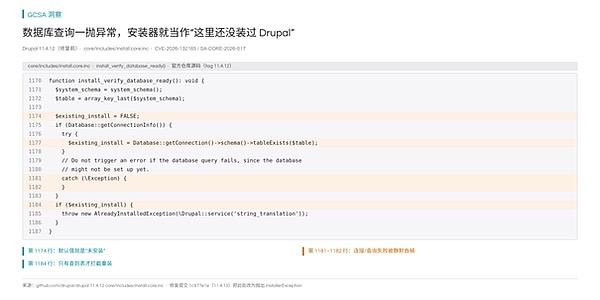
Figure 1: Before the fix, install_verify_database_ready(): database query exception was swallowed, and the default value "not installed" was retained (Drupal 11.4.12).
In line 510 of the caller `install_begin_request()`, this check is only invoked if `database_verified` is false. Searchlight Cyber's analysis restores the exploitable sequence to "failure, failure, success": the first database connection check fails, only setting `database_verified` to false without terminating the process; the second failure occurs in `install_verify_database_ready()`, the exception is swallowed, and the site is judged as "not installed"; if the database has recovered by the third connection during the requirements check phase, the installer will begin a clean install, allowing visitors to fully reinstall the site and create their own administrator accounts.
III. How an attacker can turn it into a pre-certified RCE
"Letting the database fail at the right time" is the premise of this chain. Searchlight Cyber's approach is to exhaust system resources: on the default Apache (MaxRequestWorkers 150) + PostgreSQL (max_connections 100), they push the number of connections to the limit with a large number of requests that will hold database connections, and then switch between the limit and the limit minus one, creating a sequence of the first two failures and the third success. For PHP-FPM (which only has 5 workers by default), they need to rely on the source port exhaustion caused by TIME_WAIT. Researchers assessed that a 4 vCPU server can be remotely utilized, while a 2 vCPU server depends more on the deployment configuration.
After the reinstallation began, the researchers found a more direct code execution path than "installing malicious modules": the installer allowed selecting SQLite and customizing the database file path. The attacker set the path to the site directory, ending with .php, and then filled in a piece of PHP code as the site name. This code was then written into the .php database file. Drupal's built-in .htaccess would normally refuse direct access to PHP files outside of core, but its allow rule only checks if the request URI ends with /core/<name>.php and does not start with an anchor. Therefore, when requesting /modules/<file>.php/core/x.php, Apache executes the first .php file, and the second half is treated as PATH_INFO, allowing arbitrary PHP code to run.
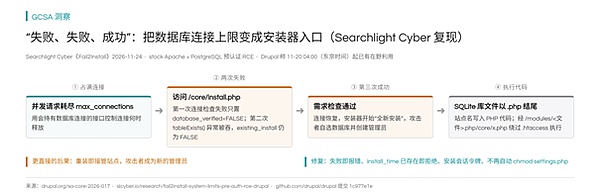
Figure 2: Exploitation chain for Searchlight Cyber reproduction: connection limit manipulation to create "failure, failure, success", followed by code execution using the SQLite.php file after reinstallation.
The Drupal announcement states that "if the web server cannot write or modify permissions in settings.php, some (not all) exploit paths will be mitigated." This is because the installer writes database credentials and hash salt back to settings.php; before the fix, the installer's `drupal_verify_install_file()` function, which checks if settings.php is readable and writable, would automatically perform a `chmod` operation to "fix" permissions. This is why the fix requires modifying this part as well.
IV. How to plug the patch
The fix submission 1c977e1e made four changes in core/includes/install.core.inc:
1.Failure will result in an error.The catch branch of install_verify_database_ready() will now throw InstallerException(“The configured database could not be verified”), which the caller will record as configured_database_failed, and the requirement check will directly issue a blocking error based on this.
2. The check conditions have been tightened, anda second checkindependent ofschemaqueries has been added. The call condition has been changed from database_verified to settings_verified; at the same time, if the installation task log is "done", or if there is already a task and the state contains install_time (written when installation is complete), an AlreadyInstalledException will be thrown.
3.Installation can only continue from the browser session that initiated it.`install_bootstrap_full()` generates a random token for the first arriving interactive session, stores only the hash in the state, and sends an "Access denied" message to all other sessions; the token is deleted after installation is complete.
4.Automatic modificationofsettings.phppermissions is no longer required.All three calls to `drupal_verify_install_file()` are now passed `auto_fix: FALSE`.
V. What should the site administrator do now?
1.Upgrade immediately.Upgrade from 11.4.x to 11.4.13, from 11.3.x to 11.3.22, and from 10.6.x to 10.6.22; older branches no longer have security support and should be migrated as soon as possible.
2.Block the installer.Regardless of whether it has been upgraded, follow the Drupal official guide "Securing the Drupal installer" to deny external access to /core/install.php (including variants with PATH_INFO such as /core/install.php/...) at the web server layer.
3.Tightenpermissions onsettings.php.Ensure that the web server process cannot write to or modify the permissions of sites/*/settings.php and its directory.
4. Investigatelogs afterNovember20thto rule out a compromise. Pay close attention to access to install.php, a large number of concurrent requests within a short period,database "Too many connections" errors, newly appearing .php files in the site directory (especially SQLite database files), requests in the form of /modules/*.php/core/*.php, and newly added administrator accounts or modified site names. If any signs are found, treat it as a compromised host: isolate it, preserve evidence, restore from a trusted backup, and rotate database and site credentials.
5.SitesusingDrupal Stewardare already protected against known attack vectors, but Drupal still recommends upgrading as soon as possible in case new attack paths emerge.
VI. Main Sources
• Drupal: SA-CORE-2026-017 (including in-the-wild updates):
https://www.drupal.org/sa-core-2026-017
• Fixed commit drupal/drupal 1c977e1e (fix: SA-CORE-2026-017):
https://github.com/drupal/drupal/commit/1c977e1e8e6c4f9a6678d5aeb783542bd4d863c4
• Before the fix, the source code install.core.inc (tag 11.4.12) was as follows:
https://github.com/drupal/drupal/blob/11.4.12/core/includes/install.core.inc
• CISA Known Exploited Vulnerabilities Catalog (CVE-2026-132165):
https://www.cisa.gov/known-exploited-vulnerabilities-catalog
• NVD: CVE-2026-132165:
https://nvd.nist.gov/vuln/detail/CVE-2026-132165
• Searchlight Cyber: Fail2Install: Turning System Limits into Pre-Auth RCE in Drupal (2026-11-24):
https://www.slcyber.io/research/fail2install-system-limits-pre-auth-rce-drupal
Conclusion
The Drupal vulnerability warrants reviewregarding what operations are allowed when the system cannot verify the site's status.When database checks fail, the installer cannot determine if the site has been successfully deployed. Continuing execution might grant permissions to write configuration files, initialize the site, and establish administrative privileges. For teams maintaining installers, initializing interfaces, or recovery tools, database timeouts, connection exhaustion, and permission anomalies should all be included in release testing to verify whether these failures would unexpectedly revert the production site to the initial deployment process.
For the site operations team, patch deployment time is a crucial juncture for defining the investigation window. Web access logs, application logs, and site change records should be used to verify installer access, administrator account changes, and abnormal file writes. If suspicious signs are found, it should be treated as an intrusion incident, prioritizing the isolation of the affected environment and preservation of evidence, followed by recovery and credential rotation based on the confirmed scope of impact.
For vulnerabilities that have already been exploited in the wild, the handling log should answer two questions: when did the patch take effect, and what was found in the exposure window before it took effect?
Copyright and Disclaimer
This article was published by the GCSA Global Cyber Security Alliance. Copyright of original content belongs to GCSA; copyright of third-party content cited or reproduced belongs to the original rights holder. Please indicate the source and retain the original link when reprinting.
This article is for cybersecurity research and informational purposes only and does not constitute investment, legal, or financial advice. The related technical analysis, risk assessments, and attack attributions are based on existing evidence. The scope of GCSA's independent verification is as disclosed in this article, and the conclusions may be updated as new evidence emerges.
Follow GCSA on social media for the latest updates.
·GCSA X (Twitter):
https://x.com/gcsa_com
GCSA Telegram:
GCSA WeChat Official Account:
https://mp.weixin.qq.com/s/ouyL9NwrDDjhMumvehdOmw
Source:Global Cybersecurity Alliance (GCSA)
Website:www.gcsa.org
Get updates in your inbox
We respect your privacy. See our Privacy Policy