
Introduction
A hardware wallet can power on normally, generate a correctly formatted mnemonic phrase, and perform signatures and transfers as usual. Users are virtually unaware that the wallet seed may lack sufficient randomness from the moment it is generated. On November 24, 2026, Coinkite, the manufacturer of COLDCARD, released a post-incident review, confirming that attackers had exploited this vulnerability to steal user funds. The review cited estimates from Galaxy Research, stating that approximately1,778.84 BTCwere stolen, involving over8,600 on-chain addresses.
The issue can be traced back to a firmware integration change in 2021. The affected firmware, when generating wallet seeds, actually invoked a software pseudo-random number generator, deviating from the originally designed hardware random number path. Devices could still generate usable mnemonic phrases, and routine functional tests passed normally, allowing the vulnerability to remain dormant for over five years. Attackers could deduce the private keys of some affected wallets offline without physical contact with the device and use these keys to sign transactions. The device remained in the holder's possession, yet the funds could have already been transferred out.
This report traces the random number call path in the delivered firmware, explains why the defect slipped through multiple rounds of review, and details how Coinkite subsequently verified and fixed the issue during the build and runtime phases. Holders should determine if they are affected based onthe device model, firmware version, and generation method used when the seed was initially generated. If the seed is confirmed to be affected, even if the device has been upgraded, a new seed must be generated and funds migrated. Restoring the original mnemonic phrase on another device will perpetuate the existing risks.
The following is the full text of the original report:
A flaw in COLDCARD seed generation led to the theft of approximately 1,778.84 BTC: For five years, wallet seeds were generated using software-generated pseudo-random numbers, and attackers recalculated private keys offline.
Daily Security Insights (Event Analysis) | November 25, 2026 | All times in this article are Tokyo time (UTC+9)
On November 24th, Coinkite, the manufacturer of the COLDCARD Bitcoin hardware wallet, released an 18-page incident report (snapshot date: November 23rd), fully recounting the seed generation flaw that surfaced in July of this year. From March 29th, 2021 to July 30th, 2026, the COLDCARD firmware used the Yasmarang software pseudo-random number generator built into MicroPython instead of the hardware random number generator on the STM32 chip. Coinkite estimates that the effective entropy of the affected seeds was only about 40 bits (Mk2/Mk3) or about 72 bits (Mk4, Mk5, Q), far below the design target of 128 bits. Starting July 29th, attackers recalculated the private keys corresponding to these seeds in batches offline and transferred funds.
The report cites Galaxy Research's statistics from August 14th:1,778.84 BTCwere stolen, involving over 8,600 addresses. The devices themselves were not remotely compromised or taken over, and the attackers did not need physical access to any of the devices. The most important point for users to remember is:upgrading firmware cannot fix already generated seeds. As long as a seed was generated on the affected firmware, it remains a weak seed regardless of whether it is subsequently restored, imported, backed up, or copied to another device.
I. Event Timeline
Table1:Timeline of Defects inCOLDCARDSeed Generation
Time (Tokyo timeUTC+9) | event | Source/Evidence |
2021-03-01 | Coinkite introduces libNgU (an embedded libsecp256k1 wrapper), changing seed generation from ckcc.rng_bytes() to ngu.random.bytes(). | Accident Report 1.1; Technical Background Description |
2021-03-29 | The first affected public version of the signature, v4.0.1, has been released. | Accident Report 1.1 |
March 2022 to June 2026 | At least 15 independent reviews and studies (including two paid third-party reviews and an AI-assisted review) have failed to identify this integration defect. | Accident Report 1.6 |
2026-07-29 | Affected seeds began to exhibit abnormal output. | Accident Report 1.1 (Based on independent reports) |
2026-07-30 | Users discovered the theft; Coinkite identified the defect and issued its first security advisory, isolating unshipped inventory at the factory. | Accident Report 1.1 |
2026-07-31 11:40 | The fix was submitted as ca724637 "fixes rng" and pushed out; fixed firmware was released on all supported versions that day. | github.com/Coldcard/firmware; Incident Report 1.8 |
2026-08-14 | Galaxy Research reports that 1,778.84 BTC were stolen, involving more than 8,600 addresses. | Accident Report 1.1 |
2026-08-20 | Mk4/Mk5 5.6.1, Q 1.5.1Q: Generate new seeds that force user entropy and mix STM32 TRNG with the entropy of two security chips. | Accident Report 1.8 |
2026-09-03 / 09-30 | Versions 5.6.2 and 1.5.2Q added View TRNG Words and verify_seed_mix.py; Versions 5.6.3 and 1.5.3Q were released. | Accident Report 1.8 |
2026-10-15 | Keylabs independent review: Repairs were effective within its scope, and the defect has been closed. | Accident Report Appendix A |
2026-11-18 | Coinkite support team statistics: Approximately 300 lost support tickets, corresponding to 242 accounts. | Accident Report 1.5 |
2026-11-24 | Coinkite releases full accident report | blog.coinkite.com/coldcard-postmortem-published |
II. Where are the shortcomings: The source of random numbers that are "silently replaced"
COLDCARD was designed to retrieve seed entropy only from the STM32 hardware random number generator, and the firmware was not intended to fall back to a software generator. The problem arose during the build integration when libNgU was introduced in 2021. After reviewing the code, Keylabs summarized the call path into three steps: COLDCARD's board-level configuration set MICROPY_HW_ENABLE_RNG to 0; the guard in the libNgU code pinned to the firmware, which should have prevented this configuration, was not working; therefore, the rng_get() symbol resolved to the MicroPython software generator during linking. Coinkite characterized it as "a defect in COLDCARD's integration, not a defect in libNgU itself," with the failed libNgU guard being a contributing factor.
The MicroPython file ports/stm32/rng.c is divided into two branches based on this macro: when the macro is true, rng_get() reads the STM32's RNG data register; when the macro is false (the source code comments specify that this is for MCUs without RNG), rng_get() returns the result of Yasmarang. The image below is taken from MicroPython submodule commit 4107246f referenced in the pre-fix COLDCARD firmware.
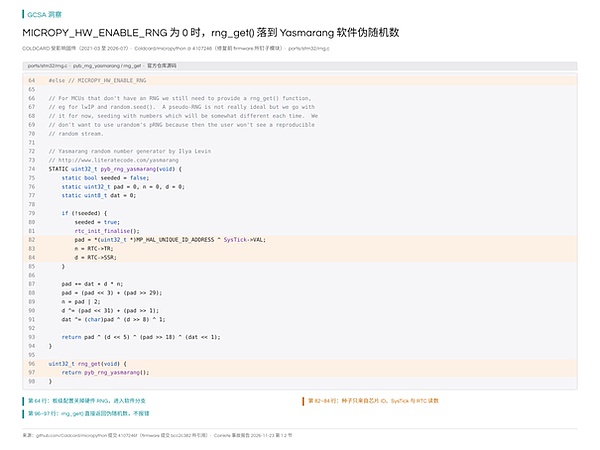
Figure 1: MicroPython source code referenced by the firmware before the repair: When the macro is 0, rng_get() returns a Yasmarang pseudo-random number, with the seed taken only from the chip's unique ID, SysTick count, and RTC reading (Coldcard/micropython@4107246f).
The code reveals the generator's initial states: line 82 XORs the chip's unique ID with the current SysTick value; lines 83 and 84 read the RTC's time register and sub-second register. Subsequent outputs involve shifting and XORing these 32-bit/8-bit states without introducing any new entropy. The chip's unique ID is not a secret random value, and the SysTick and RTC readings are related to the power-on time, so the actual number of possible initial states is far less than the apparent number of bits. Coinkite's technical notes state that on Mk2/Mk3, the PRNG is primarily seeded by device and timing states, with an effective search space of approximately 40 bits based on the current attack assumptions; starting with Mk4, the TRNG values of two additional security chips (SE1, SE2) are mixed into the PRNG state, increasing the effective search space to approximately 72 bits. The report also notes that this 72-bit figure has not yet been independently confirmed.
Why did it go unnoticed for five years? The report's analysis is straightforward: the hardware RNG did not fail during runtime, nor did it trigger any rollback logic. The interfaces exposed by the two implementations were compatible, so the build succeeded, the device did not report errors, and the generated mnemonic phrase format was completely correct. The seed was hashed before use, which changed the "appearance" of the output but did not add any entropy that was not originally present. Coinkite's original release checks—signature manifest, public source code, reproducible builds, functional tests, and random output statistics tests—all proved that "the hardware RNG code exists in the firmware" and "the output appears random," withoutchecking which implementation the seed generation path actually called. Keylabs also used simulations to confirm that the old generator passed the statistical health tests used by Coinkite.
III. How attackers steal data: They recalculate offline without touching the device.
Section 1.2 of the report clarifies that the physical security layer, libsecp256k1, coercion functions, and transaction authorization controls are not involved. Attackers do not need to obtain or remotely control the device. Only about 40 or 72 bits of the effective entropy seed are within the reach of offline brute-force recalculation: an attacker only needs to enumerate possible initial states according to the generation method of the affected firmware, deduce the corresponding mnemonic phrase and address, and then compare which addresses have balances on the blockchain to directly sign transfers using the recalculated private key. On the blockchain, these appear to be normally signed transactions.
The reports list different loss metrics and cannot be added together: the initial public analysis reconstructed at least 328 seed roots; Coinkite support received approximately 300 loss tickets by November 18th, corresponding to 242 accounts (approximately 0.21% of the estimated user base); Coinkite's blog post published on the same day identified 236 accounts, approximately 0.2%; Galaxy Research had collected data from 8,865 addresses as of August 24th. Coinkite believes the actual number of victims is likely higher, as not every victim submits a ticket. The report states "unknown" regarding who committed the theft and how the vulnerability was discovered; law enforcement agencies and the Canadian Cyber Security Centre are both investigating.
Regarding the discovery method, the report separately lists it as "hypothesis, not constituting an attribution": Kimi K3's full weights were made public on July 27, and the theft began two days later. Coinkite believes that "AI-assisted discovery" is a plausible hypothesis. The report also records that after the disclosure, several large models were able to reproduce the defect after reading the fix diff or public information, but those were all post-event reproductions, not blind testing discoveries.
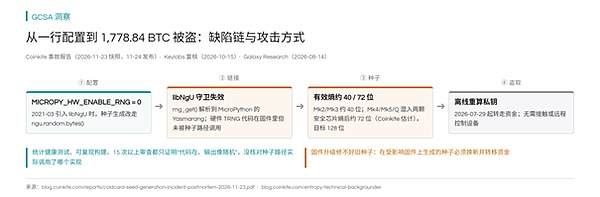
Figure 2: Flaw Chain and Attack Method: A single configuration line reduces the seed entropy to approximately 40/72 bits, allowing attackers to directly transfer funds after offline recalculation of the private key.
IV. How to plug it up during repair?
The fix submission ca724637 on July 31st did two things. First, it stopped compiling MicroPython's stm32/rng.c in the mpconfigboard.mk files for all models: it replaced the upstream rng.o with an empty object and used -Dpyb_rng_yasmarang=error-do-not-want-this to cause any residual references to fail during compilation; simultaneously, it explicitly defined rng_get() in the board-level rng.c, making it use COLDCARD's own hardware read function rng_get_or_fault(). Second, it added an rng-code-check build target to shared.mk, using arm-none-eabi-nm to check that the upstream rng.o must not define any symbols, and the board-level rng.o must define a global rng_get; otherwise, the build will fail.
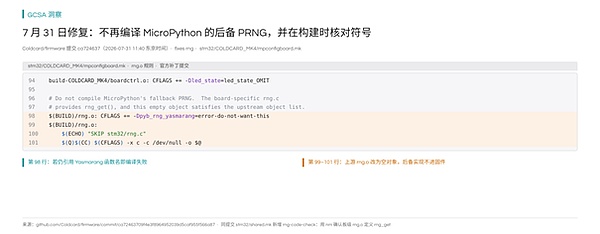
Figure 3: July 31 fix submission: The upstream backup PRNG no longer enters the firmware, and the source of rng_get is checked during the build phase (Coldcard/firmware@ca724637).
Subsequent versions added several layers: Starting with 5.6.1 / 1.5.1Q, each newly generated master seed must include user-input entropy (at least 65 unpredictable key presses, 50 dice rolls, or 128 coin tosses), then mix it with the STM32 TRNG, SE1 fresh entropy, and SE2 entropy; the libNgU general generator was replaced with SHA-256 Hash_DRBG; at boot, it checks if the running rng_get() is indeed entering the hardware read path, otherwise it stops; and it "stops upon failure" when the hardware RNG continues to malfunction. Versions 5.6.2 / 1.5.2Q restored "View TRNG Words" and released verify_seed_mix.py, allowing users to independently recalculate the final seed using the device entropy displayed on the screen plus their own dice sequence. Keylabs confirmed in its review on October 15th that all four standard signed images could read the STM32 RNG data registers, while the pre-fix 5.5.1 image only had Yasmarang on that path.
V. Scope of the impact and what you should do now
Table2: Affected Firmware and Minimum Fix Version (Incident Report1.4)
Model/Version Line | Seeds generated on the following firmware are affected. | Minimum Fix Version |
Mk2 / Mk3 | Versions 4.0.1 to 4.1.9 | 4.2.0 or higher |
Mk4 / Mk5 Standard Edition | Prior to version 5.6.0 | Version 5.6.0 or later (currently 5.6.3) |
Mk4 / Mk5 Edge | Prior to 6.6.0X | 6.6.0X or higher (currently 6.6.2X) |
Q Standard Edition | Prior to version 1.5.0Q | Version 1.5.0Q or higher (currently 1.5.3Q) |
Q Edge | Prior to 6.6.0QX | 6.6.0QX or higher (currently 6.6.2QX) |
There are three rules for determining whether a seed is affected: seeds generated safely outside of the affected process and subsequently imported into COLDCARD are unaffected; seeds generated on the affected firmware are still affected regardless of whether they are subsequently restored, imported, backed up, or cloned; and seeds generated using "Add Dice Rolls" with at least 50 fair, independent, and unrecorded dice rolled, and using the final mnemonic phrase after the dice roll, are unaffected by this defect.
1.First, determine which firmware your seed was generated on.Refer to the table above; if unsure, treat it as affected.
2.If affected, switch to a new seed and transfer funds.Install the verified repair firmware, generate a new seed, verify the seed against the backup, and then transfer funds to the new wallet. Wallets with BIP-39 passphrases should also be migrated; additional layers such as passphrases, dice, and multisignatures cannot repair an already affected seed.
3.Do not give the seed to anyone.Do not send your mnemonic phrase, passphrase, dice sequence, private key, backup file, or backup password to anyone (including Coinkite), nor enter them into any website. Only contact the vendor through the support channels linked at coldcard.com. Any unsolicited requests for "recovery," "migration," or "compensation" should be treated as fraudulent.
4.Large assets are protected by an independent defense system. This includesreal, private dice rolling, strong and unique passphrases with separate backups (fingerprint recording and recovery testing), and multi-signature authentication commensurate with the threat model.
5.Verify new devices before use.Check the serial number tamper-evident bag and transparent casing. Verify the bag number upon first power-on. Install the currently verified firmware before generating or importing seeds.
VI. Main Sources
• Coinkite: COLDCARD Seed-Generation Incident Postmortem (PDF, 2026-11-23 snapshot):
https://blog.coinkite.com/reports/coldcard-seed-generation-incident-postmortem-2026-11-23.pdf
• Coinkite: Our COLDCARD seed-generation postmortem is now public (2026-11-24):
https://blog.coinkite.com/coldcard-postmortem-published/
• Coinkite: Technical Deep Dive into the Entropy Issue:
https://blog.coinkite.com/entropy-technical-backgrounder/
• COLDCARD Security Status:
https://coldcard.com/security/status
• Fixed submission Coldcard/firmware ca724637 (fixes rng):
https://github.com/Coldcard/firmware/commit/ca72463709f4e3f8964952039d5caf955f566a87
• Before the fix, the MicroPython submodule ports/stm32/rng.c (Coldcard/micropython@4107246f) was as follows:
https://github.com/Coldcard/micropython/blob/4107246f8a080807b62c3b4838e71e812ea68b6f/ports/stm32/rng.c
• Keylabs: COLDCARD Seed Generation Review (2026-10-15):
https://blog.coinkite.com/reports/coldcard-seed-generation-review-keylabs-2026-10-15.pdf
Conclusion
The COLDCARD incident raised a specific question for hardware wallet auditing:how to prove that the firmware version in the user's possession actually used the entropy source required by design when generating the seed?Checks such as the inclusion of hardware random number implementations in the source code, the ability to reproduce the build in the released firmware, and the passing of statistical tests for random output are all valuable. Even if these checks pass smoothly, the actual seed generation path may still deviate from the design. Verification needs to cover the final delivered firmware for each model and version, confirm the actual entropy source used by the device when generating the seed, and check whether the device stops generating the seed when that entropy source is unavailable.
After the firmware fix is released, new seeds can be generated through the revised process, andexisting assets will still be controlled by the private keys derived from the affected seeds. For vendors, incident disclosure needs to provide a clear scope of impact and judgment criteria so that users know whether their seeds need to be replaced. For holders, the migration is considered complete only after confirming the impact and transferring funds to a wallet controlled by the new seed.
The security of a hardware wallet depends not only on where the private key is stored, but also on how the private key was originally generated.
Copyright and Disclaimer
This article was published by the GCSA Global Cyber Security Alliance. Copyright of original content belongs to GCSA; copyright of third-party content cited or reproduced belongs to the original rights holder. Please indicate the source and retain the original link when reprinting.
This article is for cybersecurity research and informational purposes only and does not constitute investment, legal, or financial advice. The related technical analysis, risk assessments, and attack attributions are based on existing evidence. The scope of GCSA's independent verification is as disclosed in this article, and the conclusions may be updated as new evidence emerges.
Follow GCSA on social media for the latest updates.
·GCSA X (Twitter):
https://x.com/gcsa_com
GCSA Telegram:
GCSA WeChat Official Account:
https://mp.weixin.qq.com/s/ouyL9NwrDDjhMumvehdOmw
Source:Global Cybersecurity Alliance (GCSA)
Website:www.gcsa.org
Get updates in your inbox
We respect your privacy. See our Privacy Policy