Foreword
When businesses and individuals send source code, business materials, internal documents, or even access credentials through AI platforms, how many service providers does this information actually pass through? And to what extent does "Zero Data Retention" (ZDR) provide protection in the multi-layered AI inference supply chain?
In November 2026, a series of findings disclosed by cybersecurity researchers made this issue a real security risk.
Dragos' Chief Research Officer, HD Moore, and his team sent approximately 2 million test prompts embedded with unique canary tokens to their AI service over a period of about four months. Canary tokens are special markers used to detect information breaches; when a unique link or credential within the token is accessed or used unauthorizedly, researchers can trace potential breach paths. The investigation revealed that at least three inference service providers were compromised, with attackers continuously copying customer requests; some of the stolen requests were even explicitly marked as ZDR.
On November 22, OpenRouter, an AI model routing platform, announced the removal of three service providers from its platform, the cancellation of ZDR (Zero Distance Recognition) qualifications for 125 model endpoints, and notified affected users. OpenRouter stated that its own system was not compromised and that the adjustments included preventative measures.
The significance of this incident goes beyond the security breaches of individual service providers. The investigation revealed a structural risk in AI inference services: when users call models through a unified API, their requests may pass through multiple routing platforms, marketplace sellers, and the actual inference service providers. Each stage may not only encounter complete prompts and model responses, but the actual data processing methods may also not be transparent to the end user.
Of particular note is that researchers established a chain of evidence—from canary credentials to the transmission of secret messages via cue words to third-party access—using canary credentials, web access logs, and request path tracing. This provides a practically valuable detection method for identifying data breaches in the AI supply chain.
GCSA believes that the core issue exposed by this incident is the lack of sufficient and verifiable security safeguards between the privacy promises of AI services and the actual data processing chain. ZDR can constrain normal data storage behavior, but it cannot prevent attackers who have taken control of the service provider's system from copying traffic, nor can it automatically eliminate the risk of undisclosed third-party forwarding.
The following investigation report outlines the timeline of the incident, canary evidence collection methods, different types of data breach mechanisms, relevant service provider reports, and security handling recommendations, for reference by AI developers, enterprise users, security researchers, and service providers.
[Original Analysis Report]
Three AI inference service providers were hacked for months without their knowledge: Canary hints revealed the theft of ZDR requests, leading OpenRouter to shut down three service providers and revoke the zero-reservation status of 125 endpoints.
Daily Security Insights (Event Analysis) | November 23, 2026 | All times in this article are Tokyo time (UTC+9)
On November 22, OpenRouter, an AI model routing platform, issued an announcement stating that, based on findings by security researchers, it had taken three inference service providers offline, removed 125 endpoints from its "Zero Data Retention" (ZDR) qualification, and notified affected users (regardless of whether the relevant service providers publicly announced it); OpenRouter itself was not compromised. It also stated that it would transform the researchers' testing methods into routine checks and verify network paths to detect instances where requests were forwarded to third parties. This action was triggered by research published on November 19 by the team of Dragos' Chief Research Officer, HD Moore: between July and November, they sent approximately 2 million hints containing unique "canary" secrets to various AI services, discovering that at least three inference service providers had been compromised and were continuously replicating customer requests. The earliest incident began in mid-July, and all three providers only became aware of the intrusion after being notified by researchers.
Some of these copied requests were explicitly marked with ZDR. The researchers' decoy prompts were processed along with the real customer requests, meaning that when attackers copied the decoys, they almost certainly also copied the real customer prompts—which often included source code, internal communications, customer information, and various credentials.
I. Event Timeline
Table1:Timeline ofAIInference Service Provider Prompt Theft
Time (Tokyo timeUTC+9) | event | Source/Evidence |
2026-07 | Dragos has begun sending canary-related prompts to its AI service; Phala says researchers have been including canary credentials in their requests since July 1. | Dragos; Phala Preliminary Report |
Mid-July 2026 | The earliest of the three service provider intrusion incidents; the service provider initially attributed it to internal tool configuration and partner data processing, but it was later discovered that internal credentials had been stolen, which has not been publicly disclosed to this day. | Dragos |
10-21 09:00 | Phala: An attacker gains access to a server's internal management interface and implants malware; the exposure window for DeepSeek V4 Flash 0731 begins from this point. | Phala Preliminary Report |
10-22 14:41 | Phala observed the earliest instance of exploitation of the stolen data. | Phala Preliminary Report |
Late October | The largest single intrusion: Approximately two hundred decoy AWS keys were issued within several short time windows, and all requests within those windows were stolen. | Dragos |
11-01 | The same attacker began using the AI-driven penetration testing framework ARTEX to verify the keys they already possessed. | Dragos |
11-05 17:15–11-06 02:55 | Phala detected and contained the first intrusion: disabled the confidential virtual machine created by the attacker and shut down the vulnerable service. | Phala Preliminary Report |
11-06 14:02 | Phala completes KMS root key rotation | Phala Preliminary Report |
11-08 13:12–14:35 | Phala received evidence from researchers, located and took offline the compromised inference deployment, thus completing the containment operation. | Phala Preliminary Report |
11-19 | Dragos publishes research titled "Three breaches, endless leaks". | Dragos Blog |
11-21 | Together AI issued a security advisory: Test prompt word samples were downloaded without authorization. | Together AI Blog |
11-22 | OpenRouter Announcement: Three service providers have been taken offline, and 125 endpoints have had their ZDR eligibility revoked (including preventative removal). Affected users have been notified. | OpenRouter Blog |
II. Why are the prompt words seen by so many parties?
AI routing platforms provide developers with a unified API endpoint, forwarding requests to an upstream model pool. This upstream could be a first-party model vendor or an inference service provider hosting open-source models; the latter is sometimes itself another route. Dragos points out that requests often pass through more than one route before reaching the server where the model actually runs, with complete prompts and responses visible at each hop. Some routes operate in an open market: the lowest-priced seller receives the request, and sellers use methods to drive down prices, including sharing consumer subscriptions and startup credits. In the gray market, there are even stolen AWS credentials and consumer API keys.
ZDR is the strictest privacy setting, meaning that prompts and responses are not stored, and the router should only forward such requests to service providers offering equivalent commitments. The problem is that this flag only constrains the first hop: whether the router actually selects the upstream according to the flag, whether the upstream is truly not stored, and whether there are any undisclosed hops after the upstream are all things the client cannot see.
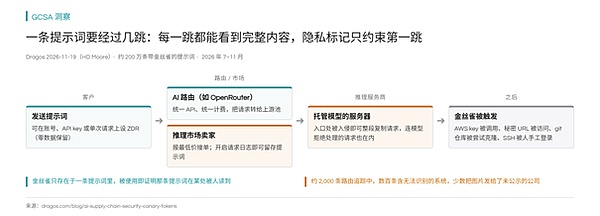
Figure 1: The path of a clue word: Routing, Marketplace Seller, Inference Service Provider. Each hop allows you to see the complete content; the canary being triggered proves that you have read it at a certain hop.
III. How researchers proved the cue words were stolen: Canary
A canary is a secret that exists only in one place; once someone uses it, that place has been compromised. Dragos initially used Thinkst Canarytokens, but later built its own service: generating a unique seed for each hint word, deriving a unique hostname, URL, and credentials, and actually running the services these credentials point to (DNS, Web, Git, SSH, database, email, etc.); the AWS key is the real key, bound to an empty account with full logging enabled. Any access can be traced back to which hint word, which model, which route, and which privacy setting was used.
To pinpoint which hop in the chain the leak occurred at, researchers created an "AI-inference version of traceroute": They included an image URL pointing to their own server in the request, exposing the IP address, HTTP client, and time of each system scraping the image; then, they sent slightly flawed requests, leveraging the routing conventions of each layer to encapsulate the next hop's error within their own format, extracting three or four layers of "envelopes" from a single error response, and comparing them against a signature database to identify the software and operator at each hop. Of the approximately 2,000 traced routes, hundreds contained unidentifiable systems, a few sent images to companies not on the publicly disclosed path, and one marketplace seller secretly added approximately 1,000 hidden tokens to each prompt.
IV. Three types of problems, three types of leakage methods
1. Service provider compromised: Attackers copied entire requests at the entry point.
The most serious intrusions involved approximately two hundred decoy AWS keys: each key was sent with only one request to a single service provider, all within a few short time windows in late October, and every request sent within these windows was stolen. Some of the stolen keys came from requests that the service provider had already rejected before the model ran—indicating that the attackers were copying traffic at the service provider's entry point, not deep within the inference stack, so whether the model processed the request or whether it was marked with ZDR was irrelevant. In two other intrusions, some of the stolen requests were also marked with ZDR.
After obtaining the keys, the attackers' actions were highly programmed: first, they verified each key individually, with some keys being invoked within hours of being sent; then they searched for data, listing S3 buckets and searching Secrets Manager and Parameter Store; finally, they attempted to scale and persist the data, including enabling the Bedrock hosting model, creating Bedrock API keys, and adding their own IAM users. The decoy keys were used in tens of thousands of AWS API calls. One attacker appeared to have compromised two service providers simultaneously: secrets sent to both were almost simultaneously used from the same rented server. Over three weeks, their tools changed from a script disguised as Windows Chrome to Boto3 on OrbStack, and then to the AWS CLI on Kali Linux; starting November 1st, they also added AREX, whose User-Agent artex-agent and artex-judge-r121 are not listed in any public metrics; Dragos recommended adding them to their detection.
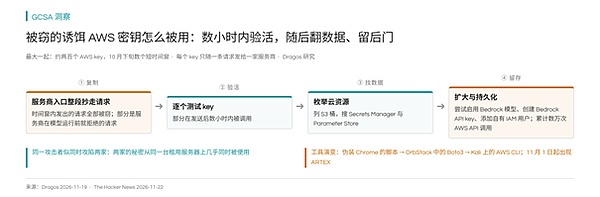
Figure 2: The process of using the stolen AWS decoy key: entry point copying, verification within hours, enumeration of S3 and keystore, and attempts at Bedrock and IAM persistence.
2. Marketplace sellers: No vulnerabilities are needed, just enable logging.
The second type of leak doesn't require intrusion. Sellers on inference marketplaces simply list a model at the lowest price, enable request logs, and wait. Researchers sent two hints from the same seller's offer. About a day and a half later, a desktop browser on a home broadband connection opened two secret URLs and began guessing usernames on the login page. Hints from other sellers for the same model were never touched, indicating that the leak followed the seller. In another example, a Mac user on a French home broadband connection extracted the password from two hints, manually attempted to log in to SSH as root, and then tested multiple decoy AWS keys in the same session—one of which wasn't sent through the marketplace but through another route that unknowingly redirected some traffic to the marketplace.
3. Privacy settings are ignored: ZDR requests are captured, redirected, and opened in chat groups.
The third type involves no one using credentials, but rather secret URLs being repeatedly crawled. A system from a Chinese AI lab crawled secret URLs from over half of the suggestions researchers sent to its model between July and October, including about two-thirds of requests marked "Do Not Collect Data" or ZDR. The crawls typically occurred two to three days after the requests. Requests reselling the lab's model through a US hosting provider also triggered the same crawler. Subsequently, another cloud-based Git client began attempting to clone private repositories referenced in the suggestions, targeting only those using the lab's model. Large US service providers also had issues: one continued crawling the secret URL for over two months after a researcher made a single inference call to its search endpoint; another's crawler returned to crawl the URL several days after each request, regardless of the route the request took. The most unusual case was a message marked with ZDR sent to a US service provider. Twenty-four days later, its secret link was posted to a Lark group of a Chinese service provider and opened within two minutes on three computers and three mobile phones in Beijing and Shanghai. When the researchers disclosed the message to the service provider, they only gave the first eight characters of the link. The person who posted the link was reading the archive of the complete message.
V. Publicly Announced Service Provider Notices
OpenRouter's announcement listed the service provider reports it had received. Phala stated that the attackers chained together an outdated external service and several management interfaces that trusted callers solely based on "originating from the loopback address" without independent authentication. They first created an unauthorized confidential virtual machine and obtained application credentials, then similarly took over an inference virtual machine on a new GPU server already carrying production traffic, even though it hadn't fully hardened for production. Processing request data was thus visible. Requests sent to its DeepSeek V4 Flash 0731 between 09:00 on October 21 and 14:35 on November 8 should be considered compromised, and the keys, tokens, and passwords within them were rotated. Phala said that of the canaries placed by researchers since July 1, only those sent on October 21 and 22 were abused.
Together AI claims that its cue word samples (primarily from requests to MiniMax M3, GLM-5.2, and Kimi K2.6 on June 24, July 4, 8, and 14) collected for routine software testing and stored in a private Hugging Face repository were downloaded without authorization. The reason given was that an AI coding agent submitted credentials for accessing the private repository when developing the public xorl repository. After downloading the samples, the agent searched for other service credentials and tested them one by one. Five of the tested credentials were Dragos canaries. Novita confirmed that a routing configuration issue caused some MiniMax requests to be forwarded to the official MiniMax API, exceeding the expectations of these customers.
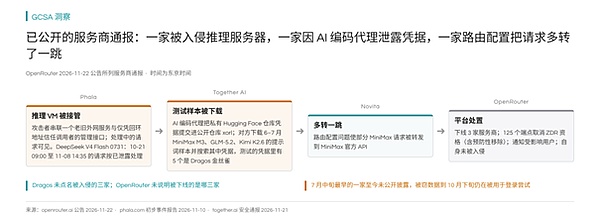
Figure 3: Publicly Announced Service Provider Notices and OpenRouter's Handling of the Issue
Dragos stated that the second wave of intrusions in late October was confirmed and the relevant service providers were notified immediately, with one of them issuing a preliminary security alert. Regarding data sharing issues not involving credential abuse, notifications have been issued gradually since early November, and they are currently working with over a dozen service providers. The stolen keys and secret URLs are still being accessed months after the incident.
VI. Why "zero data retention" can't stop it?
ZDR is a data processing commitment, not a security control. It can constrain a compliant service provider not to write data to disk or use it for training, but it has no binding force on attackers who have already entered the service provider's interface. As HD Moore said, "Privacy tags are useless when the attacker is already inside." It also cannot constrain undisclosed next hops. For users, what truly determines the exposure surface is which systems the prompt actually passes through, which is precisely the least transparent part of the routing model; the AI agent will then put everything it can read—including credentials—into the prompt as is.
VII. What should the user do now?
Users who used OpenRouter to access the DeepSeek V4 Flash 0731 deployed by Phala between October 21st and November 8th should, as required by Phala, rotate all keys, tokens, and passwords appearing in the requests and check for any unusual activity in the relevant accounts during this period. Users who received notifications from OpenRouter or their service providers should follow the timeframe specified in the notification. For long-term practices, Dragos recommends: self-hosting the most sensitive tasks; secondly, directly using first-party model vendors, dealing with only one contract and privacy policy; specifying upstream service providers when using routing, not accepting default pools, and verifying that privacy settings have indeed changed the request destination, staying away from the inference resale market; including your own canary credentials in the context already sent by the proxy and pipeline, and handling them as events once used; enabling key filtering provided by the service provider, but not treating it as the sole line of defense.
VIII. Main Sources
• Dragos (HD Moore): Three breaches, endless leaks: Your AI supply chain needs canaries:
https://www.dragos.com/blog/ai-supply-chain-security-canary-tokens
• OpenRouter: Data Processing Incidents on Inference Providers:
https://openrouter.ai/blog/announcements/data-processing-incidents-on-inference-providers/
• Phala: November Preliminary Incident Report:
https://phala.com/posts/phala-november-preliminary-incident-report
• Together AI: Security event: Prompt leakage for requests in June and July of 2026:
https://www.together.ai/blog/security-event-prompt-leakage-for-requests-in-june-and-july-of-2026
• Novita: Privacy notice regarding MiniMax requests:
https://novita.ai/blog/minimax-requests-privacy-notice/
• The Hacker News: OpenRouter Drops 3 Providers After Researchers Catch Months of Prompt Theft:
https://thehackernews.com/2026/11/openrouter-drops-3-providers-after.html
Conclusion
The security boundaries of AI services should not stop at the model itself.
With the widespread adoption of model routing, third-party inference, and AI agents, prompts are becoming a new data entry point for carrying source code, business data, identity credentials, and other sensitive information. Once this content enters a supply chain lacking transparency, traditional data protection commitments face new challenges.
This incident demonstrates that zero data retention does not equate to zero risk of leakage, and a platform's privacy statement cannot replace continuous verification of the actual data flow.
For enterprises, identifying upstream service providers, restricting the transmission of sensitive information, reviewing data forwarding paths, and establishing verifiable leakage detection mechanisms are becoming important components of AI security governance.
For the AI service industry, ensuring that data processing commitments are auditable, traceable, and verifiable will directly impact users' long-term trust in the entire AI infrastructure.
GCSA will continue to monitor the security of the AI inference supply chain, risks of third-party services, and the development of related protective technologies.
Copyright and Disclaimer
This article was published by the GCSA Global Cyber Security Alliance. Copyright of original content belongs to GCSA; copyright of third-party content cited or reproduced belongs to the original rights holder. Please indicate the source and retain the original link when reprinting.
This article is for cybersecurity research and informational purposes only and does not constitute investment, legal, or financial advice. The related technical analysis, risk assessments, and attack attributions are based on existing evidence. The scope of GCSA's independent verification is as disclosed in this article, and the conclusions may be updated as new evidence emerges.
Follow GCSA on social media for the latest updates.
GCSA X (Twitter):
GCSA Telegram:
GCSA WeChat Official Account:
https://mp.weixin.qq.com/s/ouyL9NwrDDjhMumvehdOmw
Source:Global Cybersecurity Alliance (GCSA)
Website:www.gcsa.org
Get updates in your inbox
We respect your privacy. See our Privacy Policy