
Introduction
In mid-November 2026, a series of security incidents involving digital assets, personal information, financial services, enterprise infrastructure, and artificial intelligence systems were disclosed in the global cybersecurity field. From the abuse of privilege management mechanisms in DeFi protocols to malicious implantation in hardware wallet distribution channels; from data breaches of medical and financial service providers to high-risk software vulnerabilities that have been exploited, and new attack techniques that use blockchain infrastructure to hide remote control addresses, security risks in different fields are showing complex characteristics of multiple layers and cross-systems.
This issue of GCSA Insights compiles nine recent security incident analyses and threat intelligence reports, organized into four categories: digital asset and Web3 security, data breaches and third-party risks, critical infrastructure and AI security vulnerabilities, and advanced threats and emerging attack techniques. The reports cover incident details, technical mechanisms, potential impacts, threat indicators, and defense recommendations.
These incidents involve different technological environments, attackers, and risk causes, and there is currently insufficient evidence to suggest they belong to the same attack campaign. However, from a security governance perspective, these cases collectively reveal several noteworthy issues: high-privilege operations and code upgrade mechanisms may become key risk points for digital asset systems; third-party service providers and hardware distribution channels are expanding the actual trust boundaries of organizations; legacy software components, AI gateways, and management interfaces exposed to the internet continue to face real attack threats; and attackers are also constantly leveraging legitimate digital infrastructure to enhance the concealment and persistence of malicious activities.
GCSA hopes that this special issue will provide cross-domain threat intelligence references for security researchers, enterprise technology teams, digital asset practitioners, and users, and promote continued attention to new attack methods and systemic security risks.
The following nine reports were prepared based on publicly available information, technical research, and relevant evidence listed in their respective publications. The factual scope, technical conclusions, and risk assessments of each report are based on their original content and the information cited.
Part 1: Digital Assets and Web3 Security
01. Reental RNT Lend stablecoin suffered a loss of approximately $955,000.
Reental RNT Lend stablecoin was siphoned off approximately $955,000: the administrator key was granted to an unverified forwarder, and aToken was replaced with a 75-byte implementation that anyone could drain.
Daily Security Insights (Event Analysis) | November 20, 2026 |All times in this article are Tokyo time (UTC+9)
On the evening of November 18, 2026, RNT Lend, a lending protocol running on Polygon by the Spanish real estate tokenization platform Reental, had approximately $954,700 worth of stablecoins withdrawn within about an hour. On-chain records show that a key holding the ReentalAaveAdmin administrator privileges first granted the POOL_ADMIN role in the Aave V3 system to a 59-byte forwarding contract that performed no verification on the caller. This forwarder then called PoolConfigurator.updateAToken, replacing the implementation of the two aToken proxies for USDT0 and USDC with a 75-byte drain contract. Subsequently, two MEV bot transactions used drain() to withdraw approximately $454,800 of cash from the two USD markets; the same key also withdrew approximately $499,900 of USDT0 from 1,149 user wallets and 4 Safe tokens, leaving Polygon via a cross-chain bridge. After approximately $49.34 million in property tokens were transferred out using the same key, Reental managed to recover them all within about two hours using a token management contract.
The protocol runs on Aave V3 code. Lenders deposit stablecoins into two USD markets, and borrowers lend using real estate tokens as collateral; the underlying tokens for each market are stored in the corresponding aToken proxy contract. Whoever can upgrade the aToken implementation controls these tokens. Reental did not release a post-event report publicly; the following technical reconstruction is based on Sourcify's verified source code, Polygon transactions, and Bitquery's on-chain tracking.
I. Event Timeline
Table1:Timeline ofRNT LendDrain Events
Time (Tokyo timeUTC+9) | event | Source/Evidence |
Around 20:39 on November 18th | Administrator key 0x30729b69…2691 Deploys a no-verification repeater 0xb67ed59e…3d45 (59 bytes of runtime bytecode) | Polygon eth_getCode / Create Transaction |
11-18 20:40:31 | The same key calls ReentalAaveAdmin.executeStewardPayload, granting POOL_ADMIN to 0xb67ed59e; ACL RoleGranted log confirmation. | tx 0x4f19ab2e…5059 |
11-18 20:41:38 / 43 | After the repeater calls PoolConfigurator.updateAToken, both USDT0 aToken (0xfaF2338E…2121) and USDC aToken (0xd3cb693d…d880) are replaced with 0xcc555fac…ac09; the ATokenUpgraded event is confirmed. | tx 0xa97dcfe2…7e93 / 0xdd760fef…e84d |
11-18 20:41:58 | MEV bot 0xb0fe6e9c…1101 invoked drain on USDT0 aToken, transferring out 294,040.36 USDT0. | tx 0xb977d09c…642f |
11-18 20:42:02 | Another bot called `drain` on USDC aToken, transferring out 160,785.05 USDC; the call to the key itself within the same block failed. | tx 0x60674299…fa79; Bitquery |
11-18 20:51–21:37 | According to Bitquery: The key was replaced with an implementation that only the user could call, allowing the withdrawal of $499,877 USDT from 1,149 user wallets and 4 Safe wallets, which then exited via Relay and Bridgers. | Bitquery 2026-11-19 |
Approximately 20 minutes from 21:22 on November 18th. | The key was upgraded across 89 real estate markets, resulting in the withdrawal of approximately $20.98 million in collateral tokens (at in-pool prices), and an additional $28.36 million was transferred from Reental Safe; totaling approximately $49.34 million in real estate tokens. | Bitquery |
11-18 night | Reental used a token management contract to recover all property tokens in two transactions; the balance of property tokens held by the key was reduced to zero. | Bitquery |
11-18 23:03 | The three other owners of PoolSafe removed the key from the owners. | Bitquery |
11-19 01:55 | PoolSafe has suspended all 108 markets and revoked the granted management privileges. | Bitquery |
11-19 08:05 | Replaced 91 market implementation codes that were modified on the same day; as of 21:47 on November 19th, the pool remains suspended. | Bitquery |
II. How administrator privileges are transferred
RNT Lend's pool configuration is handled by an Aave-style PoolConfigurator, where updateAToken is modified by onlyPoolAdmin: only addresses holding POOL_ADMIN_ROLE in ACLManager can upgrade the aToken implementation. Reental incorporates this set of permissions into its self-developed contract ReentalAaveAdmin (proxying 0x712ad417…3226, implementing 0x8820a4d0…083e, Sourcify exact match).
The intended purpose of the `executeStewardPayload` function in this contract is to temporarily grant `POOL_ADMIN` to the "Steward listing new assets," execute the transaction, and then proceed with subsequent whitelisting and other follow-up actions. In the source code, it first performs an `onlyAdmin` check on the caller, thenperforms no contract validationon the passed`steward_`address, directly calls `grantRole(POOL_ADMIN_ROLE, steward_)`, and then calls `steward_.execute()`.After execution, it doesn't`revokeRole`. Once the administrator key has signed this transaction, any address can obtain the role that allows modifying the `aToken` and hold it until someone else reclaims it.
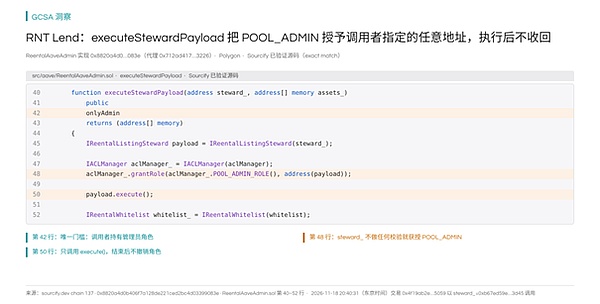
Figure 1: ReentalAaveAdmin.executeStewardPayload: Only checks the caller, does not check or reclaim stewward_'s POOL_ADMIN
At 20:40:31 that evening, the key was set to `steward_` to the newly deployed address `0xb67ed59e`. This address has only 59 bytes of runtime bytecode: if the call data is less than 20 bytes, it stops and returns success (therefore, a 4-byte call like `execute()` will "succeed" but do nothing); otherwise, the first 20 bytes are used as the target address, and the remaining calldata is called as is,without anycallerverification. After obtaining `POOL_ADMIN`, anyone can use it to call the management functions of `PoolConfigurator`.
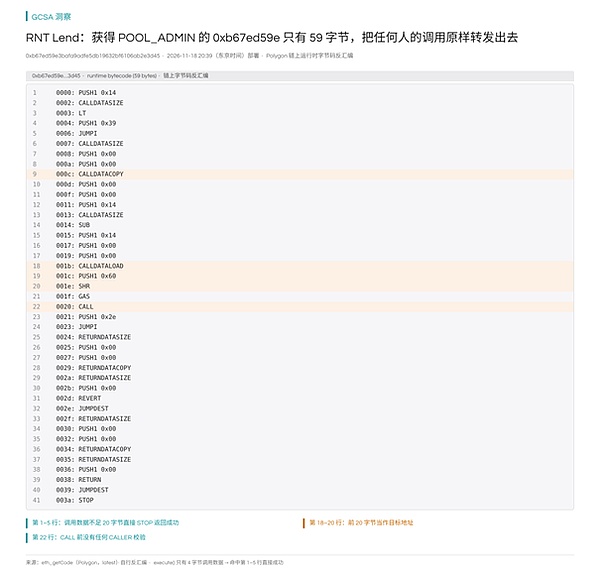
Figure 2: 0xb67ed59e: 59-byte unchecked forwarder granted POOL_ADMIN, on-chain bytecode disassembly
III. What was aToken replaced with?
At 20:41:38 and 20:41:43, the two `updateAToken` calls sent by the relay replaced the implementations of USDT0 and USDC aToken with 0xcc555fac…ac09. This implementation is only 75 bytes long: it only recognizes the selector 0xabf59fc9 (shown in the signature library as `drain(address,address,uint256)`); all other selectors (including `initialize`, which is normally required by `Aave` for `aToken`) will successfully stop, so the initialization call in `upgradeToAndCall` will not fail. `drain` concatenates the token address, receiving address, and amount in `calldata` into `transfer(to, amount)`, and sends it with `aToken` itself as `msg.sender`—the `aToken` proxy executes this code with `delegatecall`, transferring out its own stablecoins.
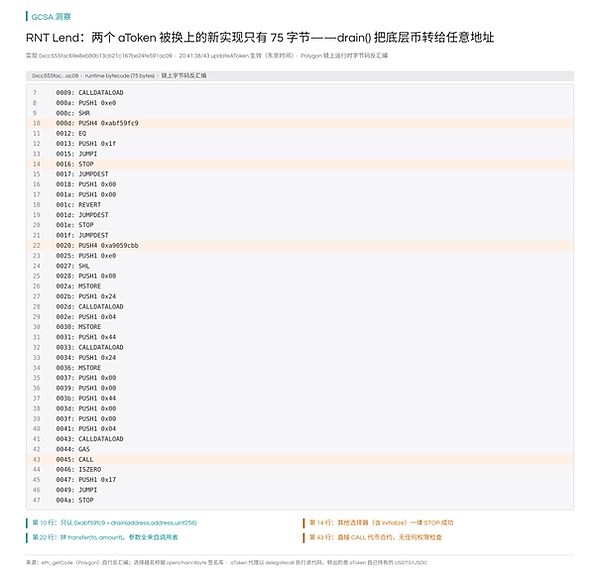
Figure 3: The replaced 75-byte implementation: only provides a drain without permission checks, on-chain bytecode disassembly.
Twenty seconds later, the cash in two USD markets was emptied: address 0xb0fe6e9c…1101 withdrew 294,040.36 USDT0, and another address withdrew 160,785.05 USDC, totaling approximately $454,800. The drain call for the same key in the same block failed because the balance was empty; according to Bitquery, the tip for the USDT0 bot payment was approximately 240,000 times the tip of the key.
IV. Losses and Handling
According to Bitquery's on-chain review on November 19, 2026, a totalof $954,703flowed out of stablecoins: $454,825 in MEV bots, and $499,877 withdrawn by key holders from user wallets and Safe, which then flowed out of Polygon via Relay and Bridgers. Before the withdrawal, lenders in the two USD markets had approximately $10.01 million in deposits, of which approximately $9.57 million had already been lent out; the withdrawn funds were the remaining cash. Approximately $49.34 million (based on the pool price) in real estate tokens was transferred out using the same key and subsequently recovered by Reental. Blockaid's alerts on that day only counted two transactions of approximately $454,000 in aToken, excluding the latter half of the outflow.
The blockchain only shows "Reental signed these transactions using an administrator key that has been used since 2023," making it impossible to distinguish whether the key was stolen or used internally. Other Reental Safe owners established a new Safe that evening, reclaimed the property tokens, and removed the key from the pool's Safe owners at 23:03; the following day, all markets were suspended and the modified code replaced. As of 21:47 on November 19th, according to Bitquery's review, the pool remained suspended, and deposits, repayments, and withdrawals were all unavailable. Reental's official X account did not release any explanation regarding this data drain before or after the incident.
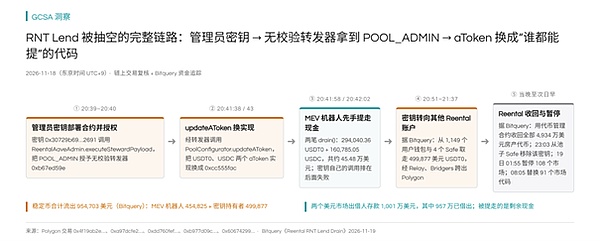
Figure 4: From granting POOL_ADMIN to MEV withdrawal, key renewal, and Reental recovery: the complete attack and handling chain.
V. Recommendations
RNT Lend / Reentalusers:Do not deposit new funds into RNT Lend until the official confirmation of recovery and explanation of the lender repayment arrangements are provided; existing positions should be confirmed through official channels. The real estate tokens have been withdrawn, but the US dollar market has been emptied of cash. How much lenders can ultimately recover depends on borrower repayments and the project team's arrangements.
Similar toAaveforks andRWAlending operators:the Steward process for temporarily granting POOL_ADMIN must verify the target contract (code hash/whitelist), immediately revoke the role after execution, and avoid attaching the permission to upgrade aToken to a single-signature hot key; critical management actions should be multi-signatured and time-locked. For publicly disclosed "administrator upgrade" transactions, MEV observers will respond within seconds, leaving an implementation where "anyone can withdraw" is equivalent to open bidding.
Reference source
• Blockaid: RNT Lend is being exploited - Alert (2026-11-18 21:39 Tokyo Time):https://x.com/blockaid_/status/2123033403553689899
• Bitquery: Reental RNT Lend Drain — $955K Gone, MEV Bots Took Half (2026-11-19):https://bitquery.io/investigations/reental-rnt-lend-drain
• 0xCERT-2026-0379: Reental RNT Lend aToken Upgrade Drain (2026-11-18):https://www.0xcert.com/advisory/0xCERT-2026-0379
• Sourcify: ReentalAaveAdmin implements 0x8820a4d0…083e (Polygon):https://repo.sourcify.dev/137/0x8820a4d0b406f7a128de221ced2bc4d03399083e
• Sourcify: PoolConfigurator implementation 0xaa9c22b7…4c71 (including updateAToken):https://repo.sourcify.dev/137/0xaa9c22b7aee7f8434d7e614c1f863bb2e4394c71
• Polygon Transaction: RoleGranted / executeStewardPayload:https://polygonscan.com/tx/0x4f19ab2ecc1ff24ff8887c56c936855973829503b0834f8f7398d87a39775059
• Polygon Trading: USDT0 aToken upgraded to 0xcc555fac:https://polygonscan.com/tx/0xa97dcfe2728c0d20a5833f46d0c6fe58a0cb317fb31fb1b33ce39ea97d727e93
• Polygon transaction: USDT0 drain 294,040.36:https://polygonscan.com/tx/0xb977d09c1cb4f74c6b33ed0c0a4f5b9536b0c48f86adda65ca072694b2e0642f
02. Ledger's official retail hardware wallets have been compromised by a data theft device.
Ledger's official retailer hardware wallets were compromised by a data breach, resulting in the wallets of buyers in Dubai and Berlin being emptied.
Daily Security Insights (Threat Intelligence) | November 20, 2026 | All times in this article are Tokyo time (UTC+9)
At 03:09 (Tokyo time) on November 19, 2026, Ledger released an update on its investigation on X: the hardware implantation incident, previously described as a "localized issue in Southeast Asia," has been confirmed to have involved modified devices in Berlin, and investigations into two reports filed in Dubai are underway; a Ledger Nano Gen5 has also been found among the affected models in Southeast Asia. On the same day, on-chain analytics firm Bitquery released a tracking report: on November 14th and 16th (UTC), 16 wallets were emptied by the same script, totaling approximately $1.68 million; of these, approximately $922,000 came from three buyers who publicly filed reports in Dubai and Berlin, and approximately $759,000 came from wallets that had not yet publicly filed reports. Key evidence is that the TRON control address involved in the CryptoBilis case in October paid the TRX transaction fees for the emptied wallets at the same second the theft occurred on November 14th. Even if you have never used a Southeast Asian reseller, if your device was purchased from a third party, it must now be treated as "potentially modified."
I. Event Summary
Table1:Key Milestonesof the LedgerHardware Implantation Event
Time (Tokyo timeUTC+9) | event | Source/Evidence |
Around 10-10 | Ledger confirmed that a device sold by Southeast Asian distributor CryptoBilis contained unauthorized hardware; at the time, all confirmed theft cases were linked to this distributor. | Ledger Support / Ledger X |
10-13 15:39 | Donjon: The implanted board reads screen data; when initializing the display of 24 words, the microcontroller decodes the words and transmits them via LTE through the pre-installed eSIM; it does not modify Secure Element, Ledger OS, or transactions and signatures. | Ledger X Long Article (Updated by Donjon) |
10-14 07:03 | Ledger has instructed its distributors and retailers in Indonesia, Singapore, Thailand, the Philippines, Vietnam, Malaysia, and Hong Kong to suspend sales and remove the product from shelves. | Ledger X 10-13 Update |
10-15 | Ledger published an article titled "Response to the Hardware Implant Attack": Attackers purchased genuine products, added custom components, and then re-entered the distribution channels; the security chip, operating system, and server remained uncompromised. | ledger.com/blog |
11-15 04:43 — 05:15 | Buyers in Dubai and Berlin had their TRON/BTC/SOL wallets emptied in batches within the same second or block; approximately 1,300 SOL, 507,672 USDT, 4.72 BTC + 11,000 USDT were transferred out. | Bitquery, November 18, 2026; Public user transactions. |
From 15:27 on November 16th | The attackers then emptied two wallets; BTC was exchanged for 222.2 ETH via Chainflip; and 922 ETH was deposited into Tornado Cash in 40 separate transactions from three addresses. | Bitquery |
11-19 03:09 | Ledger: Berlin has confirmed modified machines; Dubai is investigating two police reports; Southeast Asia has confirmed one Nano Gen5 was affected; same method used; machines are being sent back to the Vierzon factory in France for X-ray inspection. | support.ledger.com (Last updated 11/19/2026) |
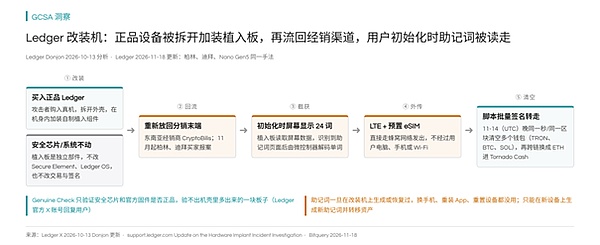
Figure 1: The complete path of the modified device from "adding an implant board" to "transmitting the mnemonic phrase via LTE and emptying the wallet with a script".
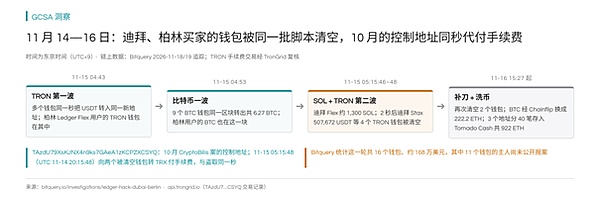
Figure 2: The clearing schedule from November 14th to 16th, and the on-chain correlation between the control address and the instant payment fee in October.
II. Why are there risks?
This isn't a chip vulnerability, nor is it a breach of the official website. The attackers bought genuine products, installed additional circuitry, and sold devices that appeared brand new. The 24 words you copied onto the screen were simultaneously read by the board inside the casing.
The mnemonic phrase displayed on the screen is the attack window.
Hardware wallets require the mnemonic phrase to be displayed on a dedicated screen during initialization, allowing you to manually copy and back it up. Donjon concludes that the implanted board "only listens, doesn't modify"—it copies the screen content, decodes the words after recognizing the mnemonic phrase page, and the words you type on the device when restoring an existing wallet, as well as the passphrase, can also be intercepted. The private key never leaves the security chip, but once the mnemonic phrase appears on the screen, it becomes equivalent to the private key.
The message is transmitted without going through your computer or Wi-Fi.
Ledger explicitly states: the implanted board uses a pre-installed eSIM to transmit over LTE. Your computer's antivirus, home firewall, and disabling Wi-Fi won't stop this board from dialing itself. Trezor's teardown of three CryptoBilis Safe 5 units yielded the same conclusion: the additional circuit board is sandwiched between the motherboard and the screen, encrypted and transmitted over the mobile network; the firmware and Secure Element have not been modified.
Genuine Check cannot detect this board.
In a response to users, Ledger's official account stated that Genuine Check detects and blocks devices "without a genuine security chip or official firmware," which falls under a different category of threat. An implanted board without modifying the chip or firmware can easily pass the genuine product detection.
The same group of people are still active.
Bitquery points out that the TRON address TAzdU79XsKJNX4n9ks7GAeA1zKCPZXCSYQ was the control address in the October CryptoBilis case; at 20:15:48 (UTC) on November 14th, it transferred TRX to two wallets that were about to be emptied, the same second the theft occurred. We pulled recent transactions from this address using TronGrid and can see multiple small TRX transfers out at the same timestamp, consistent with the report's description.
III. What consequences might this cause?
What has already happened:Starting in October, modified devices distributed through Southeast Asian channels led to the theft of user assets; Bitquery estimated the loss at approximately $102 million across 335 wallets (Ledger has never officially confirmed any total loss). Another round of emptying occurred from November 14th to 16th: Bitquery estimated approximately $1.68 million lost from 16 wallets; publicly reported losses included approximately 1,300 SOL and 507,672 USDT from a buyer at the Dubai Virgin Megastore, and approximately $320,000 (4.72 BTC + 11,000 USDT) from a buyer in Berlin. Ledger has confirmed the Berlin modified device and is investigating the two reports from Dubai; one Nano Gen5 device in Southeast Asia has been confirmed to be affected.
Trezor'sside:As of the November 12th update, 48 CryptoBilis buyers had contacted Trezor; the lab confirmed three Safe 5 units had implanted boards, purchased between August 20th and September 23rd; no financial losses have been reported. Trezor released firmware 2.13.1 on November 11th, preventing these implanted boards from intercepting screen content, but it cannot protect mnemonic phrases intercepted before the update; the global distribution network has been reduced by approximately 80%.
What this means for you:Once a mnemonic phrase has been generated or restored on a modified device, changing phones, reinstalling apps, resetting devices, or even importing the same mnemonic phrase onto a brand new device will not recover it—the attacker can now complete transactions anywhere. Only by generating a new mnemonic phrase on a completely new device that has never been used with the modified device, and then transferring assets there, can the attack be truly stopped.
IV. What you should do now
1.First, check your purchase channel.If you purchased Ledger from any reseller in Southeast Asia, Berlin (from January 2026), or Dubai from a third party, or purchased Trezor Safe 5 from CryptoBilis, follow the steps below.
2.Uninitialized device: Do not power on or set it up.Do not create a wallet or restore an old mnemonic phrase. Contact official customer service. Do not disassemble the device and give it to strangers.
3.For devices already in use: Purchase a new device directly from the official website and generate a completely new mnemonic phrase.Order from ledger.com/trezor.io; create a new wallet and a new passphrase on the new device; transfer all assets from the old device. The old mnemonic phrase and passphrase will be permanently invalidated.
4.Discontinue use of the old equipment and trigger an alarm.Retain the equipment as evidence; Ledger can arrange for it to be sent back to the Vierzon factory in France for X-ray physical testing via an official work order. Do not send the equipment to any "customer service" outside of the work order.
5.Beware of impersonation.Ledger and Trezor will never proactively message or call to request your mnemonic phrase, nor will they ask you to send your device without a formal support ticket. Scams impersonating official sources have already emerged in connection with this incident.
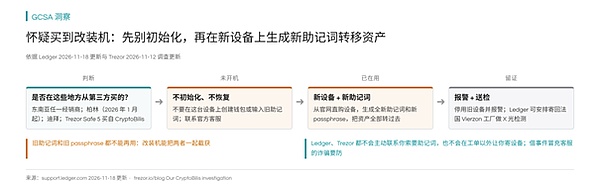
Figure 3: Procedure for handling suspected modified machines: Do not initialize first, then change the mnemonic phrase, and finally send the machine for inspection if an alarm is triggered.
V. IOC
On-chain associated address (Bitquery report; available on TronGrid):
• TRON Control Address: TAzdU79XsKJNX4n9ks7GAeA1zKCPZXCSYQ (Control address in the October case; same-second payment of transaction fees on November 14th)
Affected purchase scenarios (according to official updates):
• Ledger: Southeast Asian distribution channels (including CryptoBilis); Berlin (purchased from third parties from January 2026); Dubai (purchased from third parties); confirmed models include Ledger Nano Gen5 (Southeast Asia).
• Trezor: Safe 5 sold by CryptoBilis (three units confirmed, purchase window 2026-08-20—09-23)
Official verification information (not malicious, for comparison only):
• Authentic product purchase links: ledger[.]com, trezor[.]io
• Ledger investigation update page: support[.]ledger[.]com/article/Update-on-the-Hardware-Implant-Incident-Investigation
Note: The above IOCs only apply to the publicly available samples and the officially confirmed scope.
VI. Supplementary Explanation
Ledger characterized the case as a "localized attack at the end of the distribution chain," not a systemic contamination of the factory production line; it also acknowledged that the number of modified units could continue to increase. Trezor explicitly stated that firmware 2.13.1 disables "the current batch" of implanted boards, but does not protect mnemonic phrases intercepted before the update—this is a common boundary for all similar attacks.
VII. Recommendations for Subsequent Use
Long-term habits: Hardware wallets should be purchased directly from the official website; upon receiving the device, check the packaging seal and appearance, and contact the official website immediately if there are any abnormalities; for large amounts of assets, use devices that have never been initialized through third-party channels; mnemonic phrases should only be handwritten and saved offline, and should never be photographed, added to the memo, or added to the chat window.
Reference source
• Ledger Support: Update on the Hardware Implant Incident Investigation:https://support.ledger.com/article/Update-on-the-Hardware-Implant-Incident-Investigation
• Ledger Blog: Response to the Hardware Implant Attack:https://www.ledger.com/blog-response-hardware-implant-attack
• Ledger X: Donjon's technical notes on the CryptoBilis implant plate (October 13, 2026):https://x.com/Ledger/status/2109896739985453358
• Ledger X: Survey update on 2026-11-18:https://x.com/Ledger/status/2123116502035390510
• Bitquery: Ledger Dubai Hack (16 wallets / ~$1.68M):https://www.bitquery.io/investigations/ledger-hack-dubai-berlin
• Bitquery: Ledger CryptoBilis Hack (335 Wallet / ~$102M):https://bitquery.io/investigations/ledger-cryptobilis-hack
• Trezor: Our CryptoBilis investigation:https://trezor.io/blog/news/our-cryptobilis-investigation-what-we-found-and-what-weve-changed
• The Block: Ledger expands investigation to Germany, UAE:https://www.theblock.co/news/web3/2026-11-18-ledger-new-hardware-incidents-germany-uae-443530
03. GTA VI Release of Deceptive Crypto Scam
GTA VI Launch Bait Crypto Scam: Fake Pre-order Page Hides Crypto-Stealing Program that Impersonates Tokens and Allows Unauthorized Transfer of Buyers' Holdings
Daily Security Insights (Threat Intelligence) | November 20, 2026 | All times in this article are Tokyo time (UTC+9)
On November 19, 2026 at 03:30 (Tokyo time), blockchain security company Blockaid released a special report: In the past few months, attackers used the GTA VI release (official date 2026-11-19) to flood X with "pre-order/Ultimate Edition/airdrop" posts, directing users to fake pages; the "connect wallet" pop-up on the page contained replaceable coin-stealing toolkits. Blockaid statistics show that from July 4th to November 4th, more than 20,000 GTA-named tokens appeared on Solana, of which more than 8,800 were marked as malicious, warning, or spam; during the same period, 451 bait posts and 116 accounts were captured. The report also specifically named the Ethereum token GTA6DOG (RICO): about one minute after a buyer purchased it, the deployer called transferFrom to transfer the entire balance into a black hole address. We pulled the contract from Sourcify and verified the source code, and reviewed the 11 transferFrom transactions of the deployer on Blockscout—the mechanism was not "user authorization," but rather a backdoor hidden in the contract that could bypass authorization checks.
I. Event Summary
Table1:GTA VIDecoy Scams andKey NodesinGTA 6DOG
Time (Tokyo timeUTC+9) | event | Source/Evidence |
07-04 — 11-04 | Over 20,000 GTA-named tokens have appeared on Solana, with over 8,800 marked as malicious/warning/spam by Blockaid; 593 are from Base and 111 from Ethereum. | Blockaid 2026-11-18 |
mid-to-late August | The first wave: Leaked gameplay footage and Cyberleek hype fueled a surge in malicious dApps and counterfeit tokens. | Blockaid |
Early October to early November | Second wave: Pre-orders / Ultimate Edition / Airdrop page continues to increase | Blockaid |
11-03 11:39:23 | Ethereum deployed GTA6DOG (RICO) 0x0Cf2A91a…E35E, minting 1 billion tokens for the deployer 0xDCe8418D…5997. | Sourcify / Blockscout |
11-03 11:45 — 11-06 02:20 | The deployer called `transferFrom` on at least 10 addresses, transferring RICOs to 0x…dEaD; among them, 271,031 RICOs belonging to the Chainabuse whistleblower were removed at 22:08:47 on November 3rd. | Blockscout Transaction Decoding |
11-06 15:55 | The deployer `transferFrom(0x…dEaD → 0x6f29…2469)` retrieves 9,236,467.04 RICO, which equals the sum of the first 10 transactions. | Blockscout |
11-19 03:30 | Blockaid publishes a summary of fake pre-order/airdrop pages, counterfeit tokens, and social funnels. | blockaid.io/blog |
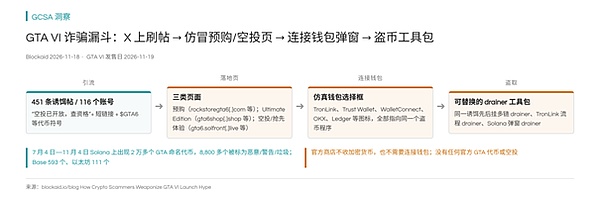
Figure 1: From the X decoy post to the fake page, the wallet connection pop-up, and the funnel with an replaceable drainer.
II. Why are there risks?
The release date provided an excuse to "act immediately".
Blockaid's summary is: scams need a countdown date, a brand trusted by the public, and a reason to act immediately. GTA VI had all three. The funnel is fixed: a social media post claiming "Pre-orders/airdrops are now available with cryptocurrency" → opening a page with Vice City visuals → clicking Pre-Order / Check Eligibility → a pop-up window to connect a wallet. Genuine Rockstar, PlayStation, Xbox, and Steam stores do not accept cryptocurrency or require wallet connections.
The brand icons in the wallet window are all props.
Blockaid cited a near-perfect PlayStation Store clone: the Ultimate Edition, priced at $89.99, prompts users to pre-order and then be presented with options like TronLink, Trust Wallet, WalletConnect, Bybit, OKX, Bitget, TokenPocket, imToken, and Ledger. All these options lead to the same cryptocurrency theft program. This same "Ultimate Edition" decoy was used with different toolkits in late October—from a multi-chain drainer to the TronLink process, and then to the Solana pop-up suite. The decoy is reusable, and the underlying kit is replaceable.
Counterfeit tokens themselves can be backdoors
Most GTA-named tokens are merely bait to attract users: the contract addresses posted in the threads often point to another popular meme, creating the illusion that the price is already rising. However, some tokens are inherently harmful. In the verified source code of GTA6DOG (RICO), the standard ERC20 is modified with a private mapping `isExile` and the decorator `maxWalletLimits`: after the function body finishes running, if `tx.origin` is in the list, `returnTx` is called—using inline assembly `mstore(0,1); return(0,32)` to directly end the entire call. The constructor adds the deployer to the list.
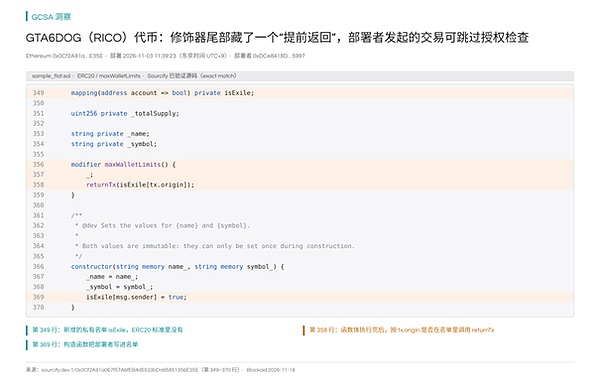
Figure 2: isExile list and maxWalletLimits: Deployers are written into the list that can trigger "early return".
The `transferFrom` statement is written with `_transfer` followed by `_spendAllowance`. `_transfer` has the aforementioned decorators attached. The `transferFrom` initiated by the deployer is immediately terminated by a `return` statement after the transfer is complete. Subsequent authorized deductions will never be executed, and therefore will not be rolled back due to "the buyer never authorized the deployer". The result is that the deployer can transfer tokens from any holding address without needing approval.
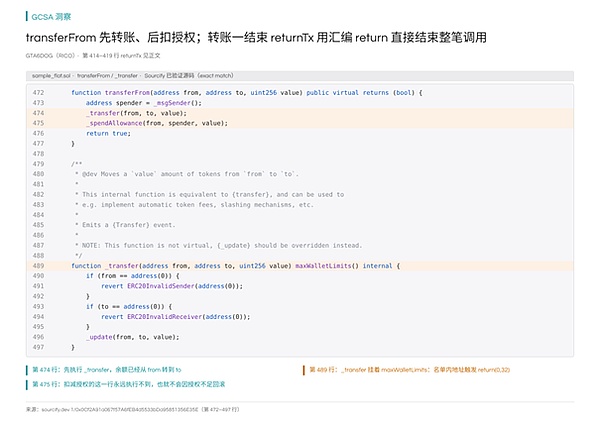
Figure 3: Transfer first, then deduct authorization; callers on the list use assembly return to skip authorization checks.
III. What are the possible consequences?
Fake pre-order/airdrop pages:When users click "Connect Wallet" or "Claim," the signature may be for unlimited authorization or direct transfer. Assets are transferred from the hot wallet; if a hardware wallet confirms a malicious transaction in a pop-up window, coins will also be lost.
GTA6DOGon-chain evidence (verified by us):Approximately 6 minutes after deployment, the deployer continuously called `transferFrom` on the buyer's address, with the receiving address being 0x000…dEaD. The transaction at 22:08:47 (Tokyo time) on November 3rd transferred all 271,031 RICO from the Chainabuse complainant. On November 6th, the deployer transferred another 9,236,467.04 RICO from 0x…dEaD—the same amount as the previous 10 transfers. 0x…dEaD has no private key and has never authorized anyone; the fact that its tokens could be transferred out via `transferFrom` directly proves that the authorization check was bypassed; "hitting the black hole" here doesn't mean destruction, but merely temporary storage.
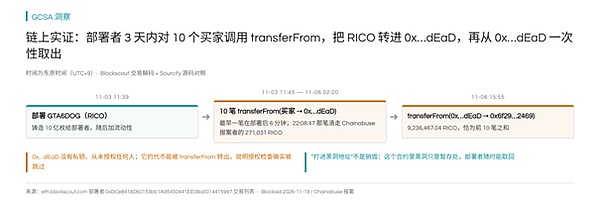
Figure 4: 10 transfers into 0x…dEaD and one full withdrawal: the trace left by the backdoor on the chain.
Blockaid's scan of the same contract concluded that it was marked as a Warning (exit fraud risk) within an hour of going live, and pointed out that most of the supply was controlled by the key controller through a shell wallet.
IV. What you should do now
1.Only buy games from official stores:Rockstar, PlayStation, Xbox, and Steam. Do not pre-order through any "crypto payment gateways".
2.There are no officialGTAtokens or airdrops.Any claims of $GTA6, $GTAVI, CYBERLEEK airdrops, or "check eligibility to receive tokens" are considered scams.
3.Turn off the"Connect your wallet to pre-order/receive airdrop"option. Legitimate retail retailers do not need to see your wallet.
4.Read the simulation results before signing.If your wallet or security plugin warns that the page is malicious, or that "claiming" will actually transfer tokens/grant unlimited authorization, refuse immediately.
5.Keep experimental funds separate from savings funds.Never link large amounts of assets to new sites; do not link hardware wallets to pages from unknown sources.
6.For thosewho have already purchasedGTA-themed altcoins:Assuming the contract may have a backdoor: Do not make additional purchases; exit as soon as trading is still possible; do not mistake "being hit by a black hole" for project team destruction.
V. IOC
Counterfeit domain name (Blockaid report, now de-emphasized):
• Pre-order: rockstoregta6.com, gta6rockstars.com, exclusivegta6.com
• Ultimate Edition: receive-crypto[.]com, gta6shop[.]shop, gta6sell[.]top
• Airdrops/Early Access: gta6sixeventslive, gta6sixeventslive, gta6airdropsite, gta6solfrontlive
Ethereum contract/address:
• GTA6DOG (RICO): 0x0Cf2A91a067f57A6fEB4d5533bDa95851356E35E
• Deployer: 0xDCe8418D60153bb1Ad5450441EE0Ba0014415997
• CYBERLEEK (Blockaid marked as malicious): 0x842a478ef15c8030290deb83da722b6c054153a8
• Grand Theft Auto VI (Blockaid marked as malicious): 0x286e5b713f1d32ec475435ceffd5be02cedf2007
Note: The above IOCs only apply to the Blockaid sample mentioned in this review and the RICO contract we reviewed. Domains and kits will rotate.
VI. Supplementary Explanation
Blockaid's detection doesn't rely on a single domain: site scanning fingerprints use known drain kits, transaction simulations demonstrate real asset flows before signing, and token static and on-chain feature markers identify backdoors and scam contracts. Fixed brands and rotating infrastructure are common practices for these launch-day scams.
VII. Recommendations for Subsequent Use
Treat "big event countdowns" as high-risk periods: the World Cup, game releases, and coin listings on exchanges are all subject to the same funnel. By default, avoid clicking shortened links, connecting to new sites, and signing transactions you don't understand; only keep experimental funds in your wallet that you're willing to lose completely.
Reference source
• Blockaid: How Crypto Scammers Weaponize GTA VI Launch Hype:https://blockaid.io/blog/ah-sht-here-we-go-again-how-crypto-scammers-weaponize-gta-vi-launch-hype
• Sourcify: GTA6DOG (RICO) source code verified:https://sourcify.dev/server/v2/contract/1/0x0Cf2A91a067f57A6fEB4d5533bDa95851356E35E
• Blockscout: Deployer Transaction List:https://eth.blockscout.com/address/0xDCe8418D60153bb1Ad5450441EE0Ba0014415997
• Chainabuse police report (report cited):https://www.chainabuse.com/
Part Two: Data Breach and Third-Party Risks
04. SBC Medical / Shonan Beauty: Personal information of approximately 1.62 million people leaked.
SBC Media's Personal Information Leaked: Approximately 1.62 Million Users' Personal Information; Official Website Database Suffered About 770,000 Attacks from Overseas, Passwords Stored in Plain Text; Tribune's Management Account Logged In on the Same Day.
On November 19, 2026, SBC Medical Group, which operates medical institutions such as Shonan Beauty Clinic, issued its first report stating that some databases held by it on behalf of the medical institutions were attacked by an external third party, resulting in the unauthorized acquisition of customer personal information. On the same day, the external appointment service "Trip" used by the group's medical institutions also confirmed that its management application had been compromised. Nasdaq-listed SBC Medical Group Holdings disclosed the same fact on November 18 (Eastern Time) in a Form 8-K/IR filing.
The website's basic personal information was stolen from approximately 1.624 million people, spanning from 2010 to 2023. Fields included name, contact information, date of birth, consultation ticket number, member ID, answer to an ad, andunencrypted passwords. Additionally, there was layered data on web appointment applications, inquiry forms, surgical procedures, and oral comprehension, involving approximately 20,000 employee accounts. The Tribune website involved 56 clinics, including Shonan Beauty Clinic (55 clinics) and Ritz Beauty Clinic Tokyo, with approximately 12,600 appointment holders and 6,800 patients' information and procedure fees, respectively. The company stated that it has not yet confirmed the unauthorized access to electronic medical records and appointment information from the mySBC website.
I. Event Timeline
Table1:SBC /Tribulation Unauthorized Access Timeline
Time (Tokyo timeUTC+9) | event | Source/Evidence |
11-16 Unknown | ITmedia: Customer information has begun to leak due to improper login. | ITmedia NEWS 2026-11-20 |
Late night period from 11-16 | SBC: Third parties launched approximately 770,000 sustained attacks against self-managed systems from overseas. | SBC First Report: "Reasons" |
11-16 Morning morning | The monitoring system detected the anomaly; the affected server was isolated from the network and access was blocked; logs were preserved. | SBC News 1 / IR |
11-16 Same day | Reported to the Japan Personal Information Protection Committee; Tribulation detected improper login to the management application, invalidated the relevant account and all passwords of the clinic, and blocked the source of the attack. | SBC News Report No. 1; Tribune 11-19 Announcement |
11-18 (Eastern United States) | SBC Medical Group Holdings has released an IR/Form 8-K listing the number of people and fields for each tier. | ir.sbc-holdings.com |
11-19 | SBC's first Japanese news report and Tribune's Japanese announcement officially informed customers that, as of the date of the announcement, no secondary victimization has been confirmed. | SBC / Tribune Official Website |
11-20 08:17 | ITmedia report emphasizes that passwords are "encrypted and saved" | ITmedia NEWS |
II. Where did the two invasions reach respectively?
SBC broke the incident down into two lines. The first is the database within the self-managed website system: attackers obtained the data after launching approximately 770,000 continuous attacks from overseas late at night. The first report did not disclose the specific vulnerability number or login port, only stating that "details of the intrusion method and path will be explained separately after investigation by an external specialized agency." The second is the Trivium clinic management application: the operator stated that a third party attempted to log into the management account of Shonan Beauty and Ritz Beauty Clinic Tokyo Branch from multiple domestic and international connection sources; how the login information fell into the attacker's hands is still under joint investigation by Trivium and SBC.
Two events occurred on the same day, but they affected different entities: one dragged away the official website's customer database accumulated over many years (including plaintext passwords and staff personnel information), while the other dragged away recent appointments and treatment fees on the reservation platform. The official website listed the electronic card, direct treatment records, and mySBC reservation site as "unconfirmed and taken."
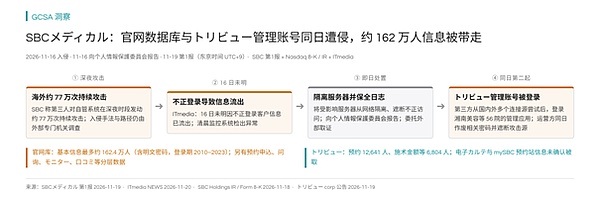
Figure 1: From approximately 770,000 attacks from overseas to server isolation, and the compromise of the Trivium management account on the same day.
III. What was leaked?
According to SBC's Report No. 1 and IR's disclosure, the official website database is mainly stratified as follows (the number of users is based on "maximum/confirmed" criteria, and the combination varies from person to person):
• Basic personal information (no appointment/treatment information): Up to approximately1,624,000people – name, gender, phone number, email,password, address, date of birth, consultation ticket number, member ID, and entry (all or part); period 2010–2023. SBC states that "the passwords registered at the time were not encrypted and stored."
• Ad/Affiliate/Event Page Reservation Applications: 255,416 people (2007–2026).
• Website inquiry forms: 217,769 people (2004–2026); of which 14 people's records contained credit card information, and the company stated that they could no longer make additional payments (such as due to expiration), with the record period being 2010–2018.
• Monitor casting: 4,513 people (including casting content and image file name, excluding the image itself).
• Direct submissions: 15,007 people (2015–2018).
There are also records that are "difficult to identify individually," such as those containing only medical examination ticket numbers or email addresses without names. The first report lists supplementary figures such as approximately 1.03 million people under item 1. On the employee side: there are approximately 20,000 employee accounts (name, ID, password, etc.) from the group and supporting medical institutions; among them, 459 individuals are also involved with bank accounts provided upon joining the company, pension-related information, withholding receipts, and dependent control declarations.
Tribute side (as of its announcement on November 19): 12,641 people made reservations – name, phone number, age, desired procedure, special treatment name, and memo; among them, 3 people who communicated with the clinic also provided the message content, date of birth, and gender; 6,804 people have already received procedures, including the procedure name, date, and amount. The operator confirms that this personal information is not linked to case records/comments (including photos); email, address, credit card, password, and electronic card are not included in this side.
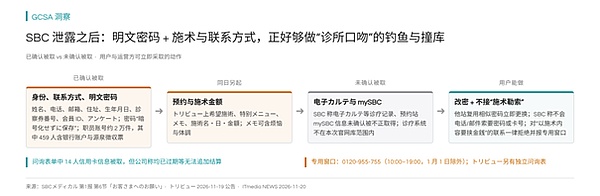
Figure 2: How the identified fields support phishing and credential stuffing attacks, and the actions users can take immediately.
IV. Impact and Company's Handling
SBC has isolated the server and is continuously blocking access, strengthening access restrictions and monitoring. They have decided to commission an external cybersecurity agency to investigate the cause and scope of the impact, and stated they will consult with the police and take a serious approach. Tribune has invalidated the logged-in account and all passwords for the clinic and blocked the source of the attack; the service itself is still being provided. Both companies stated that, as of the time of the announcement, they have not confirmed any secondary victimization or misuse resulting from this incident, and will contact affected customers individually. SBC warned that the leaked information may be used to impersonate the group to send suspicious emails, SMS messages, and phone calls, or to blackmail people for money using the details of the procedures.
Storing passwords in plaintext means that attackers don't get the hash, but rather a password that can be directly used for credential stuffing attacks. Therefore, the report requires customers to immediately change to a new, unique password if they reuse the same or similar passwords on other services; it also states that it may force a reset of the mySBC password if the risk is deemed high.
V. Recommendations
Shonan Beauty/SBCGroup Clients:1. Immediately change any similar passwords you've reused on other websites; 2. Only view notifications through the official app or manually entered on the official website, and do not click on links from unknown sources; 3. The group states that it will never ask for passwords, credit card numbers, or money via phone or email, nor will it request password changes via email links—such requests are considered scams; 4. If you receive a contact that "demands money from you regarding the details of the procedure," refuse and call 0120-955-755 (10:00–19:00, except January 1st) or provide feedback through the official website inquiry form; for Tribeau-related information, please visithttps://tribeau.jp/r/security_incident_2611.
For medical institutions and appointmentSaaSoperators:Historical passwords must be stored using one-way hashing (salting) and user rotation should be promoted; external management applications should be subject to phishing-resistant MFA and real-time blocking of abnormal/frequent logins from different locations; the network and account domains of the "official website marketing database" and the "diagnosis and treatment core system" should be completely isolated to prevent the loss of the marketing database from directly threatening the electronic card.
Reference source
• SBC Holding: The personal information about the murder of Misaki Akaisu was leaked, and the personal information leaked out. (First report) (2026-11-19):https://sbc-holdings.com/ja/news/605
• SBC Medical Group Holdings: Reports Cybersecurity Incidents in Japan (IR/2026-11-18):https://ir.sbc-holdings.com/sbc-medical-group-reports-cybersecurity-incidents-in-japan/
• Totoro Co., Ltd.: Management of the leakage of personal information of the company's private information management company (2026-11-19):https://corp.tribeau.jp/1338/
• ITmedia NEWS: Shonan Beauty Company SBC, personal information leaked by 1.62 million people "Encrypted and saved" (2026-11-20):https://www.itmedia.co.jp/news/article/2611/20/2000003355/
• BleepingComputer: Hackers steal data of 1.6 million SBC Medical Group customers (2026-11-19):https://www.bleepingcomputer.com/news/security/hackers-steal-data-of-16-million-sbc-medical-group-customers/
05. n0n leaked third-party marketing data from Chase, Visa, and Mastercard.
n0n publicly leaked third-party marketing data from Chase, Visa, and Mastercard: approximately 16,000 Reserve customers and over 6,000 Visa premium customer email addresses were exposed.
Daily Security Insights (Event Analysis) | November 20, 2026 | All times in this article are Tokyo time (UTC+9)
On November 19, 2026, after a 48-hour countdown, the ransomware group n0n released customer marketing data related to JPMorgan Chase, Visa, and Mastercard on a dark web leak site. All three organizations confirmed to the media that the affectedentities were third-party service providers, not their core payment or banking systems; payment data such as card numbers were not confirmed to have been leaked in their official statements. Cybernews researchers, after verifying the released samples, stated that approximately 16,000 customer email addresses were associated with Chase Reserve (some containing phone numbers and account IDs, and approximately 124 bank employee email addresses), and over 6,000 customers were associated with Visa's Asia Pacific premium dining/loyalty program.
This is not a case of "card organization clearing networks being breached," but rather a breach of the supply chain for high-end card marketing and loyalty programs. For cardholders, the danger lies in the fact that attackers already possess lists of "who are high-net-worth clients, which restaurants and events they've used, and how to contact them," enough to create targeted phishing attacks disguised as those from banks or card organizations.
I. Event Timeline
Table1:Ransomware and data breaches byn0ntargeting card organizations/bank suppliers
Time (Tokyo timeUTC+9) | event | Source/Evidence |
Starting from September 2026 | n0n has come into the security community's view; SOCRadar discovered its exposed operator workspace in September. | SOCRadar 2026-10-28 |
11-16 | The leaked website n0n lists Visa, Mastercard, and JPMorgan Chase, with a 48-hour countdown; it claims to have access to high-end card marketing interactions and membership directories. | Screenshot from Cybernews; eCrime.ch (quoted from Reuters) |
Around 11-16 | Visa told Cybernews: The incident is related to third-party service providers in the Asia-Pacific region; Visa's own systems were not affected, and there is no indication that payment data (such as card numbers) was affected. | Cybernews |
Around 11-16 | Mastercard: A third party has caused the email addresses of a limited number of cardholders to be exposed for certain benefits programs; the payment network remains unaffected. | Reuters / Company statement to the media |
11-19 | The countdown has ended. n0n is publicly available data; Cybernews verified that Visa's sample size is >6,000 high-end clients, and Chase's sample size is approximately 16,000 client emails, etc. | Cybernews 11-19 |
11-19 | JPMorgan Chase: A third-party vendor suffered a cyberattack, and the attackers may have gained access to some of the vendor's marketing data (possibly including customer names and email addresses); affected customers will be contacted directly and credit monitoring will be provided; this is unrelated to the service outage that week. | Cybernews / AP / Reuters |
II. What was disclosed and what was not disclosed?
A spokesperson forJPMorgan ChasetoldCybernews that the third-party service providers were attacked, and based on the investigation, the attackers accessed some of the marketing data held by these providers, possibly including some customer names and email addresses. Cybernews described the leaked documents as containing approximately 16,000 customer email addresses, some phone numbers and Chase account IDs, and approximately 124 employee email addresses; the file is approximately 502KB, and it is unclear whether it is a sample or the entire dataset. The records are related to the invitation-only Visa Reserve card—a card typically designed for customers who need to manage at least approximately $10 million in assets. When it was listed, n0n also claimed to possess "hundreds of thousands of marketing campaign interactions, tens of thousands of unique cardholder email addresses, a membership directory (including membership categories and zip codes), and marketing email subjects and sending addresses with the bank's brand."
Visa.A spokesperson stated that the incident was related to a third-party service provider in the Asia-Pacific region, and that the Visa system was not involved or affected, with no indication that payment data (such as card numbers) was affected. Fields seen by Cybernews included name, email, phone number, instant messaging application used, and appointment details (date and address); filenames such as campaign_directory.csv, campaign names including Visa LTE, Visa Elite Dining, and Dining Reminder, and geographical locations pointing to South Korea, India, Singapore, Malaysia, the Philippines, Australia, Thailand, and Vietnam. n0n had previously claimed "over 1.5 million cardholder interactions related to the loyalty program," but Cybernews verified over 6,000 customers in the publicly available collection.
AMastercardspokesperson stated that a third party exposed the email addresses (non-payment information) of a small group of cardholders in a specific benefits program. The incident is under control, and payment networks and card usage are unaffected.
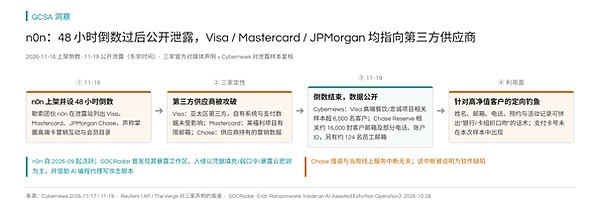
Figure 1: From the 48-hour countdown to the identification of three "third-party suppliers," and then to the public leak on November 19th.
III. Who is n0n, and how are these types of vendor attacks typically countered?
n0n (two lowercase ns with a zero in between) is a data theft and ransomware group tracked since September 2026. Their slogan includes "n0n | no js | no mercy," and their encrypted suffix is .n0n. On September 25–26, the SOCRadar Threat Research Unit discovered that their Python file server located in AS, Sweden, exposed an operator workspace (1,719 files), allowing them to reconstruct the workflow for that month: credential stuffing with FortiGate SSL-VPN, weak RDP/WinRM, exposed AWS keys, and reused managed dashboard sessions were the main entry points—no exploit payloads orCVEreferenceswere found in the workspace; this was followed by browser session and email theft, targeted extra transfers, encrypted or direct deletion of backups, and then a countdown on a data breach website followed by contacting victim customers and the media to exert pressure.
The same workspace shows that the operator used the open-source AI programming agent OpenCode to configure approximately 154 model entries (including models with security alignment removed and self-hosted models) for writing and debugging hundreds of attack scripts, with gateway costs exceeding $7,216. As of mid-October, the site listed dozens to nearly a hundred victims, with total ransom estimates reaching hundreds of millions of dollars; it also recently claimed involvement with Expedia and others. The three organizations' characterization of the site as a "third-party marketing/benefit provider" aligns with n0n's previous practice of "infiltrating suppliers and then using brand customer data to exert pressure"; none of the three organizations namedthe specific supplier or whether they usedentry points likeFortiGate/AWS.
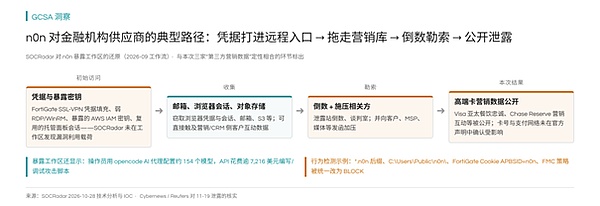
Figure 2: SOCRadar's reconstruction of the n0n credential-based intrusion and ransomware chain, and the links that correspond to this "marketing data breach".
IV. Impact and Handling
All three banks emphasized that the payment card number and payment network were not included in this confirmation; Chase stated that it would contact affected customers directly and provide support, including credit monitoring, when appropriate, and clarified that it was unrelated to the online service outage that week (which was described as a software defect). For customers with Reserve/Infinite status, the value of the leak lies in "identifiable high-net-worth identity + verifiable spending and activity context," facilitating the forgery of bank security center, concierge, or restaurant confirmation calls. The exposure of employee email addresses increases the risk of business email fraud targeting bank counters and customer service, as well as help desk impersonation.
V. Recommendations
Chase Reserve / Visapremium dining and loyalty program customers:1. Be suspicious of calls and text messages with links from people claiming to be from banks, card organizations, or restaurant concierges requesting "verification of reservations/accounts." Always return to the official app or the customer service number on the back of your card; 2. If you receive an official notification from an institution, complete the credit monitoring registration as instructed; 3. For institutions whose employee email addresses are already in the sample, increase the secondary verification for help desk resets and emergency transfer requests.
Marketing/CRM/Concierge providersfor banks and card organizations: Implement remote access control with phishing-resistant MFA; abandon long-term cloud keys in favor of short-term roles; isolate the marketing database from the network environment containing payment data; monitor for abnormal batch exports and remote administrator logins on the provider side. Hunting can be conducted by comparing against the n0n behavioral characteristics published by SOCRadar (such as *.n0n suffix, C:\Users\Public\n0n\, FortiGate requests carrying Cookie APBSID=n0n, FMC policies uniformly changed to BLOCK, etc.).
Reference source
• Cybernews: Hacker leaks Visa cardholders' data after company confirms cyber incident (2026-11-19):https://cybernews.com/security/visa-card-data-breach/
• Cybernews: Hacker leaks details of JPMorgan's ultra-wealthy cardholders (2026-11-19):https://cybernews.com/security/jpmorgan-chase-data-leak-non-ransomware-gang/
• Cybernews: Visa confirms cyberattack as hackers claim JPMorgan was hit too (2026-11-17, updated 11-19):https://cybernews.com/security/visa-jpmorgan-data-breach/
• AP News: A cyberattack leaks thousands of Chase customer emails and some phone numbers (2026-11-19):https://apnews.com/article/chase-data-leak-cyberattack-8470d475450721b66858bdace47091c0
• Reuters vendors: JPMorgan, Visa, Mastercard say third-party targeted in cyberattack (2026-11-19):https://www.streetinsider.com/Reuters/JPMorgan%2C+Visa%2C+Mastercard+say+third-party+vendors+targeted+in+cyberattack/27373799.html
• SOCRadar: n0n Ransomware — Inside an AI-Assisted Extortion Operation (2026-10-28):https://socradar.io/blog/n0n-ransomware-ai-assisted-extortion/
Part 3: Critical Infrastructure and AI Security Vulnerabilities
06. Apache Axis CVE-2026-90436: Unauthenticated remote code execution
The Apache Axis 1.x reflection vulnerability CVE-2026-90436 has been exploited in the wild: Confluence and N-central, which have SOAP interfaces open, face unauthenticated remote code execution.
Threat Intelligence | November 20, 2026 | All times in this article are Tokyo time (UTC+9). For events with only dates, the original date will be used.
On November 20, 2026, the GCSA Security Agent, during its routine inspection of new entries added to the CISA KEV database, confirmed that the insecure reflection vulnerability CVE-2026-90436 in Apache Axis 1.x had been listed in the "Known Exploited Vulnerabilities" directory on November 18 (US time), with federal agencies having only three days (November 21) to fix it. Axis 1.x is a Java SOAP framework that has long been discontinued. Apache only issued an announcement and a patch submission on November 7, and no new version will be released. The vendors that actually exposed it to the public internet are those who packaged it into their products—currently confirmed to be Atlassian Confluence Data Center, which has enabled "Remote API (XML-RPC & SOAP)," and N-able N-central, which has enabled "Legacy API." Rapid7 MDR handled a real-world intrusion on November 13th: an attacker sent an unauthenticated request to Confluence's SOAP endpoint. The server only responded with an HTTP 500 error, and seconds later, Confluence's Java process launched bash and curl. Even if you've never actively deployed Axis, as long as it's hidden in an older product and has an exposed SOAP interface, attackers can still execute commands on the server without logging in.
I. Event Summary
The vulnerability was discovered by José Apari-Pantigozo of OKIOK. Apache Axis maintainer Robert Lazarski submitted a fix to the official repository on July 12th (UTC), and it was publicly disclosed on the mailing list and oss-security on November 6th (UTC). The CVE record is marked "UNSUPPORTED WHEN ASSIGNED," affecting all versions of Axis 1.x (up to 1.4). Subsequently, downstream vendors confirmed the impact one by one, and public PoCs, real attacks, and Metasploit modules appeared successively within a week.
Table1:CVE-2026-90436Timeline
Time (Tokyo timeUTC+9) | event | Source/Evidence |
2026-07-13 01:08 | The Axis maintainers submitted a fix for 41f3b4e8 to axis-axis1-java (original post 2026-07-12 16:08 UTC). | GitHub commit 41f3b4e8d04e |
2026-11-07 00:32 | Apache has published a CVE-2026-90436 announcement on the java-user mailing list with a severity level of critical; new versions of Axis 1.x will no longer be released. | Announcement from lists.apache.org; oss-security 2026/11/06/12 |
2026-11-10 15:00 | Atlassian has released a notice stating that Confluence Data Center versions 1.x–9.x are affected when enabling the Remote API (XML-RPC & SOAP). Version 9.2.28 will fix this issue. | Atlassian Security Announcement (Original post 11-09 22:00 PST) |
2026-11-12 (Original Date) | The public release of a Proof-of-Concept (PoC) exploiting this vulnerability against N-central is one of a series of zero-day disclosures by researchers regarding N-central. | Rapid7 ETR |
2026-11-13 (Original Date) | Rapid7 MDR detected exploitation of Confluence Data Center in a customer environment; on the same day, N-able reported that its N-central Legacy API was being used in the wild and released an IOC. | Rapid7 ETR; N-able security update |
2026-11-16 (Original Date) | N-able released N-central 2026.4 HF3 (2026.4.1.39), disabling the Legacy API that exposes the Axis attack surface. | Rapid7 ETR Update |
2026-11-17 (Original Date) | Metasploit releases an uncertified RCE module for Confluence Data Center with Remote API enabled. | Rapid7 ETR Update |
2026-11-18 (US time) | CISA has listed CVE-2026-90436 in the KEV list with a remediation deadline of November 21, 2026, and requires forensic investigation (forensicTriage: Yes). | CISA KEV Catalog, CISA Announcements |
II. Why are there risks?
In short: When Axis parses an "error receipt," it loads and constructs the class name written in the message as trusted input, and this step occurs before any authentication. The following three mechanisms combined make it an unauthenticated RCE.
Axis loads the class whose name is specified in the message.
The SOAP protocol allows the inclusion of an Axis-specific `<exceptionName>` element within the `<detail>` section of `<Fault>`, intended to allow the client to reconstruct custom exception types thrown by the server. Before the fix, `SOAPFaultDetailsBuilder.setValue()`, upon receiving this string, directly called `ClassUtils.forName(faultClassName)`, which internally ultimately calls `Class.forName(className, true, loader)`—the second parameter `true` indicating "load and initialize". In other words, an attacker only needs to specify the fully qualified name of any class on the application's classpath, and the static initialization code of that class will be executed. After loading, it doesn't check if it's a subclass of `AxisFault` before handing it over to `SOAPFaultBuilder`.
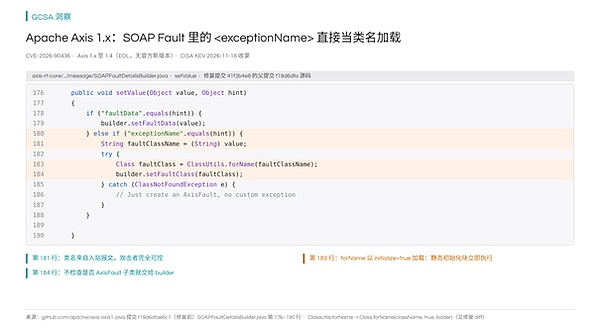
Figure 1: Before the fix, the value of `<exceptionName>` in `SOAPFaultDetailsBuilder.setValue()` was loaded in an "initialized" manner without validation (official repository source code).
Call the constructor first, then perform type checking.
If the `<detail>` element also contains a string type `<data>`, `SOAPFaultBuilder.createFault()` will look for the single-parameter constructor of the target class based on the type of this parameter (String), and pass the string provided by the attacker into `newInstance(new Object[]{ faultData })` before performing a type cast (AxisFault) on the result. For a class that is not an AxisFault, the type cast will definitely fail, but the constructor has already completed; the subsequently thrown exception falls into an empty catch block, and the Axis silently reverts to a normal AxisFault, with nothing visible in the logs. This is the meaning of the announcement's statement that it "instantiates it through its String constructor before checking that it is an AxisFault".
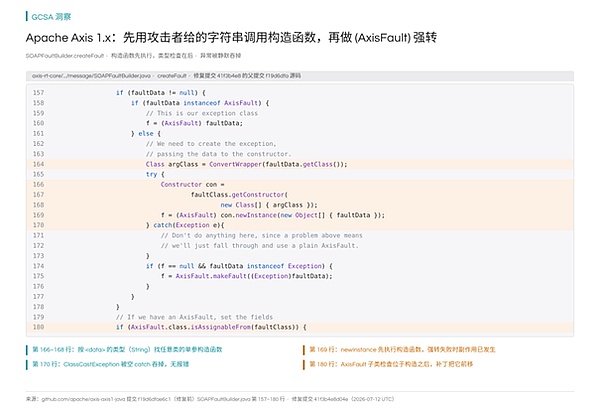
Figure 2: Before the fix, SOAPFaultBuilder.createFault(): The constructor executes first, and the AxisFault type check only appears on line 180 (official repository source code).
The shift from "being able to construct any class with any string" to "executing commands" depends on whether a suitable class exists on the classpath. The fix submission description specifically mentions an example: Spring's `ClassPathXmlApplicationContext`, whose single-parameter constructor accepts an XML configuration address and immediately loads the beans defined within it—the same exploit class used in the 2023 ActiveMQ vulnerability CVE-2023-46604. The Apache announcement states, "With a suitable class on the application's classpath, this leads to remote code execution"; Rapid7's observations of the actual intrusion and the subsequent Metasploit module description confirm that this condition is met on Confluence with the Remote API enabled.
The authentication processor cannot stop it because the message is parsed before it is dispatched.
The Apache announcement specifically states that the fault content is deserialized during the engine's "target service parsing" phase, before each service's own handler chain runs, thus rendering the authentication handlers configured on the service ineffective. The fix commit description also states that this path is reached before authentication because the engine forces the parsing of the request body during service dispatch. For Confluence, the attacker targeted `/plugins/servlet/soap-axis1/confluenceservice-v2`, requiring no account. The server's eventual HTTP 500 does not indicate attack failure: the error occurred after the malicious constructor had already executed.
There will be no new versions of Axis 1.x.
Axis 1.x has long been EOL (End of Service), and Apache has explicitly stated that it does not intend to release a patched version, only offering two options: migrate to other SOAP engines (such as Axis2/Java), or build using a version patched with 41f3b4e8. The patch does three things: `setValue()` now loads class names in a "no initialization" manner and only accepts AxisFault subclasses; `createFault()` checks `AxisFault.class.isAssignableFrom(faultClass)` before calling the constructor via reflection; and `ClassUtils.forName` adds and truly adheres to the `initialize` parameter (the original three-parameter overload ignored this parameter). This means that products with embedded Axis 1.x can only wait for vendors to release their own versions or close the relevant interfaces.
III. What are the possible consequences?
An incident has occurred (Confluenceintrusionobserved byRapid7 MDR):After exploitation, the attacker ran hundreds of hexadecimal-encoded commands and scripts using the Confluence service account. The scripts were taken from temporary Pinggy and Cloudflare Tunnel domains. The output of each command was wrapped with tagged delimiters and included a sequential task ID, which Rapid7 believes indicates the use of AI-assisted automation tools. Just over three minutes after the first execution, the attacker logged into MySQL using Confluence's own database password, querying the page content, application links, and attachments containing names, credentials, tokens, VPN configurations, and private keys. The attacker then scanned the default attachment directory /var/atlassian/application-data/confluence/attachments/v4/, parsing Office documents for credentials and filtering bank card numbers using Luhn validation.
The attacker then used the application credentials stored in Confluence to query the internal Atlassian Crowd API to obtain users and groups, and ran Impacket's GetNPUsers.py on the domain controller to attempt AS-REP Roasting (unsuccessfully). About 4 hours later, they obtained a service account credential and began querying the production cloud data warehouse. About 12 hours later, they logged into Microsoft 365 with an integration service account using traditional authentication from 192.238.253[.]176. This address also appeared in the earlier Pinggy tunnel hostname and exploit request.
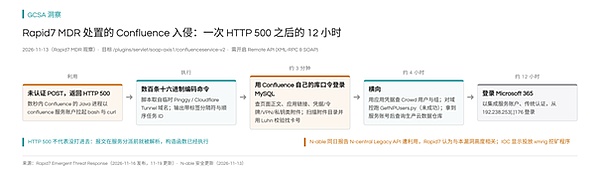
Figure 3: Confluence intrusion chain observed by Rapid7 MDR: from an unauthenticated SOAP request to Microsoft 365 login.
Occurred (N-central):The IOC announced by N-able on November 13th only applies to customers who have not disabled the Legacy API. The inbound URLs include jup.sh, xmrig.tgz, and ob/cronhit?...&persist=<method>, which point to downloading and persisting the mining program. N-able did not include the CVE number in the announcement; Rapid7's assessment is that it is "highly correlated with CVE-2026-90436".
Potential risks:Confluence typically stores a large amount of internal documents, operation and maintenance manuals, and integration credentials. A compromised Confluence instance could mean this content could be read and used as a springboard to access the cloud, identity systems, and office suites. N-central is a platform where MSPs manage a large number of client terminals; its failure could impact downstream customers. Other Java applications that embed Axis 1.x and provide SOAP services are also at risk, although no other vendors have publicly confirmed this yet.
IV. What you should do now
1.First, confirm whether you have any exposed interfaces.For Confluence Data Center: Administrators should go to "General Configuration → Further Configuration" (or `<base_url>/admin/viewspacesconfig.action`) and check if "Remote API (XML-RPC & SOAP)" is selected; then access `<base_url>/plugins/servlet/soap-axis1/confluenceservice-v2`. A return of HTTP Status 403 - Forbidden indicates the interface is closed. For N-central local deployment: Confirm that the Legacy API is closed. For other Java applications: Search for the `axis.jar` / `axis-1.*.jar` or `org.apache.axis` packages in the deployment directory and confirm whether there are any external SOAP endpoints.
2.Immediately upgrade or disable the API.Upgrade Confluence to version 9.2.28 or the current 10.x (this feature has been removed since version 10.0; Atlassian Cloud is unaffected). If you don't have time to upgrade, uncheck the "Remote API" option and save. It will take effect without a restart, but scripts, automations, and third-party plugins that depend on this API may stop working. Upgrade N-central to 2026.4 HF3 (2026.4.1.39). For self-developed or third-party Java applications: migrate to a still-maintained engine such as Axis2, or rebuild with a version containing commit 41f3b4e8.
3.Examinethe logs since November 7th according to the breach criteria.Inthewebaccess logs,look for unauthenticated POST requests to the soap-axis1 path, especially requests returning 500; in the endpoint telemetry, look for bash, sh, curl, and wget child processes spawned from the Java processes of Confluence or N-central; in outbound traffic, look for addresses such as *.trycloudflare.com, *.free.pinggy.net, webhook.site, and the addresses listed in the IOC section below.
4.Treat any suspicious activity as a complete system compromise.Isolate the host before gathering evidence; rotate Confluence database passwords, application links and Crowd integration credentials, cloud and Microsoft 365 service account credentials stored on the server, as well as keys, VPN configurations and private keys that appear in Confluence pages and attachments; check legacy authentication login records for service accounts in Microsoft 365 and consider disabling legacy authentication.
5.Inspect attachments for sensitive data.Attackers specifically scanned the attachment directory for credentials and card numbers. Pages and attachments containing payment card numbers, password lists, or private keys should be assessed and reported according to data breach procedures.
V. IOC
Table2:Threat Indicators Related toCVE-2026-90436(Hazardous Chemicals Removed)
type | index | Source/Explanation |
IP (Confluence) | 192.238.253[.]176 | Rapid7 ETR; also used for Microsoft 365 login. |
IP (Confluence) | 5.133.47[.]243 | Rapid7 ETR |
IP (Confluence) | 163.182.68[.]109 | Rapid7 ETR |
IP (Confluence) | 104.13.106[.]166 | Rapid7 ETR |
Domain name (Confluence) | *.trycloudflare[.]com | Rapid7 ETR, temporary tunnel domain |
Domain name (Confluence) | wpefh-192-238-253-176.free.pinggy[.]net | Rapid7 ETR |
Domain name (Confluence) | webhook[.]site | Rapid7 ETR |
URL (N-central) | hxxp://157.20.241[.]16:8080/jup.sh | N-able Announcement, November 13, 2026 |
URL (N-central) | hxxp://157.20.241[.]16:8080/xvgz | N-able Announcement, November 13, 2026 |
URL (N-central) | hxxp://157.20.241[.]16:8080/xmrig.tgz | N-able Announcement, November 13, 2026 |
URL (N-central) | hxxp://157.20.241[.]16:8080/ob/cronhit?h=jup_start_<rig>&persist=<method> | N-able Announcement, November 13, 2026 |
URL (N-central) | hxxp://157.20.241[.]16:8080/ob/fcheck | N-able Announcement, November 13, 2026 |
Exit (N-central) | 157.20.241[.]16 (ports 8080, 19202–19418); 139.99.69[.]109:10128; 79.76.51[.]56:39100 | N-able Announcement, November 13, 2026 |
Path (Confluence) | /plugins/servlet/soap-axis1/confluenceservice-v2 | Atlassian announcement, Rapid7 ETR, attack target endpoint |
The above IOCs only apply to the incidents reported by Rapid7 and N-able. trycloudflare.com, pinggy.net, and webhook.site are legitimate public services; their presence can only serve as clues and requires further analysis of the process and request context. Conversely, the absence of these addresses in the logs does not necessarily mean that no intrusion has occurred.
VI. Supplementary Explanation
The NVD record for CVE-2026-90436 references Apache announcements, fix commits, OSS-security emails, and CISA KEVs. CISA gives a CVSS score of 9.8, while Atlassian rates it 9.3 (CVSS 4.0). Both Atlassian and N-able emphasize that the relevant interfaces are disabled by default: Confluence's Remote API is disabled by default in new installations starting with version 3.0, and N-central's Legacy API is disabled by default. This means that the vulnerabilities targeted are instances that had these older interfaces manually enabled for integration and automation purposes and have not disabled them since. CISA specifically notes in its KEV entry that this vulnerability may affect other products using this open-source component.
VII. Recommendations for Subsequent Use
The lesson from this incident lies not in Axis itself, but in the fact that "Egg-Ended (EOL) components were packaged into products that are still running": Axis may not be in your asset inventory, but it is in the installation directories of Confluence and N-central. It is recommended to regularly conduct software component inventory for Java applications in production environments, tracking EOL components separately; temporarily opened old APIs for integration should be closed synchronously when the integration is decommissioned; for platforms like Confluence and RMM that centrally store credentials, management and API interfaces should be restricted to the internal network or designated sources, and alerts should be set for shell-forging behavior of their service processes.
Reference source
• Apache Axis Announcement: CVE-2026-90436 (java-user mailing list):https://lists.apache.org/thread/8slf0j9gz35z56t0glt5h0ncwlbn4bdz
• oss-security: CVE-2026-90436:https://www.openwall.com/lists/oss-security/2026/11/06/12
• Apache axis-axis1-java fix commit 41f3b4e8:https://github.com/apache/axis-axis1-java/commit/41f3b4e8d04e310ca81f86b92630ab2c11d608bd
• NVD: CVE-2026-90436:https://nvd.nist.gov/vuln/detail/CVE-2026-90436
• CISA: CISA Adds Four Known Exploited Vulnerabilities to Catalog (2026-11-18):https://www.cisa.gov/news-events/alerts/2026/11/18/cisa-adds-four-known-exploited-vulnerabilities-catalog
• Atlassian: CVE-2026-90436 - Remote Code Execution in Confluence Data Center:https://confluence.atlassian.com/security/cve-2026-90436-remote-code-execution-in-confluence-data-center-1874560038.html
• Rapid7: Rapid7 Detected Exploitation of CVE-2026-90436 against Atlassian Confluence Data Center, N-able N-central also Exploited:https://www.rapid7.com/blog/post/etr-rapid7-detected-exploitation-of-cve-2026-90436-against-atlassian-confluence-data-center-n-able-n-central-also-exploited/
• N-able: New Security Update on N-central (2026-11-13):https://www.n-able.com/blog/new-security-update-on-n-central
07. LiteLLM CVE-2026-40217: AI Gateway Sandbox Escape
LiteLLM gateway sandbox escape CVE-2026-40217 has been listed as a KEV: LLMJacking group targeting AI gateways. Teams that have built their own LiteLLM systems are facing the risk of upstream model keys being stolen and bills being fraudulently charged.
Threat Intelligence | November 20, 2026 | All times in this article are Tokyo time (UTC+9). For events with only dates, the original date will be used.
On November 20, 2026, the GCSA Security Agent, during routine inspections of new entries added to the CISA KEV database, confirmed that CVE-2026-40217 for the open-source LLM gateway LiteLLM had been listed in the "Known Exploited Vulnerabilities" directory on November 18 (US time). This vulnerability lies in the proxy's POST /guardrails/test_custom_code interface: it executes user-submitted Python code in a self-made "sandbox," which only uses regular expressions to check the source code text. X41 D-Sec completely bypassed this by rewriting the bytecode, obtaining uid=0 (root) in the default Docker image. What truly brought it to the KEV's attention was the LLMJacking report from Google Threat Intelligence Team (GTIG) on November 2: a group purchased ordinary virtual keys from the victim company's LiteLLM gateway and elevated them to PROXY_ADMIN administrator credentials on the gateway. Even if your gateway has been upgraded to version 1.83.10 with the sandbox fixed, as long as it is still stuck before version 1.84.0, a leaked ordinary inference key can still be promoted to administrator – and being an administrator is a prerequisite for calling this sandbox interface.
I. Event Summary
LiteLLM is an open-source proxy that unifies over 100 model service providers into an OpenAI-compatible interface. Enterprises often use it to centrally store upstream keys from OpenAI, Anthropic, AWS Bedrock, Google Vertex AI, Azure OpenAI, etc., and then distribute their respective virtual keys to internal users and applications. The vulnerability was discovered by Markus Vervier of X41 D-Sec in February; according to X41's published timeline, the vendor's response was delayed for nearly two months, and it was finally disclosed on April 8th after the longest no-embargo period on the distros mailing list expired.
Table1:Timeline ofCVE-2026-40217and Related Events
Time (Tokyo timeUTC+9) | event | Source/Evidence |
2026-02-13 (Original Date) | X41 identified the issue and completed the Proof of Concept (PoC); LiteLLM confirmed receipt on February 18th. | X41-2026-001 Timeline |
2026-04-08 (Original Date) | The distros embargo expired, X41 was publicly announced, and there was no patch at the time. | X41-2026-001 |
2026-04-10 23:16 | NVD releases CVE-2026-40217: "LiteLLM through 2026-04-08" | NVD (Original text 14:16 UTC) |
2026-04-16 08:50 | PR #25818 Merge: Replace custom sandbox with RestrictedPython | GitHub PR #25818 (Original post 04-15 23:50 UTC) |
2026-04-19 11:36 | litellm 1.83.10 released to PyPI | PyPI Release Log (Original Post 02:36 UTC) |
2026-05-12 01:17 | GitHub announcement: GHSA-wxxx-gvqv-xp7p released: Affected versions >= 1.81.8, < 1.83.10 | GitHub Advisory (Original post 05-11 16:17 UTC) |
2026-05-13 09:58 | PR #27793 Merge: Fixed privilege escalation issue where /key/regenerate could rewrite the key user_id; 15:36 Moved back to the 1.84.0rc2 branch (PR #27819) | GitHub PR #27793 / #27819 |
2026-05-14 14:45 | litellm 1.84.0 released to PyPI, the first official release to include two fixes. | PyPI Release Log (Original Post 05:45 UTC) |
2026-11-02 (Original Date) | GTIG/Mandiant released an LLMjacking report documenting how attackers elevated a regular virtual key to PROXY_ADMIN on a victim's LiteLLM gateway. | Google Cloud Blog |
2026-11-18 (US time) | CISA has listed CVE-2026-40217 in the KEV list, with a remediation deadline of December 2, 2026. | CISA KEV Catalog, CISA Announcements |
II. Why are there risks?
In short: this "sandbox" is never an isolation system, but merely a string of blacklists; and the administrators who can access it cannot protect themselves from another flaw.
The blacklist only examines the source code; it executes using the native `exec` function.
Before the fix, `test_custom_code_guardrail` first calls `validate_custom_code()`, using 34 regular expressions from `code_validator.py` to match the submitted source code string, prohibiting literals such as `import`, `__import__(`, `getattr(`, `setattr(`, `__builtins__`, `__globals__`, `__code__`, `__class__`, and `__mro__`. After passing the check, it copies the primitives provided by LiteLLM (`http_get`, `regex_match`, `allow/block`, etc.) into a dictionary, sets `__builtins__` to an empty dictionary, and then directly executes `exec(compile(...)`. There are two fundamental problems here: First, regular expressions can only see literals written in the source code; they cannot see the names spelled out at runtime. Second, clearing `__builtins__` only restricts the built-in functions that this code can "directly" call, but does not restrict it from "indirectly" accessing the outside world through injected primitives—`http_get` is a regular function defined in the LiteLLM module, and its `__globals__`... It points to a complete, unrestricted module namespace.
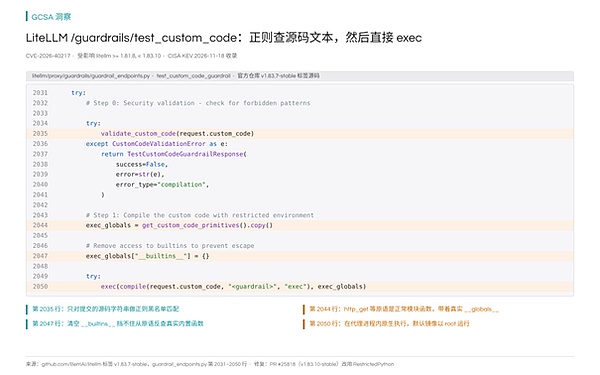
Figure 1: Execution path of /guardrails/test_custom_code before the fix (LiteLLM official repository v1.83.7-stable source code)
Rewrite the bytecode name table so that the blacklist never sees the attribute to be accessed.
The PoC for X41 links these two issues into 6 steps: First, construct the prohibited names __globals__, __code__, __builtins__, and __import__ at runtime using string concatenation; get the object base class using str.mro()[1] to bypass the __class__/__mro__ rules; define a generator function g(fn) that only yields fn.placeholder, then get its code object through the uninterrupted gi_code, and use code.replace(co_names=("__globals__",)) to replace placeholder in the bytecode name table with __globals__; use object.__setattr__ to put the rewritten code object back into g (avoiding setattr). (Rules); calling g(http_get), the bytecode actually reads http_get.__globals__, retrieves the actual __builtins__["__import__"] from it; finally __import__("os").popen("id"). Throughout this process, no blacklisted strings appear in the source code, and the attribute name replacement occurs after compilation, making it impossible for regular expressions to check—this is the meaning of "bytecode rewriting" in the CISA description.
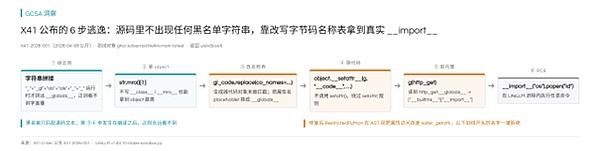
Figure 2: X41's 6-step sandbox escape method and how RestrictedPython is blocked after the fix.
The fix (PR #25818) removed code_validator.py and replaced it with compile_restricted. RestrictedPython rewrites every attribute access at the AST layer as a call to safer_getattr, rejecting all attribute names starting with an underscore. Therefore, regardless of whether gi_code, __setattr__, and __globals__ are hardcoded or constructed at runtime, they will fail. Constructors such as import, exec, and eval are rejected at compile time.
The default image runs as root and contains all upstream keys in its process.
The Proof-of-Concept (PoC) for X41 on the official mirror ghcr.io/berriai/litellm:main-latest returns uid=0 (root). Code execution occurs within the LiteLLM agent process, which itself holds the master key, database connections, and all upstream model service provider keys for configuration.
The administrator threshold was leveled off by another overreach flaw.
This interface requires the caller to have the PROXY_ADMIN role in the code, and the GitHub announcement also states that "proxy-admin credentials are required under default configuration." The problem is that GTIG observed that attackers obtained this role: LiteLLM looks up the role in the user table based on the user_id recorded on the virtual key. While `/key/update` has long prohibited non-administrators from modifying this field, `/key/regenerate` lacks the same check. Therefore, someone holding a regular key can point the user_id to an administrator user when regenerating the key. The original fix notes in PR #27793 state that a non-administrator rebinding their key's user_id to a PROXY_ADMIN user row is equivalent to escalating their privileges; the new test case after the fix changes the user_id to default_user_id and expects a 403 error. This privilege escalation vulnerability did not have a separate CVE or GitHub announcement; the first official release containing a fix was version 1.84.0.
Note the confusion in the numbering: the GTIG report lists "user_id rebinding in /key/regenerate" as CVE-2026-40217, while the description of this CVE in NVD, GitHub announcements, and CISA KEV is a sandbox escape in /guardrails/test_custom_code. These are two independent vulnerabilities, but together they form the complete path from "leaked ordinary inference key" to "gateway root privileges" (analysis infers: GTIG does not specify the version of the victim gateway, nor does it indicate whether the attacker further invoked the sandbox interface).
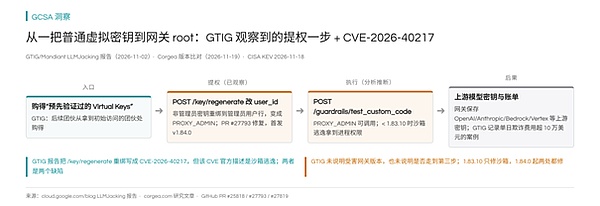
Figure 3: Attack path observed by GTIG after concatenating the privilege escalation step with CVE-2026-40217 (the third step is for analysis and inference).
III. What are the possible consequences?
(GTIGreport):In one investigation, a follow-up group purchased "pre-verified Virtual Keys" from the group that gained initial access. They then exploited this information to enhance ordinary virtual keys into PROXY_ADMIN administrator credentials, establishing persistent control within the environment. The same GTIG report also documented that daily fraudulent charges during LLMjacking intrusions exceeded $100,000, with some organizations accumulating charges of $1 million before access was revoked. Stolen credit limits were resold to underground users through so-called "LLM Mixer" gateways.
Potential scenario:After obtaining PROXY_ADMIN, an attacker can issue themselves new keys with arbitrary limits and models, read or replace upstream service provider configurations, and turn the gateway into a free model relay station. If the gateway version is lower than 1.83.10, they can also execute arbitrary commands in the gateway process through the sandbox interface, directly read all upstream keys, database passwords, and master keys in the process, and use these as a springboard to enter the container, host, or cloud account. Setting the key to "only call the inference interface" will not prevent this path, because /key/regenerate is precisely the interface that ordinary key holders can call.
IV. What you should do now
1.Upgrade toversion1.84.0or higher. Version1.83.10 only fixed sandbox escape; the /key/regenerate privilege escalation issue will be fixed in version 1.84.0. The current latest version of PyPI is 1.110.1. The LiteLLM announcement text states "Fixed in 1.83.11," but the patch version field and the v1.83.10-stable tag already include the fix; when using containers, check by image digest, not just by the tags.
2.If upgrading is temporarily impossible, first block`POST /guardrails/test_custom_code`at the reverse proxy layer.This is a mitigation method provided by both LiteLLM and X41, for example, by denying all access to this path in nginx. At the same time, restrict the management interface to the internal network or a specified source to prevent ordinary API users from obtaining the master key.
3.Check the logs.In the gateway access logs, look for call records for /guardrails/test_custom_code, especially requests from sources not commonly used by administrators; look for records with a user_id field in the /key/regenerate request body; check the virtual key table in the database for records where user_id has been changed to an administrator user (such as default_user_id), as well as recently issued high-value keys.
4.Once a suspicious call is detected, treat it as a gateway breach.Rotate the master key and all virtual keys; rotate the API keys configured in LiteLLM in the backend of each upstream service provider; change the database password; if the gateway is running in the cloud, check the call records of the service account or instance role it uses during the same period.
5.Verify upstream billing and usage.As GTIG recommends, pay attention to extremely small requests such as max_tokens=1 (used by attackers to silently verify the validity of keys), sudden increases in call volume from unfamiliar models or regions, and newly created API keys and service accounts.
6.Do notrunasroot. Run the container as a non-privileged user using `--user` to reduce the impact even if code execution occurs.
V. IOC
Table2:Threat Indicators Related toLiteLLM / LLMJacking(De-hazardous)
type | index | Source/Explanation |
Interface (Vulnerability Entry Point) | POST /guardrails/test_custom_code | GHSA-wxxx-gvqv-xp7p、X41-2026-001 |
Interface (Unauthorized Entry Point) | POST /key/regenerate (request body includes user_id) | GitHub PR #27793; GTIG Report Description |
PoC Features | The `custom_code` contains concatenated fragments such as `gi_code`, `co_names`, `str.mro()`, and `"_"+"_gl"`. | X41-2026-001 PoC Original |
Domain name (LLM Mixer) | jet-night[.]com | GTIG Report Network Metrics Table |
Domain name (LLM Mixer) | newapi[.]pro | GTIG Report Network Metrics Table |
The above metrics refer only to those published in the X41 announcement, LiteLLM fixes, and GTIG reports. The full set of GTIG IOCs is only available to registered GTI users.
VI. Supplementary Explanation
The GTIG report documented that LLMjacking entry points primarily involved leaked cloud identity credentials (IAM credentials, service account keys, GitHub PATs, session tokens). Some groups also directly collected leaked LLM API keys from public GitHub repositories. Attackers also set up LiteLLM gateways on external servers to manage and route stolen traffic. In other words, LiteLLM is both a target and a tool in the hands of attackers in these activities.
VII. Recommendations for Subsequent Use
The AI gateway centrally stores the organization's model keys, and its security level should be on par with the key management system, rather than being treated as a regular internal tool. It is recommended to expose the gateway management interface and inference interface separately, only exposing the inference interface to business applications; to set model range, limit, and expiration time for each virtual key; to include the gateway in normal vulnerability and version management, and to pay attention to upstream security announcements; and to be vigilant about functions that allow the execution of user logic, such as "custom code," "plugins," and "scripts," disabling them whenever possible and placing them in a truly isolated runtime environment when necessary.
Reference source
• GitHub Advisory: GHSA-wxxx-gvqv-xp7p (CVE-2026-40217):https://github.com/advisories/GHSA-wxxx-gvqv-xp7p
• X41 D-Sec: Advisory X41-2026-001 Guardrail Sandbox Escape in LiteLLM:https://www.x41-dsec.de/lab/advisories/x41-2026-001-litellm/
• NVD: CVE-2026-40217:https://nvd.nist.gov/vuln/detail/CVE-2026-40217
• CISA: CISA Adds Four Known Exploited Vulnerabilities to Catalog (2026-11-18):https://www.cisa.gov/news-events/alerts/2026/11/18/cisa-adds-four-known-exploited-vulnerabilities-catalog
• Google Cloud (GTIG/Mandiant): The Rise of LLMJacking:https://cloud.google.com/blog/topics/threat-intelligence/llmjacking-monetizing-compromised-cloud-models
• LiteLLM PR #25818: replace custom_code sandbox with RestrictedPython:https://github.com/BerriAI/litellm/pull/25818
• LiteLLM PR #27793: close /key/regenerate ownership-rebind + premium-gate bypass:https://github.com/BerriAI/litellm/pull/27793
• LiteLLM source code v1.83.7-stable guardrail_endpoints.py:https://github.com/BerriAI/litellm/blob/v1.83.7-stable/litellm/proxy/guardrails/guardrail_endpoints.py
• Corgea: CVE-2026-40217 in CISA KEV (Version Comparison Analysis):https://corgea.com/research/cve-2026-40217-litellm-guardrail-sandbox-escape-key-regenerate-rebind-kev-november-2026
• PyPI: litellm release history:https://pypi.org/project/litellm/#history
08. Synology DSM CVE-2024-10441: Unauthenticated root privileges vulnerability
Synology DSM unauthenticated root vulnerability CVE-2024-10441 is listed in KEV: How to use line breaks in the login box to turn a public NAS into a root reverse shell.
Threat Intelligence | November 20, 2026 | All times in this article are Tokyo time (UTC+9). For events with only dates, the original date will be used.
On November 20, 2026, the GCSA Security Agent, during routine inspections of new entries added to the CISA KEV database, confirmed that Synology DiskStation Manager (DSM) CVE-2024-10441 had been listed in the "Known Exploited Vulnerabilities" directory on November 18 (US time), leaving federal agencies with only three days (November 21) to patch it. This vulnerability, exposed at Pwn2Own in 2024, allowed attackers to execute commands on the NAS as root simply by submitting a carefully crafted username to the web login interface, without requiring any account. Patches were released gradually starting in November 2024, but two years later, a large number of unpatched devices remained exposed to the public internet. The Hong Kong Government Computer Emergency Response Technical Team/Coordination Centre (GovCERT.HK) explicitly stated in a high-threat alert on November 19 that "reports indicate this remote code execution vulnerability is being exploited in the wild."
I. Event Summary
The vulnerability was discovered and reported by Pumpkin Chang and Orange Tsai of DEVCORE, Ryan Emmons of Rapid7, and Team Smoking Barrels at Pwn2Own in 2024 (ZDI-CAN-25403). Synology released Synology-SA-24:20 (DSM) and Synology-SA-24:23 (BeeStation) on November 5, 2024, without disclosing technical details at the time; the details were released in a revised announcement in March 2025. Rapid7 researcher Ryan Emmons fully explained the mechanism in a white paper at DEF CON 33.
Table1:CVE-2024-10441Timeline
Time (Tokyo timeUTC+9) | event | Source/Evidence |
2024-11-05 16:15 | Synology posted at SA-24:20 / SA-24:23, status resolved, technical details not released (original post 15:15 / 15:16 UTC+8). | Synology Security Announcement |
November 2024 to March 2025 | Patches for various versions of DSM/BeeStation OS are being released one after another. | Synology Announcement Revision History |
2025-03-19 (Original Date) | Synology has revised its announcement, releasing detailed descriptions of the vulnerability. | Synology SA-24:20 Revision History |
DEF CON 33 (2025) | Ryan Emmons' white paper, "Disguise Delimit," fully discloses the mechanism and exploit chain. | Rapid7 White Paper |
October 25, 2026 (Original Date) | A third party has publicly released code and a PoC repository targeting this vulnerability. | GitHub Ntn10/cve-2024-10441-synology-rce |
2026-11-18 (US time) | CISA has listed CVE-2024-10441 in the KEV list, with a remediation deadline of November 21, 2026, requiring evidence collection and investigation. | CISA KEV Catalog, CISA Announcements |
2026-11-19 (Original Date) | GovCERT.HK issued a high threat alert A26-11-40, confirming a report of in-wild exploitation. | GovCERT.hk Alert |
II. Why are there risks?
In short: the login interface writes the username verbatim into an environment file read by a root process, and when it wraps multiple lines of content with "start/end markers", it does not escape the markers themselves - by stuffing an end marker into the username, it can stuff multiple environment variables into it.
Even if login fails, the plugin process will still complete.
Web login on DSM/BeeStation calls `/webapi/entry.cgi` (SYNO.BEE.API.Auth on BeeStation). During this process, `synoplugind`, running as root, writes a temporary environment file to `/run/synoplugind/tmp/`, and then starts `/usr/syno/plugin/weblogin/synocgi-plugin-weblogin` twice: `--pre` and `--post`. On the second execution, the environment file contains the login result, including `USER=<your username>`, `STATUS=fail`, `RESULT=-2`, etc. The key point is that even if both the username and password are incorrect, this process will still complete; an attacker doesn't need to guess any of the accounts correctly.
Usernames containing line breaks are enclosed in START/END, but the content is not escaped.
The DSM login page uses client-side encryption for submitted content. Ryan Emmons didn't reverse engineer this encryption; instead, he directly modified the username state in `dsmForm` using the browser's Vue developer tools on the password input page. Vue stores it as a JSON string, allowing for the inclusion of backslash-escaped newlines and tabs. The backend decrypts and accepts the multi-line username. When the value contains newlines, `synoplugind` wraps it with a pair of tags:
USER=PLUGIN_VALUE_START → Username (can include newlines) → PLUGIN_VALUE_END
The tag is a fixed string, but there's no escaping for duplicate tags appearing in the username content. Therefore, an attacker could write their own `PLUGIN_VALUE_END` in the username, prematurely closing the `USER` value, then adding their own `KEY=PLUGIN_VALUE_START` and its value, and finally opening another `PLUGIN_VALUE_END`. Testing showed that an additional independent environment variable like `NEWVAR=…` appeared in the temporary file and was passed to the plugin process running as root.
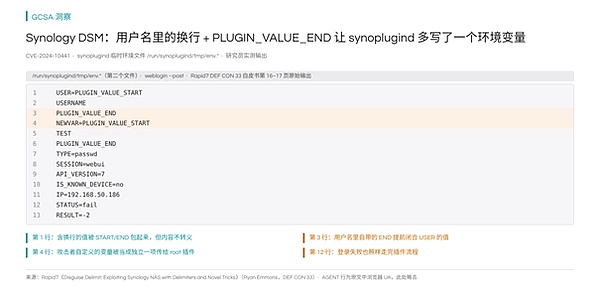
Figure 1: Researcher's actual test: After injecting PLUGIN_VALUE_END into the username, the temporary environment file has an additional NEWVAR (original output of Rapid7 white paper).
Environment variable control becomes root, allowing arbitrary file writing: debug output of the dynamic linker.
At this point, the attacker can only "add a few environment variables to a root process." Turning it into code execution relies on two debugging switches in the Linux dynamic linker:
• LD_DEBUG=libs: Instructs the linker to write the library search process to the debug log;
• LD_DEBUG_OUTPUT=/some_path: Specifies where the logs are written;
• LD_PRELOAD=<a string of content>: Specifies the path to the shared library to be preloaded.
The linker prints the value of LD_PRELOAD verbatim in its log; if this value contains a newline, a complete newline will appear in the log. On Linux, crond periodically readseveryfile under /etc/cron.d/ (regardless of its name), skipping malformed lines and executing valid crontab lines. An attacker could point LD_DEBUG_OUTPUT to /etc/cron.d/hax and insert a tab-separated crontab line intoLD_PRELOAD(tabs are not treated as library path separators by the linker, but cron recognizes them as field separators). One minute later, crond would execute that command as root.
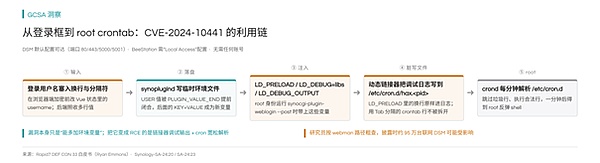
Figure 2: From the login box to the root crontab: How delimiter injection and dirty linker files stack up to an unauthenticated RCE
The vulnerability itself is classified as "improper output encoding/escaping" (CWE-116) and "parameter separator not properly neutralized" (CWE-141); what truly elevates "the ability to add environment variables" to an RCE is the linker debug output and cron loose parsing, two system behaviors.
It can be run with the default configuration and has a large public network exposure.
The white paper states that all tested DiskStation devices were exploitable under default configuration (the web service listens on ports 80, 443, 5000, 5001, etc.); BeeStation devices were exploitable under the non-default but common "Local Access" configuration. Researchers conducted a preliminary investigation based on the webman path used by the DSM web service at the time of disclosure, returning approximately 950,000 potentially affected network devices.
III. What are the possible consequences?
It has occurred:Both CISA and GovCERT.HK have confirmed that the vulnerability is being exploited in the wild; CISA has requested federal agencies to conduct forensic triage (Yes) on the KEV entry, indicating that there is a risk of "being compromised before being patched".
Possible scenarios include:attackers gaining root access, allowing them to read all files, backups, and shared directories stored on the NAS; stealing credentials, certificates, and keys; installing backdoors or ransomware; and turning the NAS into a jump host to attack other hosts on the same network segment. For businesses and individual users, NAS devices are often the central storage location for photos, documents, and backups; a compromise means all this data is exposed.
IV. What you should do now
1.Immediately upgradeDSM/BeeStation OS.Press Synology-SA-24:20 / SA-24:23:
• DSM 7.2.2 → Upgrade to 7.2.2-72806-1 or later;
• DSM 7.2.1 → Upgrade to 7.2.1-69057-6 or later;
• DSM 7.2 → Upgrade to 7.2-64570-4 or later;
• DSM 7.1 → Upgrade to 7.1.1-42962-7 or later;
• DSM 6.2 → Upgrade to 6.2.4-25556-8 or later;
• BeeStation OS 1.0 / 1.1 → Upgrade to 1.1-65374 or higher.
The official announcement did not provide any temporary mitigation measures (Mitigation: None), and upgrading is the only way out.
2.Reduce public network exposure.If the NAS does not need to have its management interface exposed to the public network, disable port forwarding or restrict the web management port to VPN/internal network; for devices that must be exposed, place them behind a firewall and enable two-factor authentication.
3.Investigate according to the vulnerability criteria.Check for abnormal files under /etc/cron.d/ (especially files with random suffixes, containing find library= or suspicious crontab lines); check if there are any Args records containing PLUGIN_VALUE_END, LD_PRELOAD, or LD_DEBUG in /var/log/synoplugin.log; check for any unknown root processes, abnormal outbound connections, or newly added users recently.
4.Treat any suspicious signs as a complete system breach.Back up and reinstall or restore from a trusted image; rotate all account passwords, shared credentials, VPN configurations, and keys stored on the NAS; assess whether sensitive data in shared directories and backups should be treated as a breach.
V. IOC
Table2:Clues forCVE-2024-10441Investigation (Hazardous Chemicals Removed)
type | index | Source/Explanation |
path | /run/synoplugind/tmp/env.* | Temporary environment files are created and quickly deleted during normal login. |
path | Abnormal files in /etc/cron.d/ (containing find library= or unexpected crontab entries) | The white paper utilizes the endpoints of the chain. |
log | Args in /var/log/synoplugin.log contain PLUGIN_VALUE_END / LD_PRELOAD / LD_DEBUG | White Paper Real-world Log Features |
interface | POST /webapi/entry.cgi (Login-related API) | DSM / BeeStation Login Portal |
The above clues come from the Rapid7 white paper's description of the vulnerability mechanism, not a list of C2 instances for a specific attack campaign. CISA and GovCERT.HK confirmed the exploitation in the wild, but did not list the specific attacker's IP address or domain name in their public announcement.
VI. Supplementary Explanation
The same announcement also disclosed two other related CVEs: CVE-2024-50629 (improper encoding of WebAPI component output, leading to limited file reading) and CVE-2024-10445 (improper certificate verification for update functionality, leading to adjacent man-in-the-middle writes to limited files). This KEV report includes CVE-2024-10441, which implements unauthenticated root RCE. The patch focuses on Base64 encoding of plugin values and validating malformed key/value pairs, eliminating separator injection at its source.
VII. Recommendations for Subsequent Use
NAS devices are often treated as "home hard drives" or "boxes in the corner of the server room," but version management and vulnerability response lag far behind servers. This vulnerability exploit chain illustrates that as long as the web management port is open to the public internet, a login box is sufficient. It is recommended to include NAS devices in the same patching cycle as servers; disable unnecessary public network management ports; enable two-factor authentication and login failure alerts for devices with public network access; and regularly check `/etc/cron.d/` and system scheduled tasks, treating "a crontab file suddenly appearing on the NAS" as a high-priority alert.
Reference source
• Synology-SA-24:20 DSM (PWN2OWN 2024):https://www.synology.com/en-global/security/advisory/Synology_SA_24_20
• Synology-SA-24:23 BeeStation (PWN2OWN 2024):https://www.synology.com/en-global/security/advisory/Synology_SA_24_23
• Rapid7 White Paper: Disguise Delimit: Exploiting Synology NAS with Delimiters and Novel Tricks (Ryan Emmons, DEF CON 33):https://www.rapid7.com/cdn/assets/bltad0709de42b54e82/689604359f008cdd02f69917/disguise-delimit-whitepaper.pdf
• NVD: CVE-2024-10441:https://nvd.nist.gov/vuln/detail/CVE-2024-10441
• CISA: CISA Adds Four Known Exploited Vulnerabilities to Catalog (2026-11-18):https://www.cisa.gov/news-events/alerts/2026/11/18/cisa-adds-four-known-exploited-vulnerabilities-catalog
• GovCERT.HK: High Threat Security Alert (A26-11-40) Multiple Vulnerabilities in Synology Products:https://www.govcert.gov.hk/en/alerts_detail.php?id=2195
Part Four: Advanced Threats and New Attack Techniques
09. UAT-12643 Hides C2 Address Using Solana Transaction Memos
UAT-12643 uses Solana transaction notes to hide remote control addresses, targeting encrypted wallets and clipboards.
Daily Security Insights (Threat Intelligence) | November 20, 2026 | All times in this article are Tokyo time (UTC+9)
On November 18, 2026, at 3:00 PM (Tokyo time), Cisco Talos released a threat report disclosing the cluster UAT-12643 it was tracking. The toolset included the Go-language Overlord remote control trojan, the Python-based Good Game data-stealing trojan, and a C++ multi-currency clipboard hijacker. The decoy filenames targeted cryptocurrency holders, game account users, and VoIP software users. Overlord wrote encrypted C2 WebSocket addresses into Solana on-chain Memo transactions; attackers could simply send another transaction when switching servers, making IP and domain blocking ineffective in subsequent detections. Good Game scanned session files from 21 encrypted wallets and searched for mnemonic phrases in desktops and documents using English, French, Spanish, and Portuguese keywords. Talos assessed with low confidence that this cluster overlapped in tactics with North Korean-linked APTs.
I. Event Summary
Table1:Public Disclosure and Sample Key Pointsof UAT-12643
Time (Tokyo timeUTC+9) | event | Source/Evidence |
11-18 15:00 | Cisco Talos releases UAT-12643 report: Overlord + Good Game + clipboard hijacking; Solana Memo hides C2; server 41[.]216[.]188[.]11 exposed. | blog.talosintelligence.com |
During the same period | Talos discovered that attackers had exposed the root directory of their Flask file service, gaining access to toolsets and port configurations: 8000 for file distribution, 5173 for Overlord WebSocket, and 5656/5959 for Python TCP data theft. | Talos Report |
During the same period | IOC data imported into Cisco-Talos/IOCs database 2026/11: Overlord, Good Game, clipboard hijacking, LNK/HTA/dl.xml hashes, and the aforementioned IPs. | github.com/Cisco-Talos/IOCs |
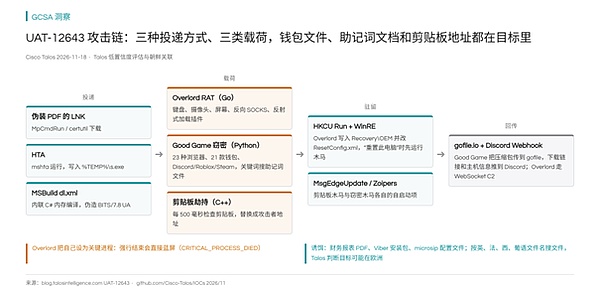
Figure 1: The complete attack chain from three delivery methods to three types of payloads, dwell time, and backhaul.
II. Why are there risks?
The system's built-in tools download Trojans for attackers.
Talos captured a disguised PDF shortcut that delegated the download to either Windows' built-in Defender command-line tool MpCmdRun.exe or the certificate utility certutil. The former, being Microsoft-signed, is usually allowed directly by applications on whitelists; after downloading, it's renamed RuntimeBroker.exe and infiltrated the system process list. The other path uses certutil -urlcache, which appears to be updating the certificate cache. Both commands retrieved data from the attacker's location: 41[.]216[.]188[.]11:8000.
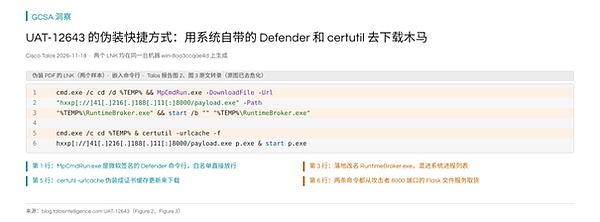
Figure 2: Command lines embedded in two LNKs: MpCmdRun and certutil download the same payload.
The other two initial access paths are: HTA runs via mshta.exe, uses MSXML2.ServerXMLHTTP to pull the binary and write it to %TEMP%\s.exe; and an MSBuild project file named dl.xml, which inlines C# to compile the downloader in memory, with the User-Agent spoofed as BITS/7.8, mixing in Windows Update-like traffic. Talos did not observe how these files were delivered to the victim's machine.
The C2 address is listed on Solana, so blocking it is ineffective.
Overlord hardcodes the Solana Memo application address, periodically querying the transaction history of the attacker-controlled wallet. For each transaction, it parses the instructions, accepting only Memo entries with a data field length of exactly 43 characters—a fixed-length Base58-encoded WebSocket URL encrypted with AES-256. After decryption, it connects to the C2 server. If the attacker wants to switch servers, they only need to send another transaction with the Memo; the infected machine will be detected in the next round of the detection cycle. Blocking the IP and domain is useless, and the on-chain records cannot be deleted.
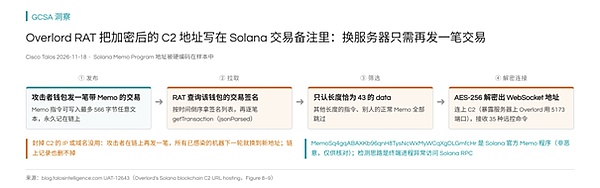
Figure 3: Solana Memo as a C2 discovery channel: Send transaction → Pull → Filter by length → Decrypt connection
Wallet file, mnemonic phrase document, and clipboard address are three parallel processes.
Good Game (public source code version 1.1.2, this campaign is packaged as a self-contained exe) runs a data-stealing thread behind a fake notepad interface. It covers 23 Chromium/Firefox browsers and collects session data from 21 wallets including Exodus, Electrum, Ledger Live, Trezor Suite, Atomic, Trust Wallet, Coinbase, and Binance. File scanning requires matching extension and keyword whitelists, with keywords covering mnemonic phrases, private keys, backups, vaults, bank payments, and other English/French/Spanish/Portuguese names. The clipboard hijacker polls the clipboard every 500 milliseconds, identifies the currency by address format fingerprint, and then overwrites it with an embedded XOR-encrypted attacker's address.
Resetting this PC doesn't remove Overlord.
Besides writing its auto-start information in HKCU\…\Run, Overlord also writes itself to %TARGETOSDRIVE%\Recovery\OEM\ and modifies ResetConfig.xml to register a randomly named batch file as a WinRE OEM task. When a user triggers "Reset this PC," the recovery environment executes the Trojan before restoring the system. It also marks itself as a critical process: forcibly terminating it will trigger a CRITICAL_PROCESS_DIED blue screen.
III. What are the possible consequences?
What has happened so far:Talos captured the complete toolset and sample hashes; exposed the visible distribution and C2 port configuration on the server. The report does not provide the number of confirmed victims or the amount of financial loss.
After infection, the following will occur:keyboard, webcam, microphone, and desktop will be monitored in real time; arbitrary command execution will occur; reverse SOCKS will penetrate the internal network; and plugins will be loaded into memory via reflected DLL injection. Good Game packages screenshots, webcam frames, browser passwords, Discord/Roblox sessions, wallet files, and documents containing the matched keywords into a ZIP file, uploads it to gofile[.]io, and then POSTs the download link and host fingerprint to Discord Webhook. Once the clipboard is replaced, any copied payment address sent will end up in the attacker's wallet.
IV. What you should do now
1.Do not open"PDF/invoice/Viberinstallation package/microsipconfiguration"files from unknown sources.Especially those with actual extensions like .lnk, .hta, or xml files that ask you to "right-click and open with MSBuild".
2.Check for startup and abnormal processes.See if unfamiliar entries such as Zoipers and MsgEdgeUpdate appear in HKCU\SOFTWARE\Microsoft\Windows\CurrentVersion\Run; if MsgEdgeUpdate.exe exists under %APPDATA%; if any unfamiliar executable files appear in the Startup folder; and if there is a process disguised as RuntimeBroker.exe but not located in System32.
3.CheckifWinREhas been modified.If the problem persists after "Reset this PC", check if there are any unfamiliar files in C:\Recovery\OEM\, and whether ResetConfig.xml has been modified. Once infection is confirmed, do not expect a reset to completely remove it.
4.Handle crypto assets based on host compromise.Create a new wallet on a clean device that has never been infected; transfer assets out; rotate all credentials including those from exchanges, email, Discord, GitHub, etc.; check and revoke authorizations for suspicious tokens. Any mnemonic phrase that has existed on the local machine as a file or screenshot is considered leaked.
5.Network-side interception.Block access to 41[.]216[.]188[.]11; issue alerts for abnormal access to Solana JSON-RPC (getSignatures / getTransaction) by terminal processes; monitor uploads to upload[.]gofile[.]io and Discord Webhook POSTs.
V. IOC
Sample hash (SHA-256, Cisco-Talos/IOCs):
• Overlord RAT: b7dfd524b305f476eebf5fc05c4689ed105df44e66353b0d21212a2192c9c26c
• Good Game Stealer: 16622bb8df60403217ccf8e326e2e9e718e01c85d7b52fe5c5e1cf44d62d 25c8;5a52d6773840fd5ab45d781d572d9fbd6a8dacb08dcda65036ce8b28548a5224
• Good Game Python script: b0b636f5c7e40af94aacf9ebd9a696dac57debcd628127414248908562380d33
• Clipboard hijacking: f1e5174084bfded283b9dcf081615478e6941d12b652793197556beb72cc7588
• LNK generator: f7951b11be06d59a3e8fdd9bde4f19869978de8385c9107129c635b2cdba5082
• dl.xml: 19ca4e0e8e7dd62d130afbfed49646f1566dce2633cf937b848d990da3e3e9a2
• document.lnk: 1b268a08e83839f6e89acf0987657776398de2ba5a323b04b1dd3925ce3a5b45
• payload.hta: c8f9ce4b58acec3ce5640041cbc6d4802e30b2dded4a88766ee2de2cefde45f7
• payment-invoice.pdf.lnk: eb5730784e7d63e1fe38a0bc28be8f2210666662e9a660efcc3282f0489ef870
• Viber.lnk: 68786345f67152eb0d52bb198b5904924cfbdbf50c078432e5329e5d02fc6659
Infrastructure:
• IP: 41[.]216[.]188[.]11 (Flask: 8000 / Overlord WS: 5173 / Secret TCP: 5656, 5959)
• External URL: hxxps[:]//upload[.]gofile[.]io/uploadFile; Discord Webhook (see Talos IOC package for specific URLs)
Landing and Stay Pathways:
• %TEMP%\RuntimeBroker.exe, %TEMP%\s.exe, %TEMP%\p.exe
• %APPDATA%\MsgEdgeUpdate.exe; Run value name MsgEdgeUpdate, Zoipers
• Randomly named executables and batch files located in %TARGETOSDRIVE%\Recovery\OEM\; ResetConfig.xml has been modified.
Official verification information (not malicious, for comparison only):
• Solana Memo program: MemoSq4gqABAXKb96qnH8TysNcWxMyWCqXgDLGmfcHr
Note: The IOCs above only apply to the samples analyzed in this Talos analysis. C2 can be changed via Solana; do not only focus on the current IP.
VI. Supplementary Explanation
Talos states that the overlap with Overlord and Solana Memo techniques is seen in the June 2026 report on UNK_DeadDrop and the Solana Memo C2 hiding mechanism (implemented in Node.js at the time), first disclosed during a Lazarus-related event in March 2026. Other threat actors are also using similar techniques. Therefore, the "association with North Korea" is a low-confidence assessment, not a confirmed attribution.
VII. Recommendations for Subsequent Use
Encryption-related operations should be isolated on dedicated devices or virtual machines as much as possible; mnemonic phrases should only be handwritten and not copied into computer files or photo albums; after copying an address from the blockchain, check the first and last few digits before pasting; maintain a default level of suspicion towards "financial statement PDFs" and "communication software installation packages," especially files opened from instant messaging.
Reference source
• Cisco Talos: UAT-12643: Suspected North Korea-aligned actor blends blockchain resilience with targeted infostealing:https://blog.talosintelligence.com/uat-12643-suspected-north-korea-aligned-actor-blends-blockchain-resilience-with-targeted-infostealing/
• Cisco-Talos/IOCs: 2026/11 UAT-12643:https://github.com/Cisco-Talos/IOCs/tree/main/2026/11
Conclusion
The nine security incidents reported in this issue demonstrate that cybersecurity risks are not limited to a single technology, platform, or attack method. Whether it's smart contracts, financial and healthcare service systems, enterprise software, AI infrastructure, or personal hardware wallets and terminal devices, security incidents can occur in areas such as permissions, interfaces, components, and supply chain links that traditional protection mechanisms fail to adequately cover.
Of particular concern is that some attacks do not rely on entirely new technological breakthroughs, but rather exploit vulnerabilities in existing systems' permission configurations, legacy functions, trust relationships, or management oversights. Meanwhile, the widespread adoption of blockchain, automation tools, and AI-related infrastructure is continuously changing the methods of cyberattacks and the difficulty of defense.
For enterprises and institutions, security governance needs to further strengthen critical access control, third-party risk management, software component lifecycle management, vulnerability response, and continuous threat monitoring. For digital asset users, greater emphasis should be placed on device origin, wallet authorization, private key and mnemonic phrase protection, and social engineering attacks targeting specific groups.
GCSA will continue to focus on major global cybersecurity incidents, emerging attack techniques, and artificial intelligence security risks, and promote security and trust in the digital world through security research, threat intelligence, and cross-domain collaboration.
Copyright and Disclaimer
This article and related technical analysis are exclusively published by the GCSA Global Cybersecurity Alliance. For reprint permission, please retain the official GCSA source and original link in full, and do not maliciously alter the core viewpoints of the report.
This article is for cybersecurity research, public risk awareness, and informational reference only, and does not constitute investment, legal, or financial advice. The terms "potential breaches," "potential risks," and attack scenarios mentioned herein should be distinguished from verified facts. Unless otherwise expressly stated, the GCSA has not conducted independent forensic investigations or attributed the attack to this incident.
Please follow GCSA on the following social media platforms for the latest updates.
GCSA X (Twitter):
https://x.com/gcsa_com
GCSA Telegram:
https://t.me/GCSAofficial
GCSA WeChat Official Account:
https://mp.weixin.qq.com/s/ouyL9NwrDDjhMumvehdOmw
Source:Global Cybersecurity Alliance (GCSA)
Website:www.gcsa.org
Get updates in your inbox
We respect your privacy. See our Privacy Policy