Author: Zhang Yaqi, Wall Street Insights
The simultaneous outbreak of financing risks for AI infrastructure and a surge in energy prices has dealt a double blow to Wall Street this week.
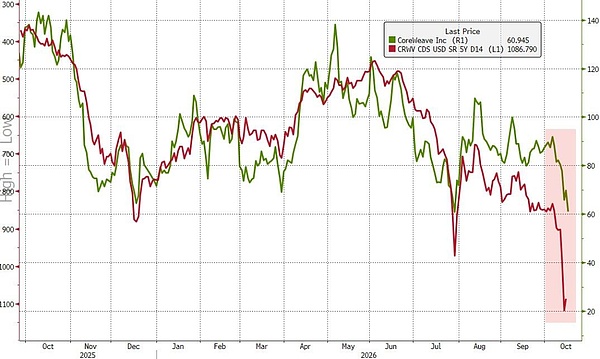
The Nasdaq 100 fell 5.5% this week, marking its biggest weekly drop since the tariff turmoil in April 2025; the semiconductor sector fell for eight consecutive days, its longest losing streak since 2008, with a decline of approximately 16%. Cloud computing service provider CoreWeave became the focus of the market—some of its bond yields briefly exceeded 15% on Thursday, with credit risk climbing to levels typically indicating financial distress, and its stock price fell another 12% on Friday, wiping out more than 50% from its year-to-date high.
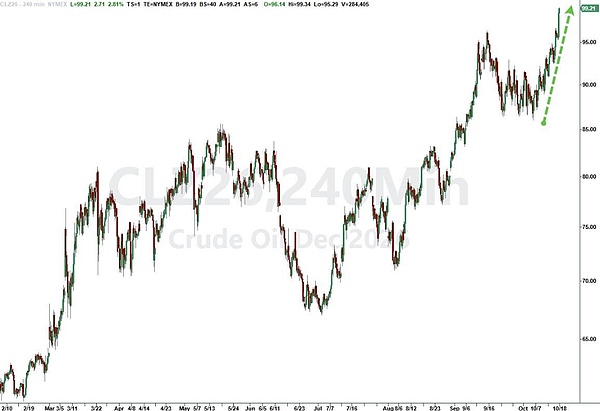
Meanwhile, Brent crude oil closed at around $110 per barrel, while WTI crude oil rose by 3.8% in a single day. The surge in oil prices exacerbated inflation concerns, pushing the 10-year US Treasury yield up to 5.097%, eroding the safe-haven logic of the bond market.
The core shift in the market this week lies in the fact that the main contradiction in AI trading has shifted from the growth in computing power demand to financing costs, returns on capital expenditures, and corporate profitability. Two major risks—the loosening of AI bubble valuations and energy-driven inflationary pressures—are releasing their effects simultaneously, exerting a coordinated downward pressure on the stock, bond, and credit markets.
AI debt risks surface, with CoreWeave becoming the trigger.
CoreWeave's deteriorating creditworthiness was the immediate trigger for this round of sell-offs. This emerging cloud computing service provider, which relies on massive debt to build its AI data center infrastructure, has seen its debt financing model come under intense scrutiny this week. Yields on some of CoreWeave's bonds briefly exceeded 15% on Thursday, and the market has priced in a default probability of approximately 60%, placing its credit risk in distress territory.
Market concerns are not limited to CoreWeave alone. Mark Malek, chief investment officer at Siebert Financial, said that tightening access to funding for emerging cloud service providers could become "a very unsettling hurdle" in the entire technology supply chain. "We are now seeing funding itself become a scarce resource and will impact the supply chain," he said.
Dennis Follmer, chief investment officer at Montis Financial, which manages approximately $1.4 billion in assets, is also wary of the debt situation of hyperscale cloud vendors. "A lot of the market's concerns stem from the scale of borrowing by hyperscale cloud vendors—they've already consumed a lot of cash flow before they even need to borrow," Follmer said. "I do think this will cause some trouble in the future."
JPMorgan strategists point out that the current recovery in AI trading is less robust compared to the sell-off in July – retail buying is weaker, the size of short positions available for a short squeeze is smaller, and corporate buybacks offer relatively limited support.
Chip and memory sectors saw concentrated selling.
This round of sell-offs extended from cloud computing to the entire upstream of the AI industry chain. The Philadelphia Semiconductor Index fell for eight consecutive days, its longest losing streak since the 2008 global financial crisis; the storage concept index fell 6.28% in a single week. SK Hynix ADR fell more than 6.5% in a single day, Micron Technology fell more than 5.6%, SanDisk fell more than 6.8%, and optical communications company Coherent fell more than 7%.
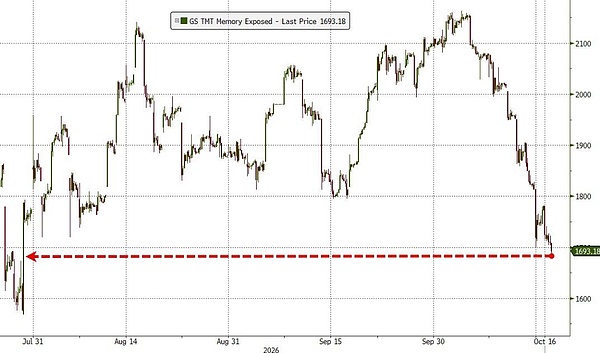
ETFs tracking DRAM memory chips fell 19% this week, marking their biggest weekly drop since their inception in April, and marking the eighth consecutive week of net outflows. South Korea's KOSPI index plunged 14% this week, its biggest weekly decline since the 2008 financial crisis, and has fallen more than 37% from its summer peak.
According to Bloomberg's October survey of US fund managers, the percentage of respondents who listed "long global semiconductors" as the most crowded trade has dropped from 82% in July to 45%—although the decline is significant, it still ranks first in terms of crowding. Michael O'Rourke, chief market strategist at JonesTrading, stated bluntly:
"The market has already factored in a bubble premium into the valuations of AI companies, and that bubble is beginning to deflate."
The surge in oil prices has shattered the logic of safe-haven demand, putting double pressure on the bond market.
In the energy market, Brent crude rose to around $110 a barrel this week, its highest level since May; WTI crude rose 3.8% in a single day, reaching $101.71 a barrel, marking its seventh consecutive day of gains. A bipartisan bill introduced by US lawmakers aims to block the agreement reached between the Trump administration and Moscow to allow Russian diesel fuel to enter the market, further supporting oil prices due to geopolitical factors.
Rising oil prices triggered a chain reaction in the bond market. Previously, even two consecutive sets of higher-than-expected inflation data failed to prevent investors from flocking to Treasury bonds as a safe haven during the stock market downturn; however, with the surge in oil prices, inflation concerns resurfaced, and the 10-year US Treasury yield rose to 5.097%, reversing its previous three-day decline. The safe-haven appeal of long-term bonds was significantly eroded on Friday.
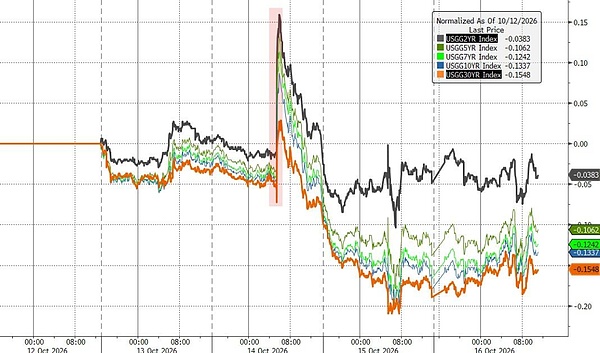
Federal Reserve Chairman Warsh declined to provide any guidance on the outlook for the October interest rate meeting at an IMF event in Bangkok, further depriving the market of policy direction. Despite this, long-term Treasury bonds, as measured by the TLT ETF, still recorded one of the strongest weeks of the year. Follmer stated that his team has begun reducing duration risk, partially replacing traditional fixed-income holdings with catastrophe bonds.
Divergence widens: Reducing positions and bottom-fishing occur simultaneously.
Despite rising panic, the market did not experience indiscriminate risk clearing. Investment-grade credit spreads remained tight at the near end of their five-year range, prompting some ETF investors to buy on dips.
Cathie Wood's ARK Investment Management took the opportunity to increase its holdings in CoreWeave and Cerebras Systems. Wood likened the current market anxiety about CoreWeave's borrowing costs to the early days of Coinbase's bond stress—when cryptocurrency exchanges subsequently benefited from overall industry growth.
Keith Lerner, chief investment officer at Truist Advisory Services, also maintained an overweight position on the technology sector, believing that most of the negative news has already been priced into the stock price, and some valuations are close to the lower end of their historical range.
The real test for the market is approaching. In the coming weeks, tech giants will release their earnings reports, at which point investors will examine whether AI-related revenue can match the continuously rising capital expenditures. Meanwhile, the upcoming US midterm elections add further uncertainty to cross-asset pricing. As Mark Malek stated, "This is a necessary stage for any industry to mature."
Source:Global Cybersecurity Alliance (GCSA)
Website:www.gcsa.org
Đăng ký tin, gửi thẳng vào hộp thư
Chúng tôi tôn trọng quyền riêng tư của bạn. Xem Chính sách quyền riêng tư