China's largest AI Infrastructure funding round has been launched! Why is capital rushing to invest in Token Factory?
In 2026, Token Factory became one of the most lucrative AI Infra sectors.
Overseas, Fireworks AI, which Huang Renxun called "TSMC of AI factories," secured $1.505 billion in funding in July, raising its valuation to $17.5 billion; Baseten raised two rounds of funding this year, significantly increasing its valuation to $13 billion; Together AI completed an $800 million funding round in July, reaching a valuation of $8.3 billion... These three US AI infrastructure startups, positioned as token factories, have all received investment from Nvidia.
in the country, the financing of domestic token factories is also booming.
On October 12, Shanghai-based AI Infra (Artificial Intelligence Infrastructure) company Wuwen Xinqiong confirmed that it had completed a RMB 2.3 billion Series C financing round, bringing its total financing to RMB 4.3 billion. Both the single-round financing amount and the total financing amount set new records in the domestic AI Infra industry, and the company is currently preparing for an IPO. On the same day, Beijing-based AI Infra startup Qingcheng Jizhi, also affiliated with Tsinghua University, completed its Series A financing round, co-led by China Telecom and Hanhui Capital.
On September 20, Beijing-based AI Infra startup Silicon Mobility, which had submitted its listing application to the Hong Kong Stock Exchange, announced that it had completed its Series B+ and Series C financing rounds, with a total financing amount of nearly 2.9 billion yuan in 2026. On September 7, Hefei-based AI infrastructure service provider Zhongke Brain-like, after completing a 100 million yuan Series B financing round in April, officially announced the completion of a multi-million yuan Series B+ strategic financing round.
Looking further back, several companies positioned as token factories have also secured new funding: In mid-August, Moxing Intelligent announced the completion of its second round of financing within three months; previously, in July, Qujing Technology's new financing brought its total financing to over 1 billion yuan within six months; PPIO (Paio Cloud) completed its B+ round of preferred stock financing in May 2026, raising approximately 253 million yuan, and released its Hong Kong IPO prospectus in June; Wuwen Xinqiong also secured over 700 million yuan in financing in May…
Echoing this trend, major internet companies are placing token factories in a strategic position. Alibaba established a Token Foundry business unit, and Tencent Cloud upgraded its MaaS platform to TokenHub. Internationally, Nvidia recently partnered with Wall Street to plan leveraging over $500 billion in AI factory capital, while IBM signed a $240 million inference cluster agreement with the token factory Together AI on the same day…
Looking at the industrial capital landscape, chip manufacturers, energy companies, IDC operators, cloud providers, local state-owned enterprises, and AI application companies have all entered the market, launching a land grab centered around the competition of token efficiency.
Who is investing in Token Factory? What are the real barriers to entry for Token Factory, which everyone is talking about? What makes investors so confident that startups can "snatch a piece of the pie" from the jaws of cloud giants? This article attempts to explore and answer these questions.
01. Capital enters the market along the token production line.
A financing table reveals who's vying for a position.
To know how, first look at what it is.
Many people use the terms "Token Factory" interchangeably with "Intelligent Computing Center" and "AI Factory," but they are actually quite different. An Intelligent Computing Center can be understood as a factory and its machines, while an AI Factory covers the entire process of data processing, training, fine-tuning, inference, evaluation, and agent operation. A Token Factory, on the other hand, is a workshop specifically dedicated to the large-scale production of inference services.
Token factories continuously transform electricity, chips, models, and data into measurable, schedulable, and priced model calling capabilities. To determine whether a company has truly entered the Token factory arena, the key is whether it merely leases GPUs or has already deployed models and is continuously delivering AI capabilities based on tokens, call volume, or service levels.
Several representative financing deals in China this year have outlined the choices of capital. The company that has received the most funding is Wuwenxinqiong, which has raised a total of 3 billion yuan since 2026; followed by Silicon-based Liquidity, which has raised nearly 2.9 billion yuan since 2026.
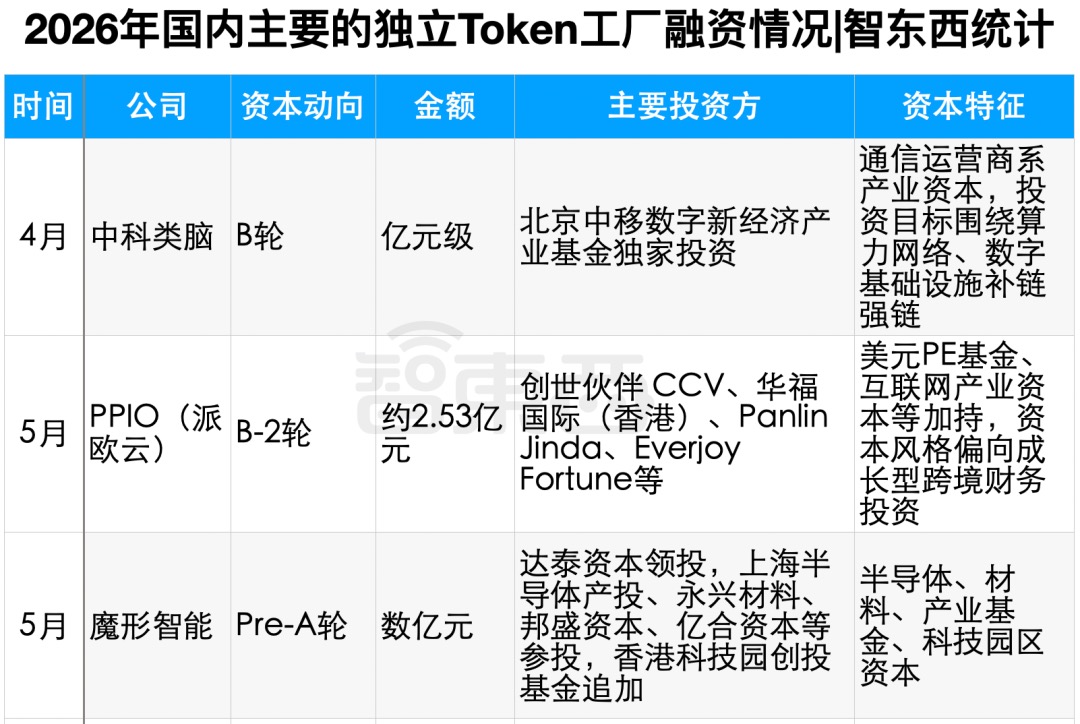
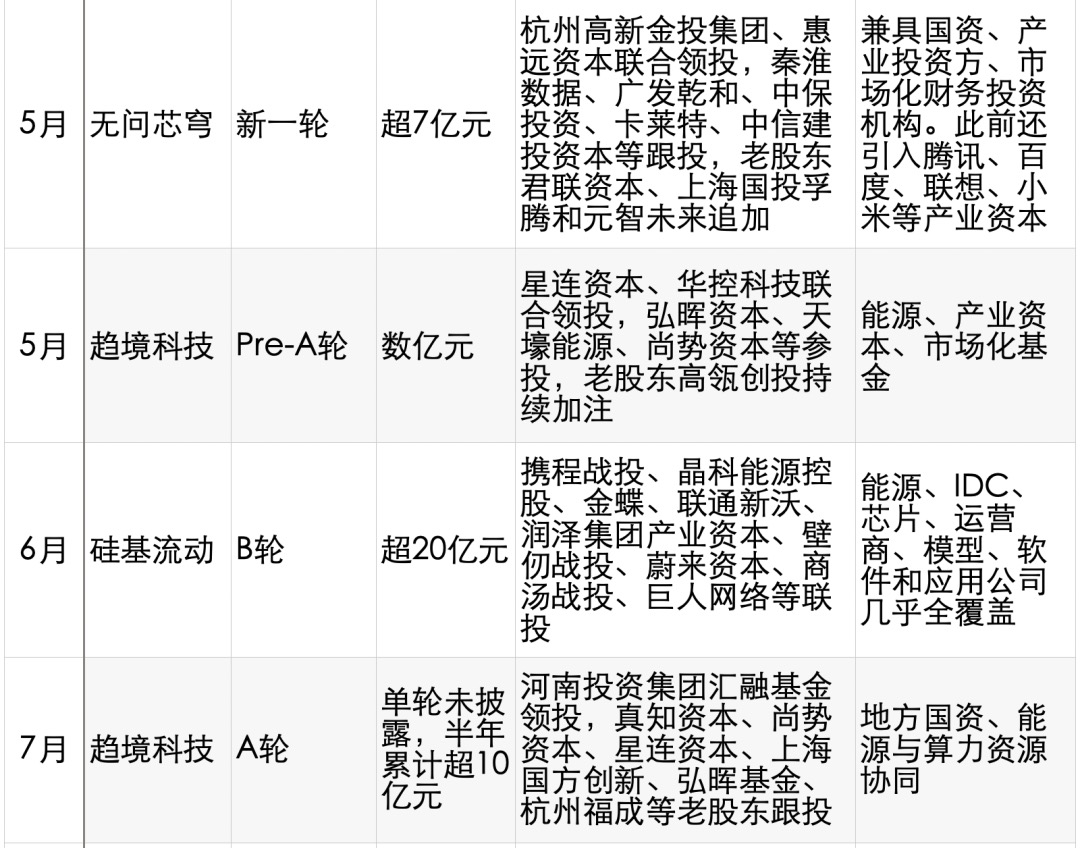
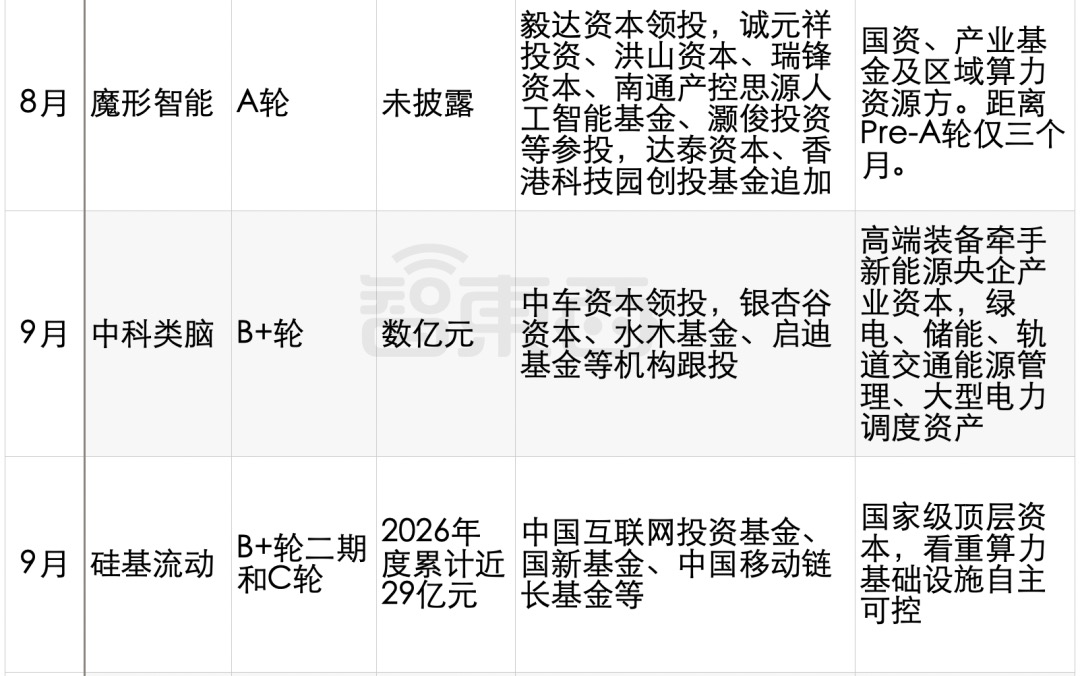
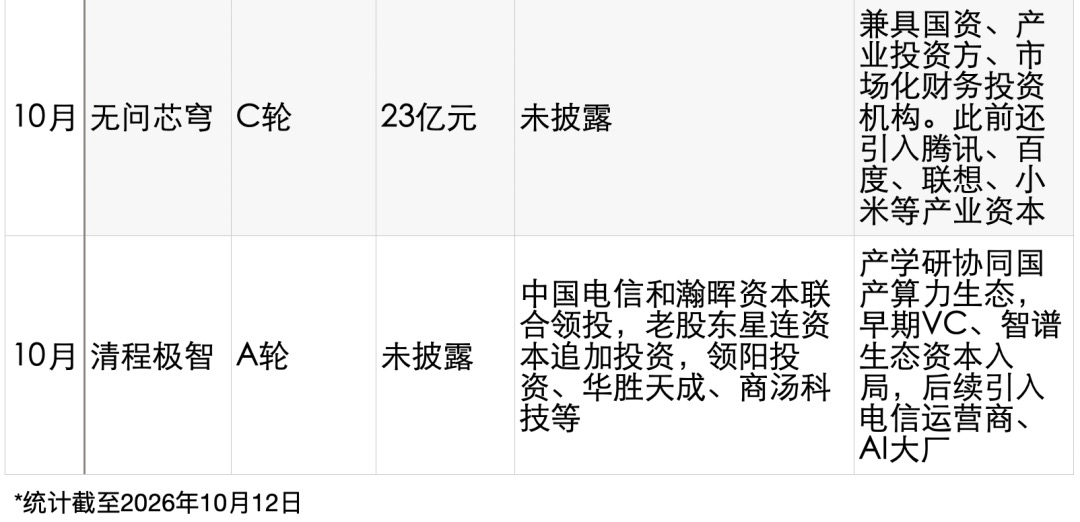
▲Financing table of domestic token factories in 2026 (statistics by Zhidx)
In an interview with CBN in August, Yang Guang, a silicon-based liquidity investor and founding partner of Yaotu Capital, said that when agent companies such as Monica and Manus did not choose large cloud vendors but instead became silicon-based liquidity users, they realized that the market demand they had previously predicted had actually materialized. The subsequent explosive popularity of DeepSeek-V3 further amplified the value of quickly deploying popular open-source models on independent platforms.
The investment wave is penetrating the entire token production chain. For example, investors in silicon-based tokens include Alibaba, Alibaba's Hubble Technology, Innovation Works, and Zhipu, while the latest Series B funding round investors include Ctrip Strategic Investment, Jinko Solar Holdings, Kingdee, China Unicom Newwo, Biren Strategic Investment, NIO Capital, SenseTime Strategic Investment, Giant Interactive, etc., covering almost all sectors such as energy, IDC, chips, operators, models, software, and applications.
Behind the 4.3 billion yuan in funding Wuwen Chip has received since its inception, state-owned capital, industrial capital, and leading venture capital firms have all entered the fray: state-owned capital such as Hangzhou High-tech Investment Group, China Development Bank Science and Technology Innovation Board, and the Social Security Fund Zhongguancun Fund; industrial partners such as Lenovo, Tencent, and Baidu; and financial institutions such as Sequoia China, Qiming Venture Partners, and Dachen Capital. Capital is betting on the efficiency hub between computing power, models, and applications.
The expansion of financing was accompanied by the frenzied expansion of these companies' businesses. Moxing Intelligent's Series A funding was led by Yida Capital, with participation from Jiangsu Provincial Data Group and continued investment from existing shareholders. Xu Lingjie, the company's founder and CEO, told Zhidx that the Pre-A round was secured before the Spring Festival this year, and the business experienced a rapid expansion "from 1 to 10" in the following months. By the time the Series A funding was announced in August, the daily token usage had reached trillions.
Investors are assembling the necessary elements for production lines. Simply put, chip manufacturers provide hardware and joint optimization, energy and IDC capital bring electricity and data centers, local state-owned assets contribute computing centers and government/enterprise orders, and application companies lock in actual usage needs... With real money at stake, the logic of industry synergy is becoming increasingly prominent.
Looking at the industry chain, domestic token manufacturers have formed five types of players: independent token producers, inference system and software vendors, large-scale token platforms, government and enterprise AI factories, and hardware and cluster infrastructure providers. For example, companies such as Silicon-based Flow, Magic Intelligent, and Qujing Technology are closer to the sales end, while Wuwenxinqiong, Shishi Technology, Qingcheng Jizhi, and Jiliu Technology are in the production technology and infrastructure stage, and are gradually extending upstream to token delivery services.
Of course, most of these companies do not focus solely on their specific business type, but rather extend their business to other areas as the technology is implemented. For example, Wuwenxinqiong and Qingchengjizhi have launched Token stores and upper-level inference services for customers, rather than simply focusing on the underlying technology.
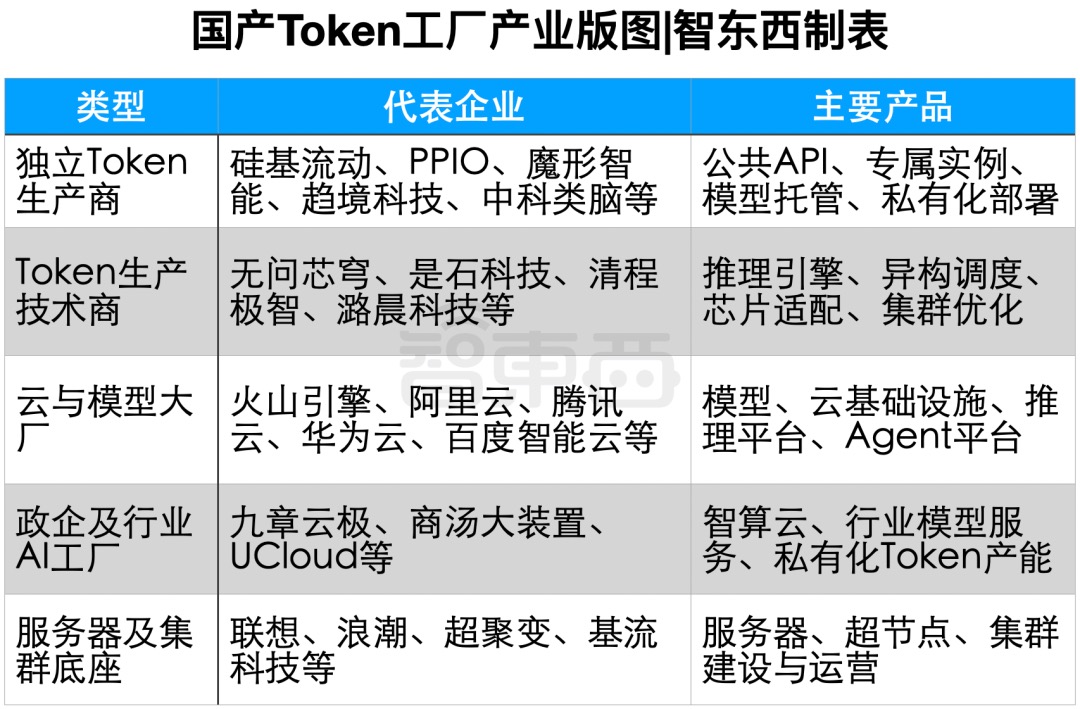
▲Industry landscape of domestic token factories (Table compiled by Zhidongxi)
Capital investment is being rolled out along the entire token production line.
02. Why the frenzy for Token Factory?
Token consumption in a deterministic increment
Rapid integration of capital and technology
Capital first sees a relatively certain demand variable.
In its May 2023 analysis of the Chinese MaaS market, renowned industry research firm IDC predicted that, under a high-growth scenario, the consumption of public cloud MaaS tokens in China would increase approximately 20 times by 2026 compared to 2025. Xia Lixue, co-founder and CEO of Wuwen Chip, revealed at the Zhongguancun Forum that starting from the end of January 2026, the token usage on their platform has doubled on average every two weeks. He remarked that the last time he saw such a growth curve was during the explosive growth of mobile data traffic in the 3G era.
Wuwenxinqiong's operational data serves as evidence on the demand side: as of July 2026, its platform's daily token calls increased 40 times compared to December 2025; its cross-cluster heterogeneous PD separation architecture, disclosed at WAIC, reduced the latency of the first token by 51.5% and the cost per token by 37.5%. The simultaneous increase in token consumption and decrease in inference costs indicates that demand is not simply stimulated by price reductions, but rather driven by real workloads such as Agents.
The underlying industry logic is that while models may change and application forms may evolve, every AI question-answering, code generation, and agent task execution requires the consumption of tokens. In particular, the agent repeatedly calls the model, reads the context, and uses tools, resulting in a single task consuming hundreds of thousands or even millions of tokens.
The movements of those upstream in the industrial chain have already demonstrated the transmission speed of this chain.
Taking Lenovo Group, a leading provider of servers for token factories, as an example, its AI infrastructure revenue nearly doubled in the first half of 2026, with a profit margin rising to 9.1%. AI-related revenue increased by 60% year-on-year, exceeding 63 billion yuan, accounting for 35% of the group's total revenue. As a supplier of equipment and infrastructure for token factories, Lenovo's performance demonstrates that the expansion of AI server, storage, and cloud service providers has translated into upstream revenue and profit.
Another set of data comes from CoreWeave. This AI cloud giant just announced in August that it would extend its A100 contract to 2029, meaning that older GPUs can still generate revenue through inference optimization. This also illustrates that one of the values of a token factory is converting "obsolete computing power" back into sellable token production capacity—a profitable business.
However, capital has not bet equally on all companies labeled as Token Factory.
Actual token usage volume is the primary key indicator, with daily token volume reaching trillions. Taking several companies that have secured funding as examples, Silicon-based Liquidity's prospectus shows that as of April 30, 2026, its platform's average daily token throughput was approximately 578.5 billion, with a peak daily throughput of approximately 1.07 trillion. Qujing Technology's AI token capacity has increased from tens of billions at the end of last year to trillions daily, with its June 2026 revenue exceeding the total for the entire year of 2025. Moxing Intelligent's daily token usage volume reaches trillions, with revenue reaching hundreds of millions of yuan, and some models achieving break-even. While different companies may use slightly different statistical methods, they all generally involve daily token volumes exceeding one trillion.
Our analysis reveals that companies that have secured funding generally share several characteristics: they have already generated large-scale real-world call volumes, possess inference engines, scheduling, KV cache, and domestic chip adaptation capabilities, are able to secure GPU, power, IDC, and customer resources, and cover public APIs, dedicated instances, and private deployments.
Projects that remain in the cluster construction and concept release stage only disclose the number of cards and theoretical computing power, lacking data on paid token quantity, utilization rate, revenue and renewal, and have not made any recent progress in financing.
03. What's open source is the blueprints; what's kept secret is the manufacturing process:
The real barrier lies in the production system.
What is the real barrier to turning GPU computing power into token-based service calls?
“The model is open source, but efficient deployment methods are not all open source,” Xu Lingjie told Zhidx. The model being able to run only means the production line is up and running; whether latency, throughput, success rate, and cost can be controlled simultaneously determines whether the token can be sold.
Let's first look at the process of token creation: it generally includes several steps such as model and chip adaptation, quantization, operator fusion, prefill and decode splitting, dynamic batch processing, KV cache management, multi-machine parallelism, and fault migration.
In simple terms, optimization can be divided into three layers: the inference engine determines whether the model can run efficiently, quantization and operators increase the output of a single machine, and caching and scheduling further affect the profitability of the cluster.
The truly difficult-to-replicate part lies within this entire token production system.
Taking Wuwen Chip Dome as an example, in 2024 it completed the world's first "4+2" heterogeneous chip hybrid training of a 70 billion parameter large model, using four domestic chips (Huawei Ascend, Tianshu Zhixin, Muxi, and Moore Threads) and two imported chips (AMD and NVIDIA), achieving a computing power utilization rate of 97.6%. Currently, its cross-domain training system has reached over 37,000P of computing power and covers 16 mainstream chips. The ability to schedule and engineer heterogeneous computing power has become a significant barrier.
Behind the scenes, traffic prediction, queuing strategies, cache eviction, cross-cluster scheduling, and fault handling rely on long-term request data, and chip joint optimization also involves hardware details and roadmaps. Model weights are like blueprints, open-source inference frameworks are like general-purpose machine tools, and the factory's internal process parameters, scheduling systems, and yield experience directly affect gross profit, which few companies will disclose in full.
In an interview with Jiazi Guangnian, Ai Zhiyuan, founder and CEO of Qujing Technology, gave an example: the actual request length can fluctuate from 128 tokens to 90,000 tokens. Extremely long and uncached Prompts consume a large amount of KV Cache and Prefill resources, potentially causing queuing, cache eviction, resource fragmentation, or head-of-the-line blocking. Qujing's cache hit rate can exceed 90% in some scenarios. Increasing the hit rate from 90% to 95% reduces the amount of data that needs to be recalculated by half.
Jin Chen, founder and CTO of Moxing Intelligence, told Zhidx that optimizations in the lab often claim improvements of 40%, 50%, or even several times, but these may not hold true in real-world business applications. The company has clients and actual workloads, allowing them to directly identify the most critical problems and solve them at a lower cost. For enterprise scenarios like AI programming, API success rate is the first hurdle; a first token delay of more than 3 seconds is unacceptable to many clients.
These specific pain points tell us that the real barrier for token factories is the stable, engineered delivery capability honed through real traffic, which is also what capital ultimately fights for.
04. Can trillions of tokens be turned into profits?
With a price war looming among industry giants, independent manufacturers have three paths to take.
With the token supply growing rapidly, how can it be turned into a profitable business?
First, let's look at the profit formula for a token factory: Profit = Paid Tokens x Token Price - (Chip + Electricity + Bandwidth + Maintenance Costs). Token prices remain under pressure, while upstream GPU and electricity costs are relatively rigid. Only by improving the efficiency of token production per card and per watt of electricity can profit margins be maintained.
According to IPO-related materials from Silicon-based Liquidity, the company's revenue in 2025 was 55.33 million yuan, a year-on-year increase of approximately 653%, but its net loss widened to 345 million yuan, with a gross profit margin of -24.0%. The prospectus explains that the negative gross profit margin was mainly due to the rapid growth in token throughput and the fact that the growth rate of computing power resource procurement costs was higher than the revenue growth rate.
The financial results of different companies vary significantly. Moxing Intelligence disclosed an ARR exceeding 100 million yuan and is close to profitability. The company's founder, Xu Lingjie, told Zhidx that some models have already reached break-even, especially those with high utilization rates that are more likely to generate gross profit. Revenue growth is now outpacing the growth rate of computing power investment, indicating that economies of scale are emerging.
Qujing Technology adheres to a "few models, deep optimization" approach. Founder and CEO Ai Zhiyuan told Jiazi Guangnian that in production environments, only a few top-tier models typically handle the majority of calls. Enterprises focus on three key aspects: the model's intelligent stability, its problem-solving efficiency, and its ability to actually improve business metrics. They don't prioritize quantity over quality; they always prioritize meeting the real needs of their clients.
Independent token factories also face competition from cloud providers. Vendors like Alibaba Cloud, Volcano Engine, and Tencent Cloud possess models, chip procurement scale, cloud infrastructure, and application ecosystems, and may very well offer price reductions to increase usage volume in the future.
According to sources in the Token Factory industry chain, startups have three main areas of focus: first, extreme inference efficiency, pushing single-card throughput to levels that cloud vendors struggle to reach; second, multi-model, multi-chip scheduling, helping customers avoid being tied to a single cloud vendor; and third, private deployment and local delivery, as financial, manufacturing, and government clients have stringent requirements for data security and customization, which cloud vendors' standardized solutions often cannot meet.
A recent IDC report evaluating large-scale model development platforms indicates that the token competition is shifting towards TCO (Total Cost of Ownership). Platforms with multi-model, multi-chip, private delivery, and TCO management capabilities are more likely to generate value independent of cloud vendors.
Valuations of independent AI infrastructure companies overseas have already taken the lead, giving domestic token factories a glimpse of greater development potential. Fireworks AI raised $17.5 billion, Baseten $13 billion, and Together AI $8.3 billion, with Nvidia participating in all of these investments. Domestic companies in the same sector have raised only tens of billions of RMB in total funding, highlighting a gap not only in scale but also in the progress of validating their business models.
Overseas companies primarily optimize around the NVIDIA ecosystem, while domestic manufacturers must address the reality of multiple chips coexisting. Heterogeneous collaboration is a rigid cost for domestic token factories, and also their most difficult barrier to replacement once it is successfully implemented. The valuation gap may simultaneously indicate that the domestic sector is still in its early stages, and that once the efficiency model is validated, independent domestic AI infrastructure has room for independent growth.
In reality, investors may not necessarily believe that startups can beat cloud vendors. Instead, they may anticipate a surge in demand for tokens, which could lead to the emergence of specialized infrastructure companies. These companies may grow into independent platforms or be integrated by cloud vendors, chip companies, or telecom operators.
05. Conclusion: After the Financing Boom
Token factories will be rapidly centralized
It can be predicted that token factories will become an important infrastructure in the AI era, but they are unlikely to replicate the widespread development of traditional cloud computing.
The public API market may concentrate on a few large platforms, inference software companies will enter the chip and cloud ecosystem, and local token factories will form regional markets by relying on low-cost energy and government and enterprise orders.
A few companies that possess real traffic, full-stack efficiency, and resource integration capabilities have the opportunity to grow into independent platforms, while more companies will become part of the cloud, chip, or carrier system.
The booming funding has provided token manufacturers with the ticket to get on the production line.
Ultimately, the winner will be the one who can use fewer chips and less electricity to continuously produce more marketable and effective tokens and penetrate more industries.
Source:Global Cybersecurity Alliance (GCSA)
Website:www.gcsa.org
สมัครรับข่าวสารตรงถึงอีเมล
เราเคารพความเป็นส่วนตัวของคุณ ดูรายละเอียดที่ นโยบายความเป็นส่วนตัว