"Another Perspective" is a column we offer to contributors. Here we collect observations from friends with diverse professional and research backgrounds on AI, payments, fintech, and business and social changes. We retain the authors' own viewpoints and language, only making necessary edits and checks on facts, structure, and expression. This issue's author, Lindja Bavo, starts with the history of money, discussing how money has evolved from metals, paper money, and bank accounts to a new form that can flow in digital networks.
We were born at the wrong time; we missed the Age of Exploration, an era that produced many heroes.
We are fortunate to be born in the Age of Exploration for Currency—because starting in July 2025, private institutions will be able to issue fiat-pegged digital currencies under a regulatory framework. —Linje Bavo
First, the most fundamental and core skill of money: getting strangers to accept it.
Economics textbooks typically summarize the functions of money as: store of value, medium of exchange, and unit of account. However, different theories offer varying explanations for the underlying logic behind these functions.
A common textbook narrative explains the origin of money with a tired old story: sheep herders wanted to exchange their sheep for grain, grain farmers wanted shoes, and shoemakers didn't want sheep. They stood in the market, looking at each other in bewilderment.
This story is easy to understand, but it's not a universal path followed by all societies. The origins of money are also related to debt, tribute, gifts, and bookkeeping.
However, it does grasp a key point: you need something that the other party is willing to accept, and you believe that the next person will also be willing to accept it, or even that everyone is willing to accept it.
Shells, metals, and various other commonly accepted items have all played this role. Later, gold and silver stood out in many ways: they are durable, divisible, not easily produced in large quantities, and easy for people to identify and value.
They seem to come with their own letter of introduction: "It doesn't matter if you don't know me, as long as you know gold."
In crypto parlance, this capability is somewhat like "trustlessness": transactions don't have to be based on mutual familiarity. However, money itself doesn't eliminate the need for credit; it simply shifts credit from specific individuals to the material itself, the issuer, the system, or the rules of the network. This is why money allows collaboration to occur beyond just acquaintances.
But gold and silver have their own temperament: the more you earn, the heavier they become. As wealth grows, so do the costs of moving them. This is rather discouraging for someone aspiring to do big business.
II. The Arrival of Paper Money: Wealth No Longer Needs Weightlifting

Gold and silver were too heavy, so in different historical periods and commercial systems, people gradually began to use vouchers to get things done. The text on the paper essentially said: with this piece of paper, you can receive the agreed-upon amount of money. At first, you trusted the person behind the counter; later, you trusted the businesses, the banks, and the systems that supported these promises.
Currency has undergone a remarkable slimming process. Wealth that once required several people to carry can now be folded and stuffed into a pocket. This change altered the form of money and the position of trust: in the past, people weighed the metal and checked its purity; now, they scrutinize the issuer—do you actually have the money? Are your promises valid? If I come tomorrow, will your door still be open? Paper money has lightened wealth, but has increased the weight of credit.
That's why a single sheet of paper can be worth a fortune, while a more beautifully printed sheet can only be used as a table leg. You can print banknotes, but you can't print trust.
III. From gold anchor to national credit, fiat currency has become synonymous with money.
In August 1971, the United States stopped foreign official holders from exchanging dollars for gold at a fixed price, and the Bretton Woods system subsequently collapsed in the early 1970s. The dollar didn't become called "dollar" from that point on; what changed was its institutional link to gold. [⁴] With the development of modern states and central banking systems, currency has become increasingly embedded in national institutions.
Today, a banknote no longer typically guarantees a fixed amount of gold. Its ability to buy things relies on a complex system: taxes, laws, monetary policy, economic activity, and public confidence in the system's continued functioning.
It's like a common language: wages are paid, goods are priced, loans are calculated, and taxes are paid. As long as everyone uses it, there's no need to invent a new method of measurement for every transaction.
This brought tremendous convenience. But the story of money didn't end at the printing press.
In the modern economy, a large portion of the money we use daily is actually deposits in bank accounts. When commercial banks issue loans, they can simultaneously create corresponding deposits; this creation is constrained by factors such as capital, risk, regulation, and monetary policy. [¹]
Therefore, the answer to the question "Where does money come from?" is far more complex than simply "The central bank printing money." Currency has evolved from a piece of metal held in one's hand into a vast network of assets and liabilities covering the entire society. It is becoming increasingly lightweight, while the relationships behind it are becoming increasingly intricate.
IV. Since money is already electronic, why do people still experience "seasickness" when crossing borders?
In the internet age, money seems to move incredibly fast; mobile payments are completed almost instantly. But once it crosses a border, this agile creature at home becomes surprisingly slow: exchanging currency, filling out forms, dealing with different banks and payment institutions, and waiting for processing. The screen displays "transferred," but the recipient says, "not yet received." Sending a photo, on the other hand, takes only seconds.
Sending money might require repeatedly refreshing the page. While cross-border payment instructions on the SWIFT network are transmitted very quickly today, the end-to-end experience still depends on compliance checks, currency exchange, time zones, and the receiving bank's final processing; some payments are fast, while others still take much longer. [⁵]
The reason is not mysterious: photos primarily convey information, while money involves the transfer, clearing, and settlement of claims between different ledgers, as well as identity and compliance checks. We have built the high-speed highways of global communication, but currency often still has to queue at financial checkpoints.
Money doesn't complain, but those who use it do. For the same transaction, if one route is faster, less wear and tear, and easier to reach, people will naturally be willing to try it.
V. Bitcoin brings the ledger to the public deck.
Bitcoin poses a bold question: if no single bank manages the ledger for everyone, can strangers still verify who owns what and which money has been spent? It establishes a new way of recording transactions using public rules, cryptography, and network consensus. In this system, the ledger is no longer stored solely in the backend of a single institution; participants running full nodes can independently verify transaction and issuance rules.
However, Bitcoin hasn't automatically become a stable price benchmark. If a cup of coffee is priced at a certain amount today, and then has to be recalculated tomorrow due to changes in the price of Bitcoin, the shop owner will have a headache, and the customer might not be happy either. Business people usually have a simple wish: that money can go far, and that prices don't ride a rollercoaster.
This discussion focuses not on all cryptocurrencies, but on fiat-pegged cryptocurrencies used for payments. Cryptocurrency is a broader concept; Bitcoin, central bank digital currencies (CBDCs), and tokenized deposits may also be categorized by different institutions. [⁸]
VI. Fiat Currency-Peged Digital Currencies: Giving Familiar Money a New Ship
Taking a common fiat-backed cryptocurrency as an example, its basic idea is: the issuer receives funds, holds the reserves according to an agreement, and then issues tokens on the blockchain, with the goal of maintaining a fixed correspondence between each token and a certain fiat currency. For users, the most intuitive change is that familiar units of account have a new mode of circulation.
A digital currency pegged to the US dollar can be transferred between supporting blockchains and wallets. It has the potential to bypass some traditional cross-border payment steps, allowing money to flow along new networks like information on the internet. In this type of product, blockchain technology is like the ocean-going vessels of the Age of Exploration for currency. In the past, for a currency to enter distant markets, it often required a vast banking network and local channels; now, with compliant trading, custody, and exchange services, a digital wallet can become a new port.
However, a ship sailing fast doesn't guarantee the reliability of its cargo. On-chain records typically allow verification of token issuance and transfer history on a particular network; however, the same token may be distributed across multiple networks, and further evidence is needed to determine the adequacy of off-chain reserves, their legal protection, and their ability to ensure timely redemption in case of a crisis. Seeing the tokens doesn't equate to seeing the full extent of trust.
Whether these fiat-pegged cryptocurrencies can maintain "stability" ultimately depends on reserves, redemption mechanisms, and governance. Differences in the creditworthiness of different issuers may also cause these tokens to deviate from their promised face value. [²]
Moreover, the completion of an on-chain transfer does not mean the recipient has converted the money into a locally usable bank account. The final leg of the journey remains crucial. New routes reduce some friction, but also bring other issues to a new level.
7. Is "bad money drives out good money" a truth or a paradox? Who is driving out whom?
When discussing currency, people often cite the famous saying: "Bad money drives out good." It sounds like a pessimistic fatalism in the monetary world—the worse the money, the easier it is to win. But this doesn't hold true under all circumstances.
This statement holds true only under a crucial premise: two coins with different actual values are required to be used at the same nominal value. Suppose two coins are legally both worth one dollar, one containing more silver than the other. People will naturally spend the one with less silver first, keeping the one with more. Thus, the less valuable coin continues to circulate, while the better one is collected, melted down, or taken elsewhere.
The "expulsion" here refers to the withdrawal from daily circulation, not that superior currency has lost its value. The key point is that two types of money with different actual values are required to be used at the same nominal value. [³]
However, if people have the freedom to choose and set their own prices, the story might be reversed. A constantly depreciating currency won't make everyone willingly abandon a reliable one simply because more is printed. You can print mountains of banknotes, and merchants might still refuse to accept them, and be even less willing to use them as a store of value.
Ultimately, the competition for currency boils down to a struggle over human choice. This point is systematically discussed by Hayek in his 1976 book, *Choice in Currency: A Way to Stop Inflation*. [⁶]
Therefore, we can say that whoever's money can better retain purchasing power, is easier to pay, easier to redeem, and whose promises are more trustworthy has a greater chance of staying.
8. After private entities issue currency, will the state withdraw from the process?
We can deduce this from the following: if a country stipulates that taxes can only be paid in its own currency, it will reserve a portion of the basic demand for that currency. However, this alone cannot guarantee its purchasing power, nor can it guarantee that it will always occupy the majority share of market circulation. There are two things in this world that no one can avoid: death and taxes. However, the fact that the state will not withdraw from the political arena and how much market a currency can occupy are two different things.
Since the release of the Bitcoin white paper, and especially after the passage of the US GENIUS Act in 2025, a topic that has been discussed for decades has returned to the attention of many economists: the denationalization of money. Austrian economist Friedrich Hayek's *Denationalization of Money*, first published in 1976, was written in the years following the collapse of the Bretton Woods system. This book is like a blinding ray of light illuminating an endless darkness.
We will not delve into overly academic discussions here. The GENIUS Act does not grant all private entities the right to issue currency. It stipulates that for a payment-type, fiat-pegged digital currency to be issued in the United States, the issuer must be a legally permitted entity and meet requirements regarding reserves, redemption, disclosure, anti-money laundering, and regulation. [⁷] Compliant issuers can still build their own brands, connect with their own users, and leverage open networks to transcend geographical boundaries.
However, there's an intriguing relationship here: an approved private institution issuing a dollar-pegged digital currency may, on the one hand, weaken the advantages of certain traditional payment channels, and on the other hand, it may bring the dollar to more places. The captain may have changed, but the unit of account on board remains the dollar. Therefore, a more private issuing entity and a more open circulation network do not necessarily mean that the value basis has departed from national currencies. It's more likely that the roles of the state, banks, issuers, and users are being redistributed.
Who provides the value anchor? Who holds the reserves? Who maintains the ledger? Who controls the access? Who has the right to freeze assets? And can users take their assets with them and change course? These questions will determine just how open the new monetary world will be. What's truly worth looking forward to is people having more reliable choices.
Publishers can't just say "trust me," they also have to answer: Why should I trust you? What can I verify? Can I withdraw?
9. Money may become less valuable, but promises should not become less so.
If we imagine currency as an evolving life form, it seems to be constantly searching for a more suitable form to survive: from heavy metals to thin paper; from paper to bank ledgers; and from institutional ledgers to on-chain digital assets that can be transferred across global networks. It continuously expands its scope of activity, reducing the burden of carrying and trading.
However, one crucial point must not be forgotten: ease of issuance benefits issuers; only when the currency is worth holding benefits users. If issuance growth consistently exceeds market demand, or if the underlying assets and redemption capacity cannot keep pace, the purchasing power or face value commitment of the currency may be eroded. A truly vibrant currency needs to combine convenience with restraint, velocity of flow with credit quality. It may lack the weight of metal, but it cannot lack the weight of commitment.
This is perhaps the most interesting contrast in the past and present of money: we have spent a long time getting money rid of its heavy body; but in the end, we still have to seriously ask what exactly makes that invisible and intangible credit stand firm.
Back then, merchants stood on the docks, inspecting the ship's planks, ropes, and wind direction before deciding which vessel to entrust their wealth to. Today, we face wallets, issuance rules, reserves, and digital ledgers. The seas have changed, but the age-old question remains:
I'm about to embark on my great sea voyage. Which ticket should I buy?
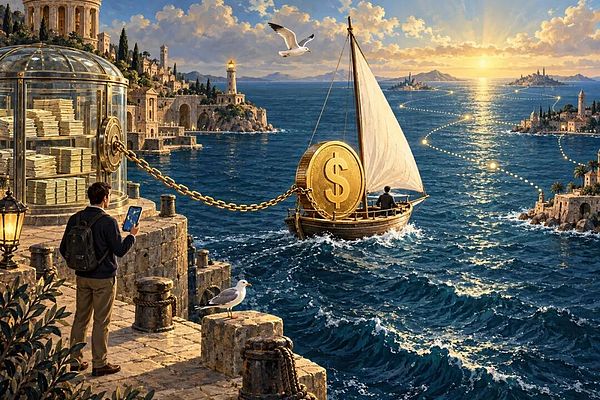
As for how money and banks have "developed stealthily" and "grown wildly," that's another story worth telling in this great voyage of currency.
References cited in the text
¹ Bank of England: Money Creation in the Modern Economy
² Bank for International Settlements: Stablecoins versus tokenized deposits (Original title: Stablecoins versus tokenized deposits)
³ International Monetary Fund: Gresham's Law under Fixed Exchange Rate Conditions
⁴ Federal Reserve History: The end of the US dollar's convertibility to gold and the Bretton Woods system in 1971
⁵ SWIFT: The final leg of cross-border payment speed and receiving end
⁶ Institute for Economic Affairs, UK: Choice in Currency: A Way to Stop Inflation
⁷ U.S. Government Publishing Administration: GENIUS Act (Public Law 119-27)
Source:Global Cybersecurity Alliance (GCSA)
Website:www.gcsa.org
Langgan berita, terus ke e-mel
Kami menghormati privasi anda. Lihat Dasar privasi