Author: Bootly, Bitpush
On Friday, October 16, US tech stocks came under renewed pressure, with Nvidia-backed AI cloud computing company CoreWeave falling more than 10% at one point during the session. The stock had already experienced a sharp sell-off in the previous two trading days, plunging 15.5% in a single day on October 14.
The sell-off quickly spread to the chip, cloud computing, and data center sectors. The Nasdaq faced one of its worst weekly declines in months this week, as the global AI investment boom encounters a crisis of confidence.

But this decline is different from the past.
In the past, investors worried that AI valuations were too high; now, they are starting to worry that AI has too much debt.
Among them, a long-standing and important indicator—credit default swaps (CDS)—is becoming the core of this storm.
"Doomsday" insurance is getting more expensive.
CDS is essentially a type of debt default insurance. Bondholders pay premiums to the seller periodically, and the CDS seller is responsible for compensating for losses should the issuing company default.
When the market is calm, these tools are almost ignored. But when CDS prices start to rise, it oftenmeans that someone is paying for the "worst-case scenario."
According to Bloomberg, since the fall of 2025, CDS prices for tech giants such as Microsoft, Nvidia, Meta, and Amazon have surged, with some companies' prices even doubling. The increases for second-tier giants like Oracle and Broadcom have been even more dramatic.
According to the latest statistics from Reuters on October 15, CoreWeave's five-year CDS broke through 1,100 basis points, setting a record. Oracle's CDS approached 300 basis points, and credit risk indicators for tech giants such as Nvidia, Meta, Amazon, and Alphabet also rose significantly.
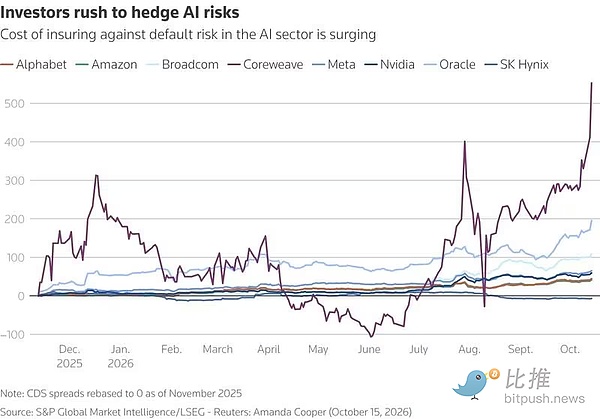
What does 1,100 basis points mean? To give a simple example, if you were to buy default protection for $1 million in debt, the annual premium would be as high as $110,000.
Reuters' model shows that CoreWeave's CDS imply a more than 60% probability of default over five years, compared to about 30% a year ago. Of course, this is just a model pricing and does not mean that the company actually has a 60% probability of going bankrupt.
But a dangerous shift has already occurred:the risks of AI investments are spreading from stock valuations to debt repayment capabilities.
CoreWeave is a prime example. Its business model involves borrowing money to buy Nvidia GPUs, build data centers, and then leasing that computing power to clients like Microsoft and OpenAI. Demand is indeed strong. CoreWeave's second-quarter revenue reached $2.575 billion, a year-over-year increase of 112%, with contract revenue backlogs of approximately $104 billion.
But behind the impressive growth, the financial report also reveals another set of figures: a net loss of $626 million in the quarter, with net interest expenses alone reaching $640 million.
Despite rapid revenue growth, the company continues to rely on financing to build data centers. LSEG data shows that its debt-related burden is approaching $50 billion, with some bond yields once exceeding 16%.
The key challenge here is whether future earnings can cover today's financing costs.
Expected contract revenue is not the same as cash on hand. If data center construction is delayed, computing power prices fall, or GPU upgrades occur faster than expected, a business model that seemed like a sure thing could face enormous pressure.
A sudden surge in inflation shattered any illusions about financing AI.
To make matters worse, the macro environment is developing in the direction that AI companies least want to see.
Data released by the U.S. Bureau of Labor Statistics on October 14 showed that the CPI rose 3.7% year-on-year in September, up from 3.4% in August, with gasoline prices rising 9.1% month-on-month.
The PPI, released the following day, surged 1.3% month-on-month, marking the largest increase since March 2022.
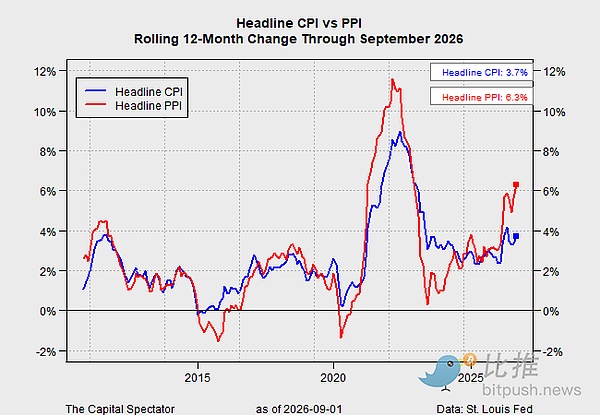
The Middle East conflict has driven up energy prices, renewed inflationary pressures, and led markets to bet on further interest rate hikes by the Federal Reserve.
What does this mean for the AI industry?
Over the past two years, technology companies have been able to continuously build data centers largely due to the capital market's willingness to fund future growth.
However, with interest rates remaining high, debt interest will increasingly erode profits. At the same time, high interest rates will also depress the present value of future cash flows, putting greater selling pressure on overvalued tech stocks.
As a result, the two originally separate risks have become intertwined: inflation drives up financing costs, and financing costs make investors doubt the returns on AI investments again.
With trillions of dollars invested in AI, Wall Street is finally starting to demand returns.
CoreWeave is just one part of the overall AI capital expenditure frenzy.
Microsoft's capital expenditures reached $41 billion in the fourth quarter of fiscal year 2026, and Meta projects that total capital expenditures for the entire year of 2026 will be between $130 billion and $145 billion.
Behind these figures lies a massive investment in GPUs, data centers, power, and network infrastructure.
However, Microsoft still generated $19.6 billion in free cash flow during the same period, which is fundamentally different from CoreWeave, which is highly dependent on external financing.
This means that the AI industry is not collectively facing financial difficulties, but rather that the capital market is beginning to differentiate: who is investing profits in AI, and who is betting on AI with borrowed money from the future.
Deutsche Bank strategist Jim Reid points out that as AI capital expenditures increasingly rely on debt rather than free cash flow, the market must pay closer attention to changes in credit prices.
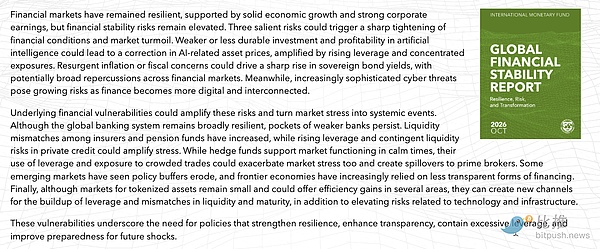
The International Monetary Fund (IMF) also warned in its latest Global Financial Stability Report that if AI investments fall short of expectations, high leverage and concentrated holdings could amplify market volatility.
However, whether the AI bubble has burst remains controversial. Nvidia CEO Jensen Huang continues to support CoreWeave; while renowned technology analyst Dan Ives predicts that 5% to 10% of AI projects may ultimately fail to materialize due to increasingly stringent funding requirements.
The AI revolution may be far from over, but Wall Street's patience for endless cash burning is running out.
Source:Global Cybersecurity Alliance (GCSA)
Website:www.gcsa.org
소식을 이메일로 받기
개인정보를 존중합니다. 자세한 내용은 개인정보 처리방침