Author: @davewardonline; Source: X, @Bankless (originally published on Bankless Newsletter); Translation: Shan Ouba, GCSA
The past two weeks have been incredibly tough for the cryptocurrency market. Bitcoin fell by more than 20% at one point during the day, with ETH and almost all other assets declining in tandem. On Saturday, BTC briefly dropped to nearly $55,000, a new low since September 2024.
The sell-off in AI stocks in traditional markets has spilled over into the crypto sector: BlackRock's IBIT saw record outflows for two consecutive days, while miners used their Bitcoin reserves to pay for their self-built AI infrastructure.
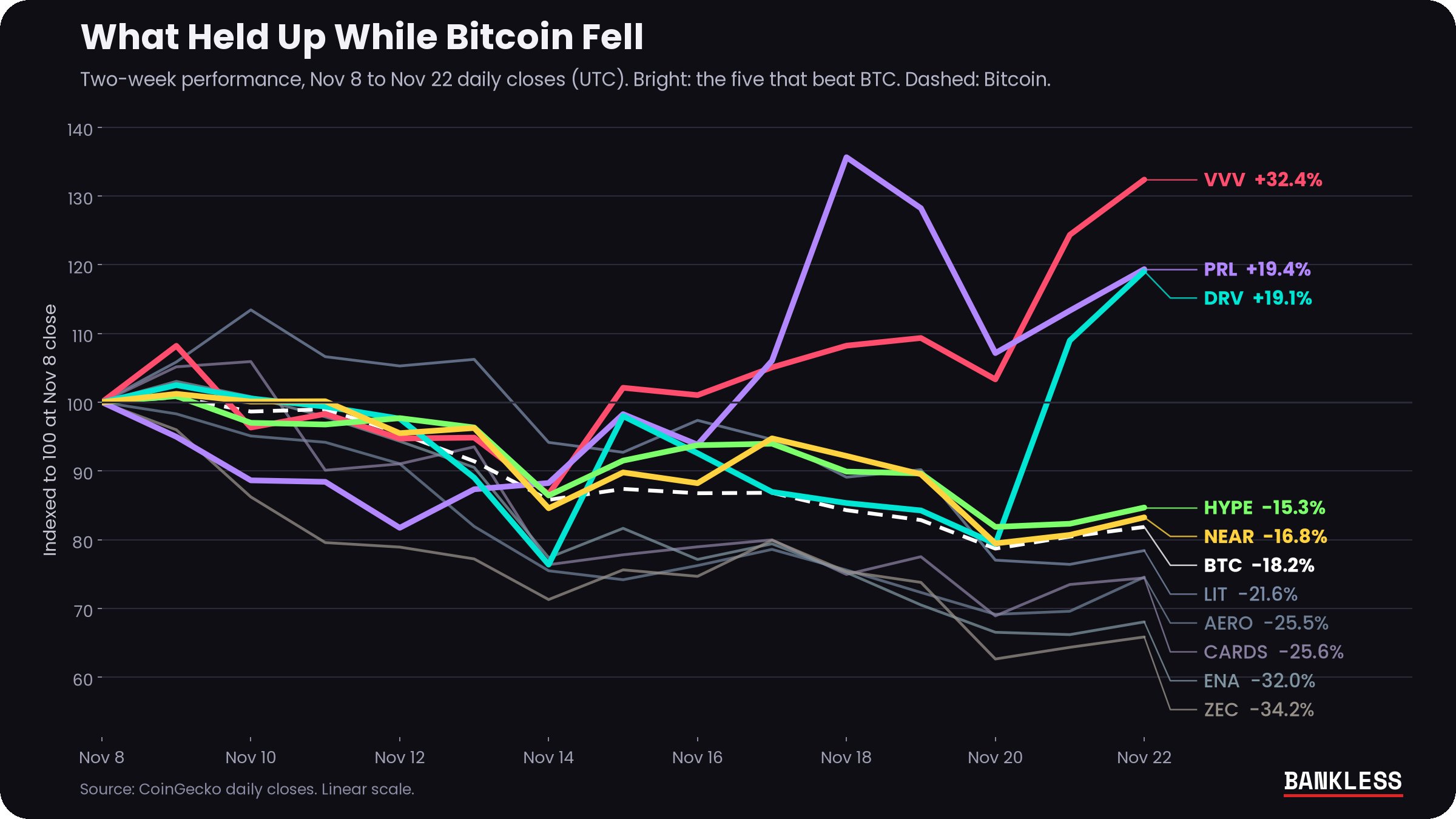
Fortunately, prices rebounded from Saturday's lows and held up until Sunday's weekly close, providing a good opportunity to check "who held firm." I selected ten of the most watched tokens in the market—each a recent hot topic—and compared them one by one with Bitcoin. Five of them outperformed.
Five ways to outperform Bitcoin
1. Venice | VVV: +32.4%
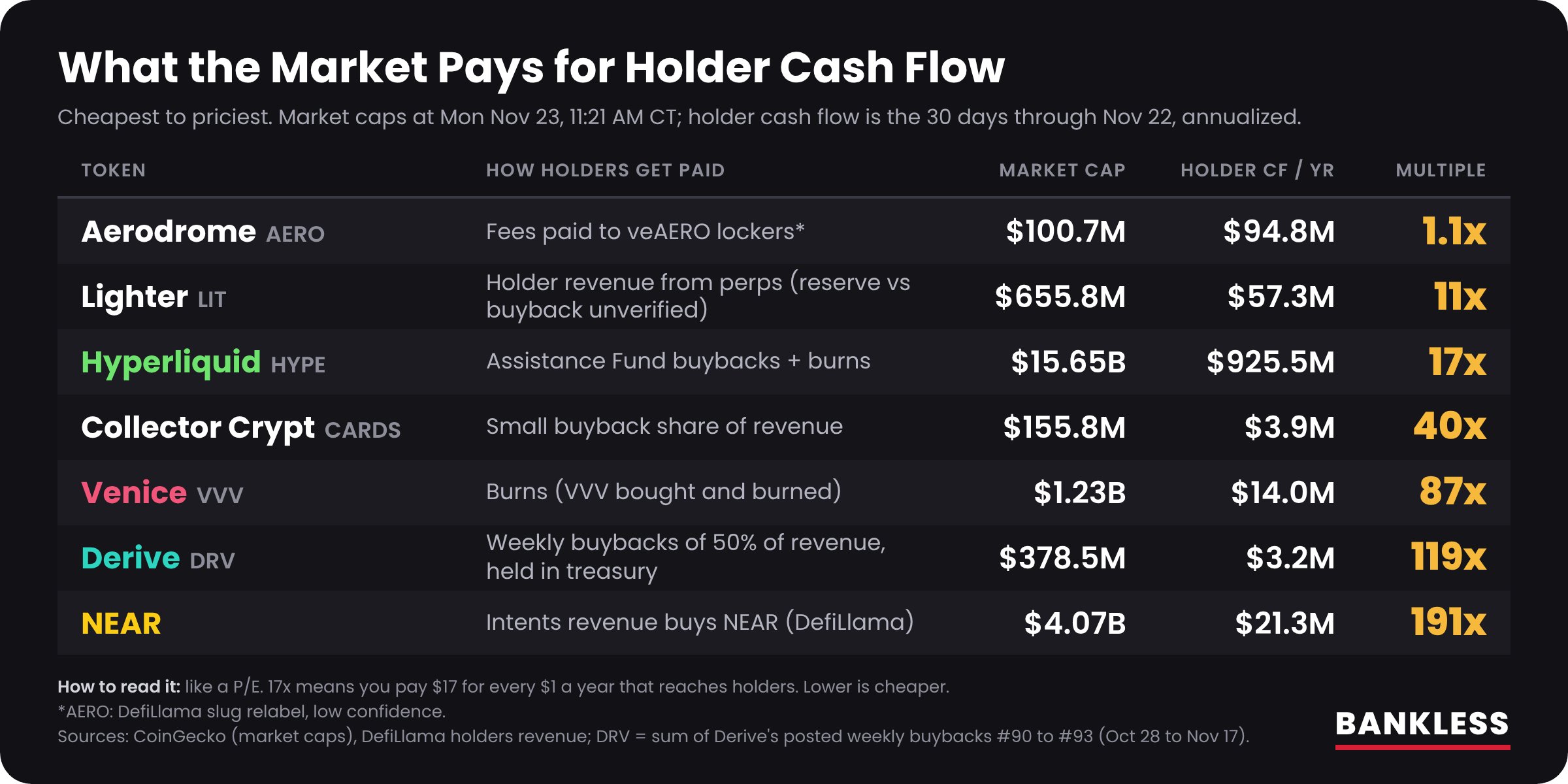
Venice (VVV) topped the list, ranking third in terms of gains among the top 100 tokens by market capitalization. Almost all of the gains came from last week: VVV rose 29.7%, while BTC fell 6% during the same period. This was indeed a week of attention for Venice, with most of that attention coming from outside the crypto community. The AI-generated movie trailer NUREMBERG, created using Venice, surpassed 35 million views on X; on November 17th, Venice's two most expensive plans saw record-breaking single-day payments. Along with this surge came Minds—a marketplace specializing in professional AI agents—whose platform fees were used to burn VVV. Prior to this surge, a record of $458,000 in VVV was burned on November 9th; the current market valuation is approximately 87 times the annualized burn amount, one of the most expensive multiples on this list.
2. Pearl: +19.4%
Pearl ranked second and rose another 14% by Monday morning. Pearl is a highly controversial Bitcoin fork, designed to allow AI computing to simultaneously serve as mining. Three things boosted it: the FP8 upgrade entered the testnet; Syncracy Capital disclosed a large holding; and Pearl Research, the research firm behind the protocol, launched the DeepSeek endpoint on OpenRouter, which was interpreted by the market as a verification of its core arguments.
3. Derive | DRV: +19.1%
On-chain options and perpetual contract exchange Derive has nearly caught up with Pearl. Market volatility has brought it its highest two-week fee revenue since January 2025, with half of its protocol revenue going towards weekly buybacks. Most of the gains were concentrated in a single trading day: DRV surged approximately 37% on November 21st. Derive's fee revenue over the past 30 days was $727,000, and its current valuation is approximately 120 times its annualized buyback amount.
4. Hyperliquid | HYPE: -15.3%
Hyperliquid outperformed Bitcoin by 2.8 percentage points, but still hit a 90-day closing low on November 20th. Like Derive, it benefited from this volatility: transaction fees rose 22% compared to the previous two weeks; approximately $76 million flowed to holders through buybacks and burns over the past 30 days, almost five times the sum of the rest of the tokens on this list. Based on this, HYPE's valuation is approximately 17 times its annualized cash flow to holders, making it one of the cheapest tokens on the list. Under the buyback mechanism, with a fixed buyback amount, the lower the price, the more tokens are bought: in the last week, approximately 15,500 HYPE were bought for every $1 million spent in buybacks, up from approximately 12,400 previously.
5. Near | NEAR: -16.8%
NEAR slightly outperforms Bitcoin by 1.4 percentage points. It often leads the market during uptrends: from its low on August 30th to its high on October 11th, it surged approximately 224%, while Bitcoin only rose 8% during the same period. However, its revenue story is the thinnest among the five relative to its price: DefiLlama data shows that $1.75 million of NEAR's 30-day transaction fees went to holders, corresponding to a valuation of approximately 191 times its annualized holder cash flow.
What does this report card tell us?
In the latest episode of his podcast, Tulip King told David Hoffman that investable tokens fall into "two buckets": "coins that are currencies" and "coins that can make money."
This aligns with the market perspective of many, including myself, and the ten tokens in this article are categorized in the same way. Zcash and Pearl belong to the first category, representing another kind of store of value, or what people expect. The other eight belong to the second category, representing emerging businesses that can generate income: Venice, Hyperliquid, NEAR, and Derive, along with Lighter, Aerodrome, Collector Crypt, and Ethena.
"Coins that can generate profits" occupied four of the five spots outperforming Bitcoin, but HYPE and NEAR only roughly matched the median of the top 100 tokens by market capitalization (which itself fell by 15.3%). Pearl was the only value store asset among the winners, and this category itself had a wide range: from Pearl's +19% to Zcash's -34%, which the author believes has been overvalued.
The same category also contributed four of the five laggards: Lighter down 21.6%, Aerodrome down 25.5%, Collector Crypt down 25.6%, and Ethena down 32%. Making money doesn't make a token immune to declines.
So what's the difference? There are two particularly prominent themes among the winners.
First is AI, which spans two categories. Venice and NEAR sell private inference services, while Pearl makes AI computation a form of mining. All three outperformed Bitcoin, while none of the five laggards touched on AI.
The second is the emerging financial market. The other two winners are exchanges that convert transaction fees into buybacks and are expanding the range of on-chain tradable assets. Hyperliquid has built a separate market for perpetual contracts, which has now extended to stocks and pre-IPO assets. Derive offers on-chain options, but on a much smaller scale. Lighter, a leveraged bet on the same perpetual contract track, is the closest but has underperformed, lagging behind Bitcoin by 3.4 percentage points. Its valuation has fallen from 15 times holder cash flow to about 11 times, rebounding by about 9% on Monday morning.
This is just a snapshot of two weeks and ten tokens, but the market's appetite is already clearly visible: it wants coins that can make money and is willing to pay a premium for two stories—AI and new financial markets.
Venice meets both conditions and its performance far surpasses all other targets on the list. The author will write a separate article to analyze VVV (this is the author's opinion and does not constitute investment advice).
This article is a translation of the original text and represents only the author's views. It does not constitute investment advice.
Source:Global Cybersecurity Alliance (GCSA)
Website:www.gcsa.org
Get updates in your inbox
We respect your privacy. See our Privacy Policy