"The Board of Directors has taken into account the views of senior U.S. government officials," this statement is printed in the third paragraph of the reinstatement statement.
Eleven days ago, the same group of directors cast the opposite votes.
I read the original English statement from beginning to end, stopping at the third paragraph. The original sentence was "the Board received input from senior levels of the United States government," which the Chinese media translated as "The Board has listened to the opinions of senior U.S. government officials."
A board resolution of a listed company included the opinion of a government department. This was not a footnote, but the reason for including it in the main text.
On November 23, local time, Nvidia posted this statement on its official website before the market opened. The board of directors unanimously voted to reinstate Jensen Huang as president, CEO, and director, effective immediately. He resigned from these three positions on November 12, 11 days later.
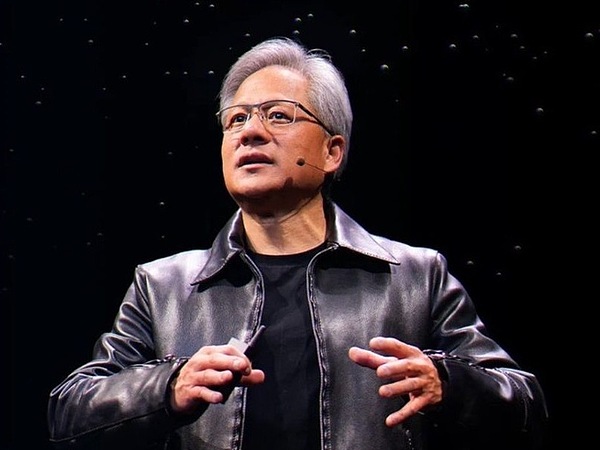
File photo | Source: Tencent News
The same group of people voted twice in 11 days.
Let's put the facts on the table first.
On November 12, Jensen Huang resigned from all positions as president, CEO, and board member, effective immediately. Kress took over as interim CEO, and Jones became the first chairman. The stock price began its downward trend that day, falling from $145.98 on November 19 to $125.53 on November 20, a drop of $20 in two trading days, representing a cumulative decline of over 27%.
The board vote was held on November 22, and a pre-market statement was released on November 23. The stock opened at $165.61 and closed at $165.05, up 31.48%.
This is Nvidia's largest single-day gain since May 2003, and the third largest since its IPO. Based on the closing price, it gained an additional $952 billion in market capitalization in one day, equivalent to approximately 6.39 trillion yuan. The previous record for the largest single-day increase in market capitalization for a global listed company was approximately $450 billion for Microsoft on July 30th of this year.
Chairman Jones stated that the board believes Jensen Huang is the right person to lead Nvidia and that restoring him to his position is in the best interests of shareholders, employees, partners, and customers.
The sentence itself is fine. What needs attention is the sentence that immediately follows it.
Jensen Huang's own statement was only one and a half sentences long: "I am honored to return to Nvidia and lead one of the world's most influential technology companies at the start of a new industrial revolution. I can't wait to get back to work." He returned to headquarters that same day, where employees crowded the stairs chanting his name. In a video, he said, "I will do a better job as CEO this second time. Thank you for giving me a second chance."
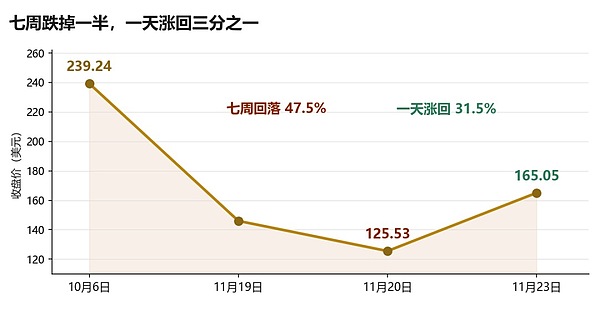
In three trading days, the stock price has recovered to nearly 70% of its October high | Data source: NYSE closing price
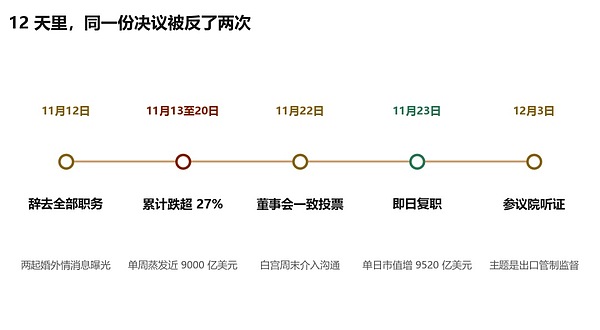
The board voted twice, with only one personnel change in between | Data source: NVIDIA's official website statement and public reports
That sentence written in the statement
I read through the statement paragraphs in order.
The first layer provides commercial justification: the candidate is suitable and aligns with the interests of all parties. The second layer provides security justification: after consulting with senior U.S. government officials, there is confidence that the candidate does not pose a national security risk.
A standard corporate governance document should end at the first level. The board of directors is accountable to shareholders and does not need to explain its personnel arrangements to the government.
This time there's an extra layer.
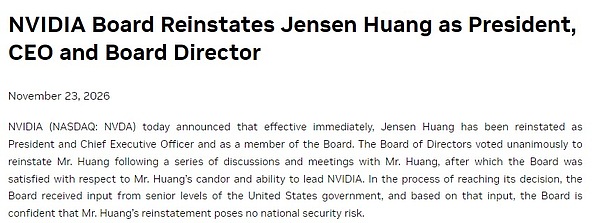
The statement included the government's opinion in the third paragraph of the main text | Image source: China Daily website, citing Nvidia's statement.
Trump posted on social media that day, saying the decision was correct and appropriate, and that the US government had no reason to believe that Huang's return would pose a national security risk. The Attorney General had confirmed that there was no evidence of any illegal activity on Huang's part. In an interview with CNBC, he was even more direct: "I talked to them, and I convinced them. I was the one who made this happen."
According to sources familiar with the matter, CCTV reporters learned that Vice President Vance increased his involvement over the weekend, communicating with the board on behalf of the president. The White House valued his prior experience working in Silicon Valley before entering politics, which gave him influence with board members. Attorney General Branch, meanwhile, discussed with Trump over the weekend whether Huang Jen-hsun posed a national security risk.
China Daily, citing sources within the United States, reported that the interim CEO and company executives were unaware of the discussions surrounding his reinstatement until the last minute.
A company worth over three trillion US dollars changed its top manager, and the temporary replacement only found out at the very end.
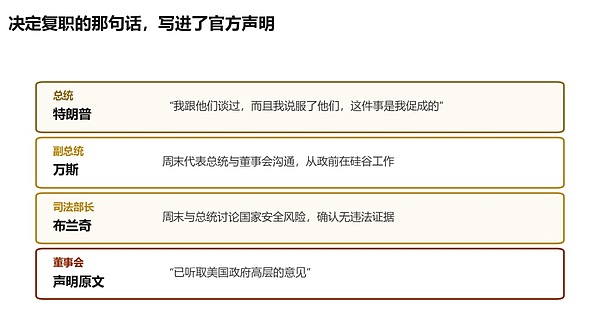
The board changed its tune after talking from the weekend to Monday | Data source: CCTV News and China Daily
Who makes decisions for the board?
Huang Jen-hsun will testify before Congress at 10:00 AM on December 3rd. The hearing will be held in the Senate office building, and will be conducted both online and offline, in a public manner.
The hearing's theme is protecting America's AI advantage, with the subtitle "Overseeing U.S. Export Controls." The Senate Banking, Housing, and Urban Affairs Committee website currently lists only one witness, himself. In addition, he will face closed-door questioning by the relevant House committee regarding whether his company has complied with export control regulations.
From this perspective, the starting point of the resignation 11 days ago and the ending point of the reinstatement today both point to the same thing.
The resignation was triggered by the exposure of two extramarital affairs. The board of directors issued a statement on November 8th saying the employee would continue in their position without interruption of duties. Four days later, they were gone. The White House was the driving force behind their reinstatement, citing national security as the reason. Between the two votes, the company's fundamentals remained unchanged; the only change was who made the phone call.
Musk posted two messages on X: one saying the matter was resolved and the other saying the error had been corrected.
I'm not entirely sure what this "error" refers to. Is it the board's judgment before November 22nd, or the resignation on November 12th? But one thing is clear: this time, the decision-making power was not in the hands of the board.
The rebound, and the unresolved issues.
Nvidia wasn't the only company to see its stock price rise.
The Dow Jones Industrial Average rose 3.01% to close at 49,595.31, a gain of 1,447.98 points in a single day. The S&P 500 rose 4.73% to close at 7,237.17. The Nasdaq Composite Index rose 6.51% to close at 24,089.56, its best day since April 9, 2025. The Philadelphia Semiconductor Index rose 14.03%.
Among individual stocks, Micron rose about 19%, Intel rose more than 16%, TSMC rose 14%, and ASML rose more than 9%.
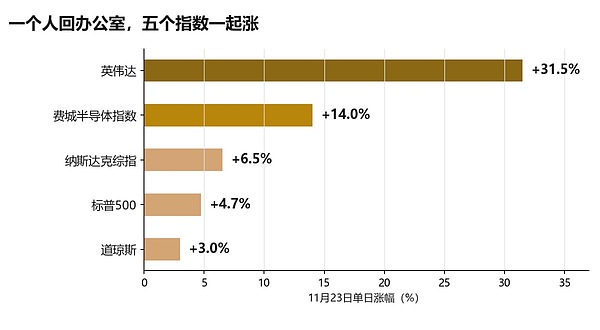
Chip stocks rebounded across the board, with Micron rising 19% in a single day | Data source: CCTV News and Guangming.com
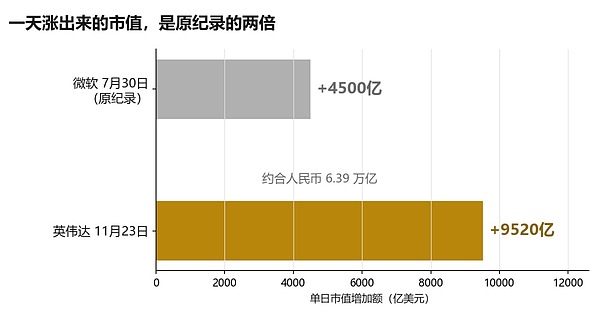
This is a global record, not Nvidia's own record | Data source: Xinhua Finance
But if we zoom out a bit, the picture doesn't look so good. Nvidia closed at $239.24 on October 6th, and is now at $165.05, still 31% below that. Its market capitalization is $3.98 trillion, far from its peak of $5.77 trillion. On November 20th, its market capitalization was $3.03 trillion, and three trading days later it became $3.98 trillion, without a single new financial report in between.
Bernstein upgraded its rating from "market perform" to "outperform" that day, raising its price target from $275 to $300. This figure is higher than the October high.
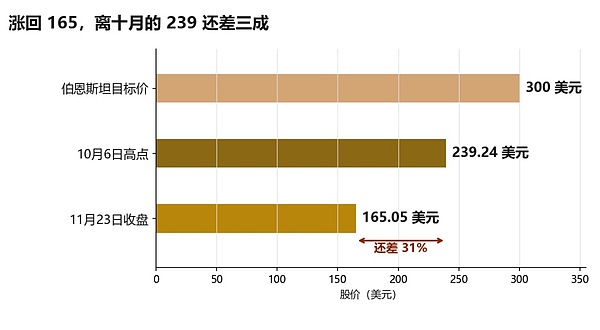
The target price is $61 higher than the October high | Data source: Bernstein Research Report
There's still one unresolved issue. Besides personnel changes, the sharp drop on November 20th was also due to the SEC's accounting audit and the California subpoena, all concerning disclosures of sales to China and revenue recognition practices. The people have returned, but the audit hasn't been withdrawn.
Glenn Smith of GDS Wealth Management told the media that the decision eliminates a key uncertainty in AI trading, and the worst is over.
His judgment may be correct. But removing a key variable and repricing the fundamentals are two different things.
Three things that concern you
First, if you hold the relevant assets. The 31.48% figure represents the resolution of uncertainty, not an upward revision of earnings expectations. There were no new earnings reports, orders, or guidance released on the same day. At $165.05, it's still $74 away from the October high. This rebound was quick, and the pullback will be just as rapid. The next fluctuation will depend on what's said at the hearing.
Secondly, if you're using AI products, the oversight of export controls is shifting from the Department of Commerce to Congress, and Huang will be facing this committee on December 3rd. Whether controls are tightened or loosened will ultimately affect computing power prices, and then your bill. A 14% increase in FeBan in a single day indicates the market is already reassessing the situation.
Thirdly, if you're in an AI-related business, this incident serves as a reminder to all companies that the final say in corporate governance may not lie with the shareholders. The larger the company, the more significant this variable becomes.
at last
A board resolution was overturned twice in 11 days. The stock price can recover in a day, but the sentence written in the statement will not disappear.
The next time a company's board of directors needs to vote, board members will probably glance at their phones first.
Source:Global Cybersecurity Alliance (GCSA)
Website:www.gcsa.org
Get updates in your inbox
We respect your privacy. See our Privacy Policy