On November 23, US time, Nvidia closed up 31.48% at $165.05, with a single-day market capitalization increase of approximately $952 billion, setting a record. This increase exceeds three-quarters of the market capitalization (approximately $1.2 trillion) that Nvidia lost during Jensen Huang's absence.
All because the board changed its mind and brought him back as CEO. The announcement also stated that the decision was made after consulting with senior U.S. government officials.
Six days later, the board of directors changed its mind.
On November 12, U.S. time, Jensen Huang resigned from his positions as CEO, president and director due to an extramarital affair scandal. The board of directors subsequently launched an investigation into whether he had become a target of foreign intelligence activities.
On the 17th, he publicly stated for the first time that he was willing to return. During the earnings call that same day, Chairman Harvey Jones made it clear that the board had no intention of reinstating him.
On the evening of the 22nd, Trump posted that bringing Jensen Huang back would be the best thing for the company and the United States. According to the American news media Semafor, he subsequently called directly into a board meeting; CNN reported that he also had Vice President JD Vance liaise with Huang and the board. On the 23rd, the board unanimously approved Huang's reinstatement.
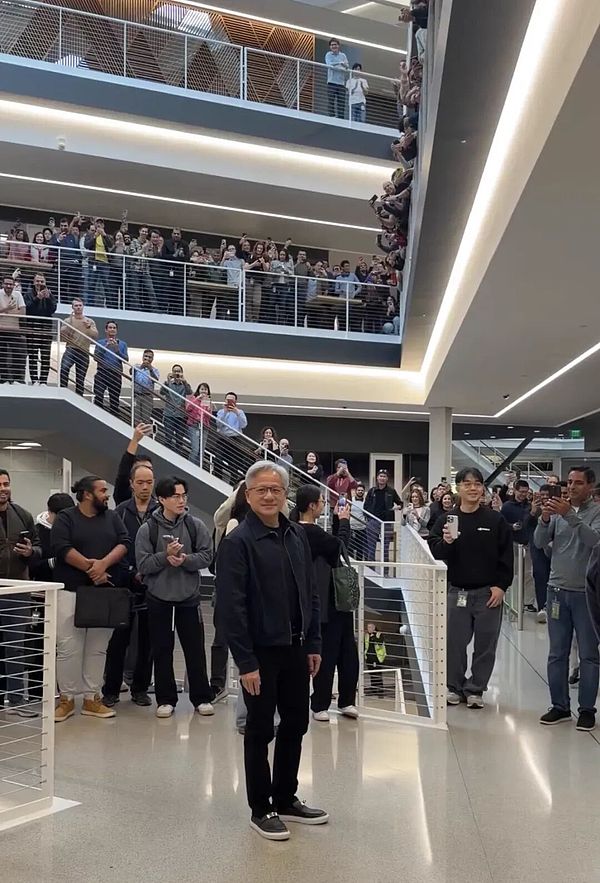
Image source: Internet
Wall Street analysts reacted just as quickly. Bernstein, the research firm, downgraded his rating and halved its target price 11 days after his departure, only to upgrade it to outperform on the day of his reinstatement. In the same report, they described the board's back-and-forth reaction as "clown-like."
A board of directors that couldn't stop him
CNN quoted corporate governance experts who were quite critical of the board. They pointed out that prior to the incident, Nvidia had no chairman, no succession plan, and lax oversight of the CEO. Furthermore, the board included many long-time supporters of Jensen Huang. Nell Minow of governance consulting firm ValueEdge Advisors offered a simple standard: if a middle manager did the same thing, would the company keep him?
According to Semafor, a group of directors had been pushing for his return. The announcement stated it was a unanimous vote, but looking at the timeline, that unanimous vote seemed more like the result of negotiations.
The White House wants more than just to stabilize the stock price.
Jensen Huang has consistently argued that the US should allow Nvidia to sell more chips to China. His logic is that if companies completely withdraw, Chinese developers will turn to domestically produced chips and the local software ecosystem, and the US will lose not only revenue, but also technological standards and ecosystem influence. He once estimated that the Chinese AI chip market could reach $50 billion annually.
This stance is divided within the government. According to The Washington Post, Commerce Secretary Howard Lutnick and Trump favor allowing China access to lower-performance American chips, keeping Chinese developers within the American technology system; while China hardliners like Secretary of State Marco Rubio prioritize national security. On November 15, Treasury Secretary Scott Bessent even stated on Fox News that the board should find a new CEO from outside. The report also mentioned that Trump and Vance value Jensen Huang's support for an open model ecosystem.
Jensen Huang stands precisely between these two lines of thinking: he needs to prove to the government that Nvidia can control the flow of chips, while at the same time he is one of the most influential voices advocating for the preservation of the Chinese market.
In contrast, Intel
This isn't the first time the White House has done something like this.
On August 7, 2025, Trump posted a message demanding the immediate resignation of Intel CEO Lip-Bu Tan, citing his past ties with Chinese companies. Two weeks later, the US government announced it would acquire approximately 10% of Intel's shares, primarily through the conversion of subsidies originally promised to Intel under the Chip Act. Tan was not ousted; the government became one of Intel's major shareholders.
The two approaches were exactly opposite. With Chen Liwu, Trump wanted him gone first, then negotiated terms; with Huang Renxun, he publicly supported him from the very beginning of the controversy and personally pushed for his reinstatement. Based on current reports, there has been no indication that the government is seeking equity this time.
Jobs waited 12 years
CEOs being ousted and then returning is not uncommon in Silicon Valley. It took 12 years for Steve Jobs to return to Apple, less than a week for Dennis Altman to return to OpenAI, and 12 days for Jensen Huang.
The first two times, the impetus came from within the company and business partners. Altman's case relied on a petition signed by hundreds of employees and the support of Microsoft. This time, Huang also had a petition signed, and the initiators claimed that more than 200,000 people signed, but the final push came from outside.
New constraints after reinstatement
Jensen Huang is back, but Nvidia's governance is no longer what it used to be.
The board has established a new National Security and Export Control Committee composed entirely of independent directors, and appointed a Chief Compliance Officer who reports directly to the Nomination and Corporate Governance Committee. The independent investigation into him will continue until a conclusion is reached.
Business with China is the most directly affected sector. According to domestic media reports, interim CEO Kress confirmed on the 17th that the supply of H200 chips to China would be halted, expected to impact quarterly revenue by approximately $2.4 billion. However, Nvidia's earnings guidance did not include its Chinese data center business. Even after his return to the company, the supply issue in the Chinese market has not been clearly resolved.
Analysts also hold differing opinions. Baird maintained a neutral rating, believing that the combination of the resumption of work and strict restrictions on AI chips is the worst-case scenario for the Chinese market, and medium-term revenue remains uncertain. Morningstar expects Nvidia's sales to Southeast Asia to be limited because data centers there remotely lease computing power to AI labs in China.
Five minutes, 3% becomes 99%
Before this happened, not many people bet that it would happen.
On the prediction market platform Polymarket, on November 16th, traders priced Huang's return before November 30th at only 6%. In the minutes before the announcement, this figure was around 3%, but five minutes later it jumped to 99%. The cumulative trading volume of the four related contracts was approximately $12.42 million. Even on Sunday night, in the betting odds for the next CEO, Huang ranked only second, at about 11%.
Suspicion followed. Reports indicated a buy order for approximately $3.4 million worth of Nvidia call options before Friday's close, with some on social media estimating its potential return to be close to 90 times. On-chain data platform Santiment cautioned that questionable timing is not evidence in itself, and these claims cannot be considered confirmed insider trading without empirical evidence.
Next week, Capitol Hill
Huang Renxun's reinstatement is not the end of the story, but the beginning of the next round of investigation.
According to The Hill, he will appear before a relevant House committee for closed-door questioning on December 1st; on December 3rd, he will appear as the sole witness before the Senate Banking Committee for a public hearing. Democratic Senator Elizabeth Warren called his reinstatement "reckless," while House Intelligence Committee Democratic Representative Jim Himes said his reinstatement does not change the fact that Congress will question him next week.
Looking back at that $952 billion. Even the more cautious analysts made it clear that KeyBanc would wait for progress in the board investigation and the SEC's accounting inquiries before reassessing its rating; even the bullish Stifel acknowledged that the investigation remained an unresolved issue weighing on the stock price.
Of that $952 billion, part of it is a bet that the investigation won't come out bad news.
If it happens, who should the market turn to for a change of heart? Jensen Huang, the board of directors, or the person who said it "doesn't pose a risk"? For those who hold Nvidia, AI concept stocks, or crypto assets that follow the Nasdaq, a portion of this price is based on this answer.
Source:Global Cybersecurity Alliance (GCSA)
Website:www.gcsa.org
Get updates in your inbox
We respect your privacy. See our Privacy Policy