Author of this article: Max
Data support | Gougu Big Data (www.gogudata.com)
The storyline surrounding Nvidia in the last two weeks is so compelling that even a short drama series like Red Fruit couldn't possibly capture it.
A lightning-fast scandal, a lightning-fast resignation, and a lightning-fast return.
Like an adrenaline shot, it injected the nerves of global AI trading that were convulsing violently due to governance turmoil and macroeconomic headwinds.
From yesterday to today, from Silicon Valley to Seoul, from New York to Hong Kong, from Taipei to Shanghai, the market has released its long-suppressed anxiety with a surge in prices.
However, the problems are also obvious.
If the shadow of regulation and revolving financing have not completely dissipated, can the entire AI sector return to its former state simply by Huang Renxun's reinstatement?
01 Chain Reaction
The news of Huang Renxun's reinstatement first triggered an epic short squeeze in the US stock market.
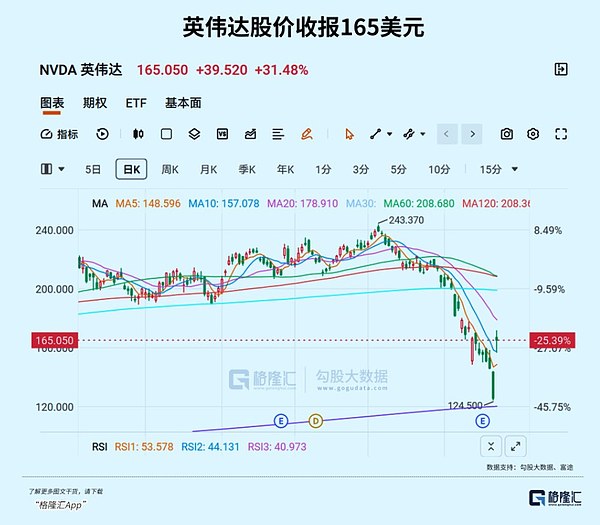
Overnight, Nvidia's stock price surged 31.48% in a single day, marking its largest single-day gain since 2003, with its market capitalization increasing by nearly $952 billion, setting a new record for the largest single-day increase in market capitalization among global listed companies.
The Philadelphia Semiconductor Index surged 14.03%, with chip stocks such as Micron and Intel recording double-digit gains. The Nasdaq Composite Index and the S&P 500 Index jumped 6.51% and 4.73% respectively, marking their best single-day performance since April 2025.
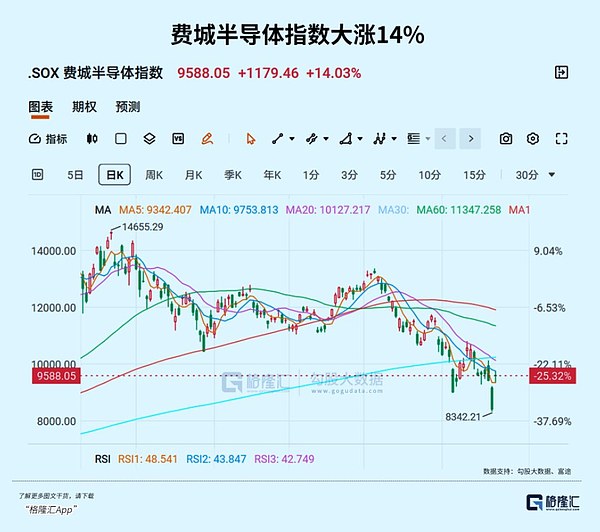
Asian markets absorbed this spillover sentiment after opening the following day, and the reaction showed a clear characteristic that the higher the hardware dependence, the greater the elasticity.
South Korea's Kospi index surged 6.7%, driven by gains of over 7% in Samsung Electronics and SK Hynix, while Japan's Nikkei 225 index rebounded by over 4% after the market closed, and China's Taiwan weighted index soared by over 9%.
In contrast, the reactions of Hong Kong stocks and A-shares were more structural.
The Hang Seng Tech Index opened more than 2% higher, while the ChiNext Index and STAR Market Composite Index both opened nearly 4% higher. However, the focus of capital inflows was extremely concentrated on optical modules, PCBs, and computing hardware.
Zhongji Xuchuang opened more than 11% higher, while Dongshan Precision and Cambridge Technology hit their daily limit, and Xin Yisheng and Tianfu Communication led the gains.
It must be acknowledged that Huang Renxun's return has indeed helped the market recover in the short term.
As the most influential figure in NVIDIA's and even the global AI computing power narrative, his continued tenure eliminates a significant governance uncertainty.
In its report, Barclays characterized the previous sell-off in the AI sector as going too far, and Huang's reinstatement has given the bulls a foothold for a comeback.
However, some Asian markets saw their gains recede or even turn negative in late trading, with Nvidia shares falling more than 3% pre-market.
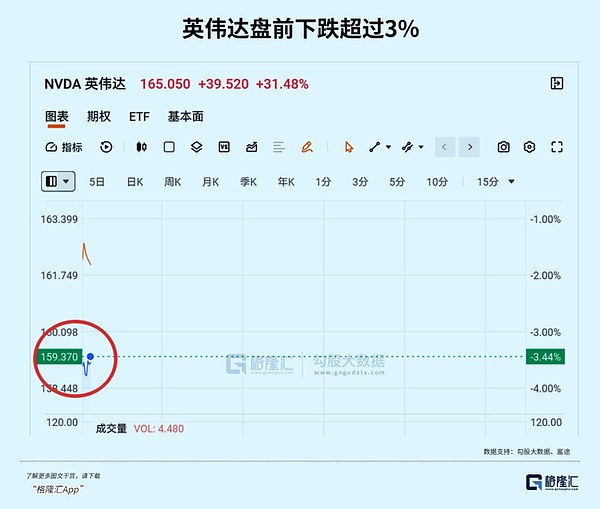
The promised violent counterattack seems to have fizzled out.
02. Pour some cold water on it
On the one hand, the price surged and then fell back, which may be due to short-term funds taking the opportunity to profit from the excessive gains last night.
More importantly, the current momentum for recovery is still limited to the founder premium.
Technical indicators also seem to support this, with Nvidia's stock price quickly recovering to between $160 and $170, the level it was at before the resignation.
Why can't it be higher?
It's clearly the result of careful calculations by major funds.
The market's previous panic stemmed from the fear of losing Jensen Huang's almost obsessive control over the technological roadmap, as well as his adept ability to navigate between the White House and Silicon Valley.
After the news of his reinstatement was announced, Trump immediately praised the board's decision on social media as "correct and appropriate" and confirmed that the government did not believe Huang posed a national security risk.
It seemed like a reassurance, but it also exposed the core of the problem:
Nvidia's fate has never been so closely tied to politics and individuals.
Moreover, the founder return premium is essentially a pricing adjustment for the worst-case scenario, namely losing the key figure and the White House's trust, rather than a reaffirmation of the unlimited demand for AI computing power.
The pressures on the fundamentals of AI have not disappeared entirely with Huang's return, especially at the regulatory level.
Looking back, many people will regret their lack of foresight, preparedness, and hedging against the Democratic Party's overwhelming victory in the midterm elections.
It could even be said that the turmoil in the AI sector over the past few weeks was entirely due to the results of the US midterm elections.
Of course, it can also be partly attributed to Trump's overly aggressive policies, including the fierce confrontation and power struggle between the two parties, as well as the overly lenient support policies for the AI industry, which led to an exaggerated and blindly rapid increase in valuations.
If the restrictions pushed by the Democrats are implemented, about 45% of the total planned data center capacity in the United States will be affected. For Nvidia's supply chain, which relies on the capital expenditure of hyperscale cloud vendors, the growth rate of demand faces the risk of being forcibly flattened by the policy.
At the same time, Huang's reinstatement does not mean that the United States will relax its control over the export of high-end chips; on the contrary, it will strengthen it, which will forcibly cut off a piece of the logic of unlimited global market penetration that previously supported its high valuation.
What alarms rational investors even more is the growing concern about circular financing amid the AI boom of the past six months.
In the nine months ending in October, Nvidia spent $58.1 billion to buy shares in other AI companies, a sum close to its stock buybacks during the same period. There is also the $500 billion financing plan launched by Nvidia in conjunction with major Wall Street institutions.
This model, where chip suppliers simultaneously act as customers and investors, easily raises questions about whether it is creating demand in disguise.
At the same time, such complex financial arrangements make it difficult for investors to assess the quality of Nvidia's revenue and its true risk exposure.
Interim CEO Kress has stated in the earnings call that the company will be more selective in future financing deals in the AI industry.
With Huang's return, under the shadow of investigations by the SEC, Congress, and state governments, this aggressive capital injection behavior will likely be curbed.
In terms of financial statements, revenue growth is likely to be lower than previously expected.
03 Is the tide already turned?
At this point, many people will subconsciously ask, do you mean that the era of AI computing power is over?
The answer is no!
If you doubted the AI industry a few years ago, thinking it was overhyped, you no longer need to prove it. Even the most ordinary mobile phone users are already using AI functions and genuinely enjoying the benefits brought by this technology.
All the concerns and doubts mentioned above point to only one outcome:
AI computing power enjoys high valuations and will face a correction.
This is a physical law and a natural law; there is no need to deny it, nor is there any need to confront it head-on.
Even if you're trying to catch a rebound, there's no need to keep aiming for the high of 243; instead, allow for the possibility that it won't return to that level in the short term.
However, this does not mean the stock price is doomed.
Since stock prices are always driven by the product of valuation and earnings, when the valuation center shifts downward, if EPS can grow at a sufficiently fast rate, the stock price can still continue to rise.
Apple's history after Jobs' return provides an excellent illustration of this.
In 2011, Steve Jobs passed away, and Apple's valuation underwent a significant shake-up of the founder's premium. Apple's forward price-to-earnings ratio (based on earnings over the next 12 months) plummeted from approximately 17 to approximately 12. By 2013, Apple's forward price-to-earnings ratio had further declined to approximately 9.
However, in fiscal year 2012, Apple's earnings per share were approximately $44, and although the growth rate slowed in fiscal year 2013, it still remained above $39, while holding hundreds of billions of dollars in cash.
When a company with annual profits of nearly $40 billion and cash on hand equivalent to a quarter of its market capitalization has a price-to-earnings ratio of only 9, any decent financial report is enough to trigger a correction.
Indeed, the story unfolded as Apple began to recover from a P/E ratio of 9, and by around 2014, Apple's forward P/E ratio had gradually risen to around 15.
Steve Jobs is gone, but Tim Cook, who succeeded him, has successfully turned the iPhone into a money-printing machine for EPS and FCF through extremely efficient supply chain management and a push strategy that is keen to meet market demands.
By 2018, Apple's annual profits and cash flow had expanded to tens of billions of dollars, successfully offsetting the contraction in its valuation multiple, and finally becoming the first U.S. company to break the trillion-dollar mark in market capitalization in 2018. Now, Apple's market capitalization exceeds 5 trillion dollars, making it the world's number one company.
Nvidia and the AI hardware industry chain are currently at a similar crossroads.
Of course, it cannot be said that Nvidia will definitely achieve the same legendary success as Apple, but as long as Nvidia can deliver a steady stream of profit and cash flow growth in the future, its stock price, driven by EPS and FCF, still has the opportunity to return to its previous level, or even reach new highs.
04 Conclusion
Huang Renxun's return is both a perfect emotional recovery and a cruel wake-up call.
It pulled the market back from the brink of a crash, but it also made everyone see the political red lines, capital constraints, and cracks in the business logic behind the AI computing power feast.
The era when valuations could be driven to the heavens by the founder's halo and the expectation of unlimited liquidity has indeed come to an end.
However, a new phase of more rational and stable valuation based on EPS and FCF is beginning.
The future AI market will no longer be a frenzy of simultaneous rises and falls, but rather a highly differentiated elimination process.
Source:Global Cybersecurity Alliance (GCSA)
Website:www.gcsa.org
Get updates in your inbox
We respect your privacy. See our Privacy Policy