
Introduction
From November 21st to 22nd, 2026, three noteworthy security incidents occurred in the field of digital asset and artificial intelligence application security. GCSA Insights focuses on the Chainflip vault asset theft, the Cyber cross-chain bridge abnormal issuance, and the attack case where an AI agent autonomously discovered and exploited the MONAI Label zero-day vulnerability.
In the Chainflip vault security incident, approximately $4.86 million in assets were transferred from the Ethereum vault in a transferBatch transaction that passed valid threshold signature verification. An additional 122.86 BTC were also transferred from the Bitcoin side. On-chain analysis revealed that the nonce used in the abnormal transaction significantly deviated from the historical signature count sequence, indicating that while the transaction met the contract's signature verification conditions, it differed significantly from the validator network's normal withdrawal pattern. The specific key exposure mechanism still awaits further official disclosure.
In the Cyber cross-chain bridge security incident, the Solana side executed a LayerZero message claiming to originate from the Cyber chain, but no corresponding sending record was found on the source chain, resulting in the abnormal issuance of 5.213 million CYBER tokens. Subsequently, these tokens were destroyed through the normal cross-chain process and released from the Ethereum-side lock-up contract, involving approximately $1.1 million in assets. The incident exposed a trust boundary issue between cross-chain message verification and lock-up asset redemption mechanisms, but the specific reason for the abnormal message's execution remains undetermined.
The MONAI Label zero-day vulnerability attack demonstrates a new trend of AI agents participating in real-world network intrusions. Amazon Threat Intelligence disclosed that attackers used the Cairn self-developed penetration framework to drive multiple AI agents, discovering and verifying the MONAI Label path-traversing vulnerability CVE-2026-133968 within approximately 11 minutes. Subsequently, in another session, by writing to `sitecustomize.py` and triggering a Python training process, they ultimately gained root access to a university server. Although the relevant fix code has been merged into the project's main branch, as of the time of this report, a formal version containing the fix has not yet been released.
The three incidents involve threshold signature authorization, cross-chain message verification, and AI-driven vulnerability discovery and exploitation, respectively. While they differ in their attack paths and technical causes, they all highlight that security systems not only need to verify whether operations conform to established rules, but also need to confirm the reliability of the authorization source, business status, and trust boundaries.
The following are three complete technical analysis reports.
[Part 1] Chainflip was robbed of approximately $4.86 million and 122.86 BTC: A transferBatch transaction with a valid threshold signature and nonce, but not in the counting sequence, emptied the Ethereum vault.
Daily Security Insights (Event Analysis) | November 22, 2026 | All times in this article are Tokyo time (UTC+9)
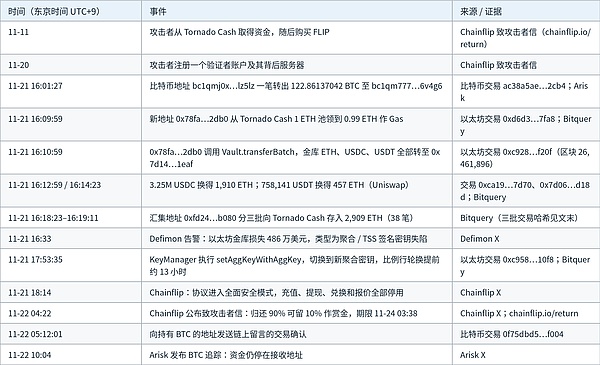
On the afternoon of November 21st, the cross-chain exchange protocol Chainflip simultaneously failed on two chains. At 16:01, a transaction on the Bitcoin chain transferred 122.86137042 BTC; nine and a half minutes later, a new address on Ethereum that had just received gas one minute prior called the Chainflip Ethereum Vault's transferBatch, transferring all 520.22 ETH, 3,249,631.41 USDC, and 758,141.33 USDT from the vault in one go. According to Bitquery's calculations based on the ETH price of $1,635 at the time of the transaction and stablecoins at face value, this Ethereum transaction totaled approximately $4.86 million, a figure consistent with those given by Defimon and Arisk. The Schnorr signature carried in this transaction passed the vault contract's verification of the current aggregated public key—from the contract's perspective, this was a legitimate withdrawal authorized by the validator network.
Chainflip entered full security mode that evening and stated in an open letter to the attackers that they had traced the attackers' acquisition of funds from Tornado Cash on November 11, their purchase of FLIP, and the registration of a validator account and its underlying server on November 20. They also stated that they had "identified the mechanism that exposed the keys and prevented such attacks from happening again." The specific mechanism has not yet been officially disclosed.
I. Event Timeline
Table 1: Chainflip Theft Timeline
II. How Chainflip Vault releases funds: A key held by multiple people, plus a nonce that only prevents replay attacks.
Chainflip does not issue a wrapper coin; users' native assets such as BTC and ETH are stored in vaults on various chains. According to Bitquery's analysis of the Chainflip documentation, the network is run by a maximum of 150 validators who jointly hold a single aggregate signature key using the FROST threshold signature scheme. Each validator holds only one key shard, and at least 100 validators are required to produce a valid signature. Validators generate a new key every three days and transfer it to the vault. The Ethereum vault only recognizes this aggregate key: any withdrawal request must include its signature.
All contract-level checks are concentrated in the KeyManager contract (0xcd35…08be, Sourcify fully matches the source code). Each withdrawal function in the vault is decorated with a consumesKeyNonce decorator, which passes the hash of the call parameters to the KeyManager's consumeKeyNonce; the latter then performs keccak256 encoding on the parameter hash, nonce, caller address, chain ID, and its own address to obtain the signed message, and then passes it to _consumeKeyNonce to do two things: verify the Schnorr signature with the current aggregate public key; check that this nonce has not been used before, and mark it as used.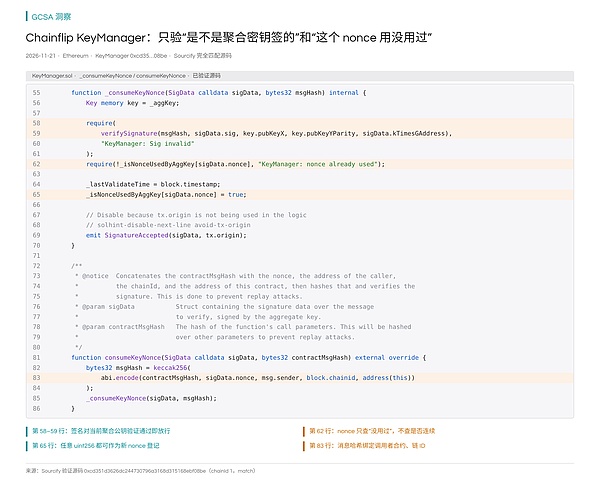
Figure 1: KeyManager's complete authorization logic: if the signature is valid for the current aggregate public key and the nonce has not been used, then permission is granted (Sourcify has verified the source code).
The nonce here exists in a mapping (uint256 => bool). The contract only asks "has this number been used?", not "is it the next number?". The design intent is to prevent replay: the same signature cannot be submitted twice. For signatures generated normally by the validator network, the nonce comes from a counter that increments by one each time; however, the contract itself accepts any uint256 that has never appeared before.
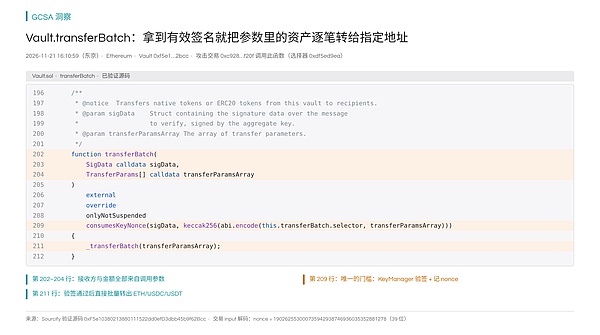
Figure 2: Vault.transferBatch: The recipient and amount are entirely determined by the call parameters, with the only hurdle being KeyManager signature verification (Sourcify has verified the source code).
The transferBatch mechanism itself has no limits, whitelists, or time locks: the parameters specify the number of transactions, the recipient, and the amount; once the signature is verified, each transaction is executed sequentially. This means that the security of the Ethereum vault is entirely equivalent to "no one being able to obtain the signature of the aggregate key outside of the normal process."
III. What did the attacker do at each step?
1. Bitcoin Vault: 122.86 BTC transferred out at 16:01
According to Arisk's tracking, at 16:01:27, the Bitcoin address bc1qmj0x9pkyup07j09axvvr6aquqfsdw254nlz5lz transferred 122.86137042 BTC to bc1qm777twlzmelyutungyfw65ykn2l5kn68e6v4g6. On-chain data shows that this transaction had only one input and one output, with a fee of 110 satoshis. The receiving address did not spend any money afterward and still held all of its BTC as of the morning of November 22 (plus the 1,000 satoshis attached to the Chainflip message transaction). The amount of stolen BTC listed in Chainflip's letter to the attackers matches this input exactly.
2. Ethereum Vault: A one-minute address submitting a 39-bit nonce.
At 16:09:59, address 0x78fa…2db0 received 0.99 ETH from Tornado Cash's 1 ETH pool, marking its first transaction. Exactly one minute later, it issued its only transaction: a call to the vault's transferBatch (function selector 0xdf5ed9ea). Decoding the transaction input reveals three transfers: 520.2243399 native ETH, 3,249,631.410561 USDC, and 758,141.332716 USDT, all received by address 0x7d14…1eaf. The signature data shows a nonce of 190262553000735942938746936035352881278, a 39-bit decimal number.
Bitquery read all 299,677 signature acceptance events recorded by KeyManager since 2023: all nonces fell on the same progressively increasing count line (skipping one nonce approximately every 20, with Bitquery's own node data showing the same gap), except for this one; the count stopped at 314,568 before the vulnerability occurred, and subsequent normal signatures continued from 314,569. In other words, the signature itself is valid for the current aggregated public key, but it is not the kind of signature generated by the validator network in a normal withdrawal process.
The transferred assets were equal to the vault's balance at the moment before. Then, 0x7d14 exchanged USDC and USDT for 2,367 ETH on Uniswap and directly transferred it to the receiving address 0xfd24…b080. He then transferred the ETH from the vault to this address, receiving a total of approximately 2,910 ETH. From 16:18:23 to 16:19:11, 0xfd24 deposited 2,909 ETH into Tornado Cash in three batches (29 transactions of 100 ETH each and 9 transactions of 1 ETH each). From receiving gas to the final deposit, less than 10 minutes elapsed. AMLBot described the entire money laundering process as being executed like a script.
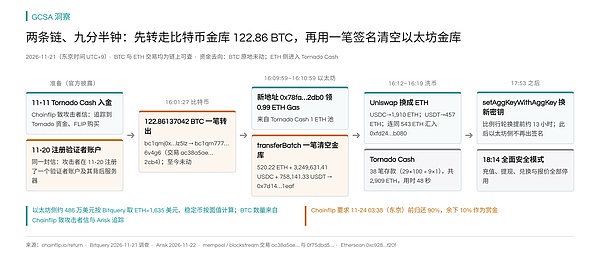 Figure 3: Full attack process: BTC is transferred out and then left untouched; on the Ethereum side, a single signature empties the vault, converting all the BTC into ETH within 10 minutes and sending it to Tornado Cash.
IV. Why can't contracts stop it?
From a contractual perspective, this withdrawal met all its requirements: the signature was verified against the current aggregate public key (both Defimon and Arisk pointed out that the signature verification used the then-current aggregate public key; Defimon also noted that the aggregate key had just been rotated approximately 2.4 days prior); the nonce had not appeared before; and the vault was not suspended. `transferBatch` does not distinguish whether "this withdrawal corresponds to a specific user's redemption"; it only recognizes the signature. Therefore, this is not a contract logic vulnerability, and Defimon categorizes it as "aggregate/TSS signature key corruption, rather than a signature verification defect."
The key question is: who obtained the valid signature of this aggregated key outside of the normal process, and by what means? According to FROST's design, a single validator only possesses one shard, insufficient for a single signature; producing a valid signature requires the participation of a sufficient number of shards, or the complete private key itself being exposed. Bitquery points out that, from a purely on-chain perspective, the traces left by "complete key leakage," "shards obtained from a sufficient number of validators," and "flawed signature verification" are identical. In its letter to the attackers, Chainflip stated that it had identified the "mechanism of key exposure" and specifically named the attackers as having registered a validator account and server the day before the attack, but did not explain the specific relationship between this account and the key exposure.
The nonce outside the counter is itself an anomaly signal that can be identified in real time on the chain: the nonce for normal Chainflip withdrawals comes from an incrementing counter, while the contract accepts any unused value. This transaction's nonce deviates from the sequence formed by 299,676 historical signatures. If monitoring uses "nonce outside the expected range" as an alert or automatic pause condition, it can be identified as not being a product of the normal process immediately after the transaction is recorded on the chain. (Analysis and inference, not an official conclusion.)
V. Losses and Handling
The Ethereum vault suffered a loss of approximately $4.86 million ($5,202,200, ETH, 3,249,631.41 USDC, and 758,141.33 USDT), figures obtained from Bitquery's unit-by-unit reconciliation of transaction transfers with vault balances; the figures from Defimon and Arisk are consistent. PeckShield's alert indicated a loss of approximately $4 million. On the Bitcoin side, 122.86137042 BTC were transferred, the amount from Chainflip's letter to the attackers and Arisk's on-chain tracking. According to Bitquery, withdrawals from Chainflip's vault on Arbitrum were normal that morning, with the largest single withdrawal being approximately $50,000.
Regarding the handling: At 17:53, KeyManager switched to a new aggregate key via `setAggKeyWithAggKey`, approximately 13 hours earlier than the scheduled rotation time. After this, there were no further signatures on the Ethereum side. At 18:14, the protocol entered full security mode. Chainflip has reported the incident to law enforcement, stating that they possess identification information for the validators and servers used by the attacker. The attacker's address has been flagged by major on-chain analytics companies, and every withdrawal from the Tornado Cash pool is being monitored. The official statement indicates that if the attacker returns 110.57523337 BTC and 2,618.1 ETH to the designated address before 03:38 (Tokyo time) on November 24th, 10% will be retained as a bounty and the attacker will be treated as a white-hat hacker.
This marks the second time Chainflip has suffered financial losses this fall. According to Bitquery, on September 12th, attackers exploited a flaw in Chainflip's Tron transaction memo parsing mechanism to steal approximately $736,000 USDT. The official explanation for the flaw was given, and a governance vote resulted in compensation for affected users. That previous incident involved a single-chain code flaw; this time, the contract executed as designed, and the problem lies with the signing rights themselves.
VI. Main Information Sources
• Chainflip's letter to attackers (including the amount stolen, preparation process, and return conditions):
https://chainflip.io/return
• Chainflip X: Enter full security mode:
https://x.com/Chainflip/status/2124068986845532605
• Chainflip X: On-chain comments and bounty conditions:
https://x.com/Chainflip/status/2124221824116703335
• Bitquery: Chainflip hack: one rogue signature emptied its Ethereum Vault:
https://bitquery.io/investigations/chainflip-hack
• Defimon Alert: https://x.com/DefimonAlerts/status/2124043470151004633
• Arisk: Ethereum Vault Analysis: https://x.com/Arisk_io/status/2124103844162646268
• Arisk: BTC Tracking:
https://x.com/Arisk_io/status/2124307906522955795
• PeckShieldAlert:
https://x.com/PeckShieldAlert/status/2124113770373120243
• Attacking transactions (Etherscan):
https://etherscan.io/tx/0xc928950f79b4e4697af674310d1f3a08c2659adc4d60e719f3af90ab023ff20f
• Key swapping transaction (Etherscan):
https://etherscan.io/tx/0xc9585068e49afee59ac68b3972acc17c8be3a47aff42f0e4ea61a94a882610f8
• BTC outflow transaction (mempool.space):
https://mempool.space/tx/ac38a5aea1ed81b84307a3709f502abd4c4d3af5502493f883c6d19624fd2cb4
• Chainflip on-chain message transactions (mempool.space):
https://mempool.space/tx/0f75dbd50f247d4d29ffb5d19dae9907f0322f9ef504720b7e27d2453624f004
• KeyManager verifies source code (Sourcify):
https://repo.sourcify.dev/1/0xcd351d3626dc244730796a3168d315168ebf08be
• Vault verifies source code (Sourcify):
https://repo.sourcify.dev/1/0xF5e10380213880111522dd0efD3dbb45b9f62Bcc
Tornado Cash three batches of deposit transactions: 0xc0cda816…5ba4, 0xf0997235…860e, 0x5813fe3c…8838 (listed by Bitquery).
[Part Two] 5.213 million CYBER tokens (approximately $1.1 million) were stolen from the Cyber bridge: Solana issued new tokens using a LayerZero message never sent from the source chain, and then withdrew the locked Ethereum tokens via normal cross-chain transactions.
Daily Security Insights (Event Analysis) | November 22, 2026 | All times in this article are Tokyo time (UTC+9)
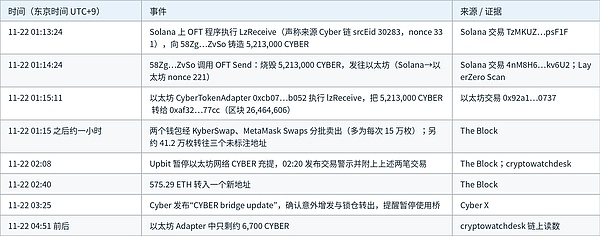
At 1:13 AM on November 22nd, 5,213,000 Cyber (formerly CyberConnect) CYBER tokens were minted out of thin air on Solana. Less than two minutes later, the same number of CYBER tokens were released from the CyberTokenAdapter contract locked for LayerZero cross-chain transactions on Ethereum and transferred to a new address. According to The Block, these tokens were worth approximately $1.1 million at the time. Within an hour, most of them were sold for ETH, with 575.29 ETH (approximately $968,000) transferred to a new address. Upbit and Bithumb suspended CYBER deposits and withdrawals. Cyber officially confirmed that "an unexpected issuance was discovered on Solana, and subsequently, CYBER was transferred out of the bridge's Ethereum lock-up," advising users to suspend the use of the CYBER bridge and not to deposit CYBER to exchanges.
We reviewed these three transactions: the trigger for Solana's issuance was an inbound message claiming to originate from the Cyber chain via LayerZero, numbered nonce 331; however, on the Cyber chain, the outbound counter for this pathway has only reached 329 so far. This means that Solana accepted and executed a message for which no corresponding message could be found on the source chain. The subsequent crossover from Solana back to Ethereum was a normal cross-chain transaction with a complete record.
I. Event Timeline
Table 1: CYBER Cross-Bridge Event Timeline
II. CYBER's cross-chain structure: Ethereum tokens are locked, while tokens are issued on other chains.
CYBER crosses chains via LayerZero V2's OFT (Omnichain Fungible Token) standard. Ethereum is CYBER's native chain, where an OFT Adapter (referred to as CyberTokenAdapter by The Block, address 0xcb07…b052) is deployed: when a user leaves Ethereum, tokens are locked into the Adapter; when crossing back to Ethereum from another chain, the Adapter releases the locked tokens. On other chains like Solana and Cyber, OFTs are "issued and destroyed": they are minted upon receiving an inbound message and burned upon leaving.
This structure has a hard constraint: the total circulating supply of CYBER on all non-native chains must equal the amount locked in the Ethereum Adapter. Each "bridge coin" corresponds to one real coin locked in the staking pool. If someone can mint CYBER on a non-native chain without staking, and then cross those coins back to Ethereum through the normal process, the Adapter will use the real staking pool to pay them off—the loss falls on the staking pool and is ultimately borne by those who still hold bridge CYBER.
In LayerZero V2, for a cross-chain message to be executed by the target chain, it must first be verified by the verification layer (such as DVN) configured for that pathway by the receiving OApp, and its payload hash must be committed on the target chain endpoint. Only then can the executor call OApp's `lz_receive`. When processing the message, OApp calls the endpoint's `clear` function, and only messages with hashes matching the committed hash can pass through. Therefore, if the Solana end can execute a message, it means that the message has been approved by the Solana end's receiving configuration. (LayerZero V2 mechanism explanation.)
III. On-chain reconstruction: What did each of the three transactions do?
1. 01:13:24, Solana: A message “from the Cyber Chain” triggered a new issuance.
The Solana transaction TzMKUZ…psF1F's top-level instruction calls the CYBER OFT program (8SeN…we66) to execute LzReceive. Decoding this instruction according to LayerZero's parameter format: the source chain srcEid is 30283 (corresponding to cyber-mainnet in LayerZero's official deployment metadata), the sender is 0x9a9d5a29206dde4f70825032df32333de5f63921 on the Cyber chain, the nonce is 331, and the GUID is 0x34e0489997…0d6278; the receiver given in the message body is 58ZgoAHMgfFPuzLkA6avW5nCh8vHibt1qDfCSvpPZvSo, and the amount (6-bit shared precision) is 5,213,000. During execution, the OFT program first creates an associated token account for the recipient, then calls the Clear function of the LayerZero endpoint (76y7…jEn6), and finally the CYBER minting permission account GvsM…yzV (which is also the address of the CYBER OApp on the Solana side in LayerZero Scan) mints 5,213,000 CYBER.
The problem lies at its source. On the Cyber chain, we called LayerZero EndpointV2's outboundNonce to query the path from sender 0x9a9d…3921 to Solana (eid 30168) and receiver to this OFT Store. The return value was 329: this path has only ever sent 329 messages and has never sent nonce 331. LayerZero Scan queries by GUID and by this Solana transaction both returned "Message not found". (Query time: November 22nd, morning, Tokyo time.)
2. 01:14:24, Solana: Successfully cross the newly minted coins back to Ethereum.
One minute later, 58Zg…ZvSo initiated an OFT Send by signing its own signature: burning the newly acquired 5,213,000 CYBER, targeting Ethereum, receiving address 0xaf32a9db0b0ac8eaa860a43a9d32a1c9277277cc, and paying the fees to the executor and two DVNs. LayerZero Scan has a complete record of this message (Solana → Ethereum nonce 221): source transaction, DVN verification, target transaction are all present, and the status is SUCCEEDED.
3. 01:15:11, Ethereum: Adapter uses real locked tokens for redemption.
Ethereum transaction 0x92a1…0737 was submitted by the executor and passed to CyberTokenAdapter via EndpointV2 (0x1a44…728c). The adapter then transferred 5,213,000 CYBER tokens from its lock-up to 0xaf32…77cc and issued an OFTReceived event, with the source chain listed as 30168 (Solana). For the adapter, this was a verified and legitimate message from a trusted peer; it had no way of knowing the origin of the 5,213,000 tokens from Solana.
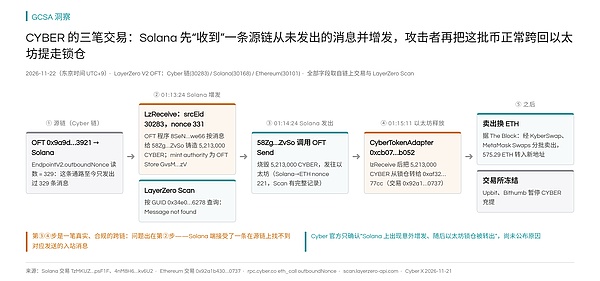
Figure 1: The complete chain of three transactions: Step ② Solana executes a message that does not exist on the source chain counter; Steps ③ and ④ are normal cross-chain transactions with complete records.
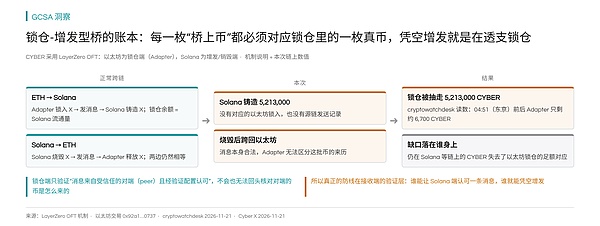
Figure 2: Ledger Constraints of Lock-up-Incremental Issuance Bridges: Every coin issued out of thin air on a non-native chain is ultimately redeemed from Ethereum lock-up.
IV. Why was it successful, and where were the obstacles?
The entire attack requires only one thing to succeed: getting the Solana-side CYBER OFT to accept an inbound message it shouldn't have accepted. Once this step succeeds, the subsequent burning, cross-chain, and release all follow the normal protocol path. The Ethereum Adapter, LayerZero executor, and DVN all function as designed in steps ③ and ④. The Adapter's check only covers "messages originating from a configured peer and having passed the verification configuration of that path"; it does not and cannot go back to check whether the tokens on the peer's chain are locked up.
Why step ② was approved is not yet publicly stated by Cyber. Based on the design of LayerZero V2, possible directions include: manipulation of the validator set configured on the Cyber chain → Solana path, compromised private keys, alteration of the receiving database or peer configuration, or other means that could allow the endpoint to submit forged payload hashes. These all require verification of the Solana-side CYBER OApp receiving configuration against the corresponding validation submission records to determine. (Analysis and inference, not an official conclusion.)
For projects using a lock-up-issuance structure, besides step ②, there are two additional safeguards to mitigate losses: First, set a cap on the number of tokens minted in a single transaction or per unit of time on the issuance side. A single minting of 5,213,000 tokens (approximately one million US dollars at $0.20) is extremely unusual in the daily cross-chain traffic of most tokens. Second, set a delay or limit on large releases on the lock-up side to allow monitoring time to react. In this case, only 107 seconds elapsed between the issuance and release. (Analysis and inference.)
V. Losses and Handling
The amount transferred out was 5,213,000 CYBER, directly confirmed by the Ethereum transaction 0x92a1…0737 (5,213,000.000000001 CYBER). According to The Block's calculations based on the price at the time, this was worth approximately $1.1 million; the 575.29 ETH transferred to the new address after the attacker sold it was worth approximately $968,000. CYBER fell approximately 8% to $0.2024 during the sell-off.
Upbit and Bithumb have suspended CYBER deposits and withdrawals (Bithumb is maintaining trading, Upbit has issued a trading warning); according to cryptowatchdesk, Kraken's status page indicates that CYBER deposits on its Optimism network may be delayed. Cyber stated that it is investigating the affected assets and cross-link routes, urging users to suspend the use of CYBER bridges and not to deposit to exchanges, emphasizing that there is no need to migrate tokens, connect wallets, or sign anything—any messages requesting action based on this should be considered scams.
VI. Main Information Sources
• Cyber X: CYBER bridge update:
https://x.com/BuildOnCyber/status/2124207519581327394
• The Block: Cyber investigating suspected $1 million bridge exploit:
https://www.theblock.co/news/defi/2026-11-21-cyber-investigating-suspected-1-million-bridge-exploit-as-upbit-bithumb-freeze-transfers-444810
• cryptowatchdesk: Cyber bridge releases 5.21M CYBER after unexpected Solana mint:
https://cryptowatchdesk.com/news/security-alert-cyber-bridge-5-21-million-cyber-minted-solana-released-ethereum-lockbox-upbit-bithumb-suspend
• Solana rights issue transaction (Solscan):
https://solscan.io/tx/TzMKUZhibQNADjETHhe1QiNp4NPpgAkyHivrJu2CJuToK7gFZMB3nFe3UR9UjpMHGLdTKE8wig5C9M9BRBpsF1F
• Solana burns and cross-chain transactions (Solscan):
https://solscan.io/tx/4nM8H6qwiEsPEGx2GE53Rd7qK7PovFhJTg4HgEZ8GmKeoVix8Uibd8VdKgss5extMvDT2B1K65ZYDMSrVMBkv6U2
• Ethereum release transaction (Etherscan):
https://etherscan.io/tx/0x92a1b430c066cbfb636f67f5354b1720c47e6075523551d9f47bb03bcdc20737
• LayerZero Scan: Solana → Ethereum message (GUID 0x16107f…df2e):
https://layerzeroscan.com/tx/4nM8H6qwiEsPEGx2GE53Rd7qK7PovFhJTg4HgEZ8GmKeoVix8Uibd8VdKgss5extMvDT2B1K65ZYDMSrVMBkv6U2
• LayerZero deployment metadata (eid 30283 = cyber-mainnet):
https://metadata.layerzero-api.com/v1/metadata/deployments
[Part 3] MONAI Label 0-day CVE-2026-133968 exploited in the wild: An AI proxy found a path to bypass the vulnerability in 11 minutes and used sitecustomize.py to gain root access to a university server.
Daily Security Insights (Event Analysis) | November 22, 2026 | All times in this article are Tokyo time (UTC+9)
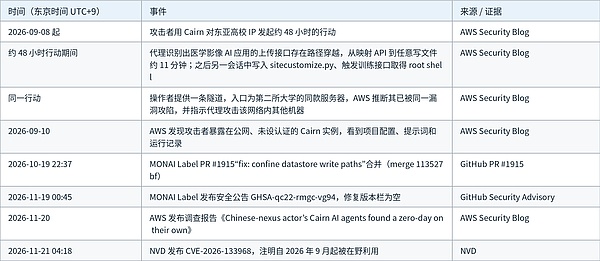
Amazon Threat Intelligence disclosed on November 20th that an attacker, identified with a medium confidence level as having ties to China, used the open-source, self-developed penetration testing framework Cairn to drive multiple AI proxies to attack universities in East Asia (outside mainland China). The proxies discovered a previously unknown path-traversing vulnerability in an open-source medical imaging AI application and used it to obtain a root reverse shell on a university server. This application is MONAI Label, part of the open-source project Project MONAI, with vulnerability number CVE-2026-133968 (CVSS 3.1 9.8), affecting all versions from 0.8.5 onwards; the NVD record states that it has been "exploited in the wild since September 2026."
The fix was merged into the main branch on October 19th, but as of November 22nd, the latest version of MONAI Label on PyPI is still 0.8.5 (uploaded in November 2024), and there is no official release containing the fix. MONAI Label servers deployed with default configurations and accessible over the network can still be written to arbitrary files without authentication today.
I. Event Timeline
Table 1: MONAI Label 0-day Field Utilization Timeline
II. What is MONAI Label, and how does it run by default?
MONAI Label is a medical image annotation server: research teams upload images such as CT and MRI scans, doctors annotate them on clients (3D Slicer, OHIF, etc.), and the server uses these annotations to train and update segmentation models. It is implemented in Python (FastAPI) and exposes a set of REST interfaces, where `/datastore/image` is used to upload images, `/datastore/label` is used to store annotations, and there is also an interface to trigger training.
According to the official security bulletin, authentication is disabled by default (MONAI_LABEL_AUTH_ENABLE=False), meaning any client that can access the service port can call these interfaces; even if authentication is enabled, having the ANNOTATOR role is enough to trigger the vulnerability.
III. Cause of the vulnerability: The image parameter is appended to the file path without any boundary checks.
The upload interface `PUT /datastore/image` accepts an optional query parameter `image`, which is used as the image ID. In `add_image` in version 0.8.5, as long as the caller provides this parameter, the code is used exactly as follows: `image_id = image if image else …`, and then the uploaded temporary file is handed over to the data storage layer.
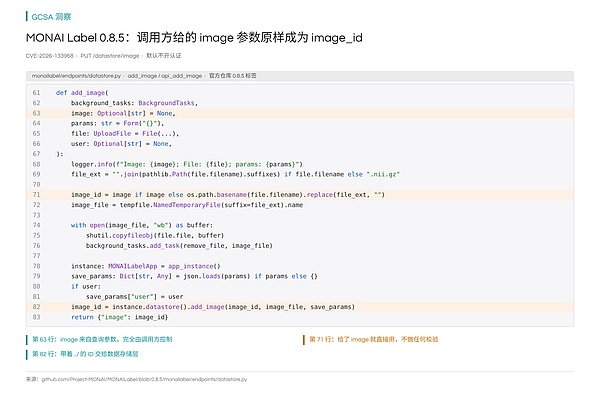
Figure 1: Interface layer: The image parameter provided by the caller becomes the image_id without validation (MONAI Label 0.8.5 official source code).
The data storage layer `LocalDatastore.add_image` adds the extension to the image ID to get the filename, `os.path.join` returns it to the image directory, then retrieves the realpath, and finally uses `shutil.copy` to copy the uploaded content. However, `realpath` only resolves `../` to the final absolute path; it doesn't check if this path is still within the image directory. Therefore, `image=../../../somewhere/filename` allows the uploaded content to land in any location the server process has write permissions to. `save_label(PUT /datastore/label)` concatenates the image ID and label to the target path, which has the same problem.
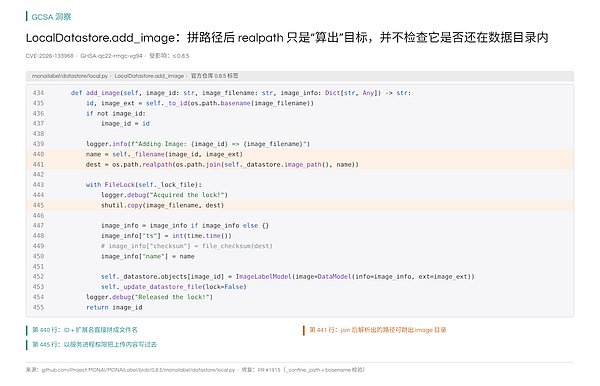
Figure 2: Storage layer: The concatenated and parsed path is directly used for writing files, and can jump out of the data directory (MONAI Label 0.8.5 official source code).
This vulnerability is essentially "arbitrary file write," with the maximum permission limit being the service process's permissions. Whether it can escalate to code execution depends on which locations the process can write to that will be executed or loaded.
IV. Attacker's Steps: From Writing Files to Root Shell
According to AWS's reconstruction, the operator only provided Cairn with a set of target IPs and one target—"obtain shell access"—with the specific methods planned and adjusted by the agent. Faced with this medical imaging server, the agent first identified the application framework, enumerated the APIs, found the upload interface with filename parameters, tested the path traversal and confirmed its success, achieving arbitrary file writing in approximately 11 minutes.
In a subsequent session, the proxy wrote a Python reverse shell payload into `sitecustomize.py`. This is a standard Python mechanism: when the interpreter starts, the `site` module automatically attempts to import a module named `sitecustomize`, and as long as it's on the module search path, its code will execute before any business logic. Writing the file itself doesn't immediately trigger execution, so the proxy then calls the MONAI Label training interface—the training task launches a new Python process that imports the tampered `sitecustomize.py` upon startup, allowing the reverse shell to connect back to the attacker as root.
For this chain to work, three prerequisites must be met simultaneously: the service port must be accessible to the attacker and the interface must not require authentication, or the attacker must have ANNOTATOR privileges; the service process must have write permissions to a directory on the Python module search path; and the application must have the functionality to be triggered externally to start a new Python process. On this server, the process runs as root, so the second prerequisite is almost automatically met.
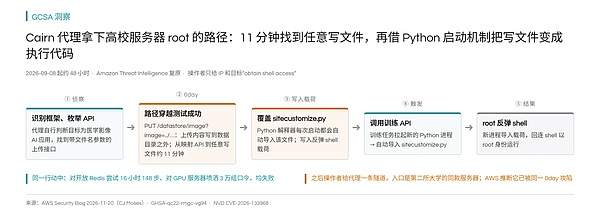
Figure 3: Cairn proxy attack chain: path traversal writes to sitecustomize.py, then a new Python process is launched through the training interface to execute the payload (AWS report restoration)
In the same operation, the agent made 148 consecutive attempts over 16 hours against a Redis instance at a university that could be accessed without authentication (master-slave replication module loading, Lua sandbox escape, writing configuration files, memory corruption, and Log4Shell injection into a service on the same machine). They also used an SSRF attack on a Qdrant instance on the same machine to uncover the internal Docker network and spray PostgreSQL and SSH passwords. Against a GPU server, they collected approximately 80 real usernames from publicly available web pages and tried over 30,000 password combinations. All of these failed; the only successful attempt was this zero-day vulnerability. AWS determined it to be a zero-day vulnerability because, at the time of discovery, there were no corresponding patches, issues, announcements, or vulnerability database records for the project.
V. How to repair the blockage, and what to do now?
PR #1915 made two layers of fixes. Interface layer: When the caller provides an image, only `os.path.basename` is retained. Null values, periods (.), and IDs starting with a dot will all return an HTTP 400 error. `../` becomes invalid at this step. Storage layer: A new `_confine_path` is added. After retrieving the realpath of the target path, `os.path.commonpath` is used to check if it is still within an allowed directory. If not, an exception is thrown. `add_image` and `save_label` are both modified to perform this check. `save_label` also applies the same constraint to the label directory itself to prevent bypassing the rules using the label name.
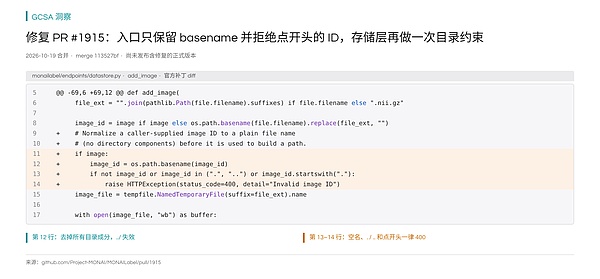
Figure 4: Interface layer fix in PR #1915: Only keep the filename part and reject IDs starting with a dot (official patch diff)
Since the official version has not yet been released, the team operating MONAI Label needs to take the following steps: restrict the service to a trusted network using firewalls and routers; enable authentication (MONAI_LABEL_AUTH_ENABLE=True) and prevent untrusted users from having the ANNOTATOR role; run the service with a non-privileged account and restrict its write permissions to the data directory; if building from source code, confirm that it includes the fix commit from October 19th before considering it patched. Servers previously exposed to the network should be checked for unexpected instances of sitecustomize.py in the Python environment, abnormal writes outside the data directory, and training tasks not initiated by the user.
Two metrics published by AWS appeared in the records from September 8 to 10, 2026: 142[.]4[.]98[.]145 and 142[.]4[.]107[.]34.
VI. Main Information Sources
• AWS Security Blog: Chinese-nexus actor's Cairn AI agents found a zero-day on their own:
https://aws.amazon.com/blogs/security/chinese-nexus-actors-cairn-ai-agents-found-a-zero-day-on-their-own/
• MONAI Label Safety Bulletin GHSA-qc22-rmgc-vg94:
https://github.com/Project-MONAI/MONAILabel/security/advisories/GHSA-qc22-rmgc-vg94
• Fix PR #1915:
https://github.com/Project-MONAI/MONAILabel/pull/1915
• NVD: CVE-2026-133968:
https://nvd.nist.gov/vuln/detail/CVE-2026-133968
• MONAI Label 0.8.5 source code: endpoints/datastore.py:
https://github.com/Project-MONAI/MONAILabel/blob/0.8.5/monailabel/endpoints/datastore.py
• MONAI Label 0.8.5 source code: datastore/local.py:
https://github.com/Project-MONAI/MONAILabel/blob/0.8.5/monailabel/datastore/local.py
• PyPI: monailabel release history:
https://pypi.org/project/monailabel/#history
• Python documentation: site module and sitecustomize:
https://docs.python.org/3/library/site.html
• The Record: Amazon says Chinese hackers used Cairn AI tool:
https://therecord.media/amazon-research-cairn-ai-university-attacks-possible-zero-day
Conclusion
The three incidents in this issue reveal the issue of trust boundaries in different security systems.
The Chainflip incident demonstrates that a valid cryptographic signature does not necessarily mean that the authorization behavior conforms to normal business processes; the Cyber cross-chain bridge incident shows that when the target link is affected by messages from an abnormal source, subsequent completely normal cross-chain operations may still result in the loss of real assets; and the MONAI Label incident shows that AI agents have the ability to autonomously explore application interfaces, discover unknown vulnerabilities, and organize actual exploitation chains.
These cases do not necessarily imply that the relevant cryptographic algorithms, cross-chain protocols, or AI technologies themselves have systemic flaws, but rather remind security teams to re-examine the gap between technical verification mechanisms and actual security goals.
From verifying signatures to verifying authorizations, from verifying messages to verifying asset status, from fixing known vulnerabilities to preventing the exploitation of self-created vulnerabilities, security protection needs to cover the entire trust chain, not just one technical link.
GCSA will continue to monitor the progress of the investigation, the disclosure of the root causes, and the subsequent safety measures taken in light of the incident.
Copyright and Disclaimer
This article and related technical analysis are exclusively published by the GCSA Global Cybersecurity Alliance. For reprint permission, please retain the official GCSA source and original link in full, and do not maliciously alter the core viewpoints of the report.
This article is for cybersecurity research, public risk awareness, and informational reference only, and does not constitute investment, legal, or financial advice. The terms "potential breaches," "potential risks," and attack scenarios mentioned herein should be distinguished from verified facts. Unless otherwise expressly stated, the GCSA has not conducted independent forensic investigations or attributed the attack to this incident.
Please follow GCSA on social media for the latest updates.
GCSA X (Twitter):
GCSA Telegram:
GCSA WeChat Official Account:
https://mp.weixin.qq.com/s/ouyL9NwrDDjhMumvehdOmw
Source:Global Cybersecurity Alliance (GCSA)
Website:www.gcsa.org
Get updates in your inbox
We respect your privacy. See our Privacy Policy